

Gold | Organic Herbal Yeast + Fungal Protocol Tincture
Glacier Peak Holistics · Montana Made
Glacier Peak Gold Microbial Defense Tincture
A nine-herb tincture protocol for dogs with yeast or fungal overgrowth often misdiagnosed as allergies.
What Most Vets Miss
The itch that will not quit. The yeasty smell you cannot place. The ear infections that keep coming back. There is a possibility you have not been told about.
If your dog has been on round after round of allergy medication, has been treated for ear infections four times this year, and licks their paws raw despite every diet change, your conventional vet may not have discussed the actual cause. It is not always allergies. It is often yeast.
Yeast is a naturally occurring organism on every healthy dog. It lives quietly on the skin, in the ears, between the paw pads, and in the gut. It only becomes a problem when something disrupts the terrain that keeps it in balance. That something is usually one of three things: a course of antibiotics that wiped out the beneficial bacteria competing with yeast, a steroid prescription that suppressed the immune surveillance that normally keeps yeast in check, or a starch-heavy diet that gave yeast the sugar it needed to overgrow.
Once yeast has expanded, it produces symptoms that look almost identical to environmental or food allergies. Itchy paws, often with rust-colored saliva staining between the toes. Inflamed ears that respond to medication and then return. Hot spots. The musty, popcorn-like, "Frito feet" smell that has no source you can identify. Recurring skin infections that respond to antibiotics and then come right back.
The problem is that conventional treatment for "allergies" often makes yeast worse. Antibiotics kill the bacteria that compete with yeast. Steroids suppress the immune system that controls it. Apoquel and similar medications block the inflammatory response but do nothing to address the underlying overgrowth. So the dog cycles through medication after medication, and the real problem keeps growing.
Glacier Peak Gold is a nine-herb tincture designed to do what those medications cannot. It directly attacks yeast and fungal overgrowth through four distinct botanical antifungal mechanisms. It protects and soothes the inflamed gut and skin tissue during the die-off. It supports the immune system that is supposed to keep yeast in check. The formula is used in a specific 30-day pulse protocol that respects the biology of yeast, including the biofilms that protect yeast colonies and the die-off reactions that happen when those colonies are finally disrupted. This is not a daily supplement. It is a protocol.
Why Your Dog's Allergies Might Not Be Allergies
Three things conventional treatment usually misses about chronic yeast
1. The Trigger
Yeast overgrows when the terrain that controls it is disrupted. Usually that means antibiotics that killed the competing bacteria, steroids or Apoquel that suppressed the immune surveillance, or a starch-heavy diet that fed the yeast directly.
2. The Overgrowth
Yeast colonies build protective biofilms that single-ingredient antifungals cannot fully penetrate. They also produce toxins (acetaldehyde, gliotoxins) that drive ongoing inflammation, skin irritation, and the musty smell that defines yeasty dogs.
3. The Misdiagnosis
The visible symptoms (itching, ear inflammation, hot spots, paw licking) look identical to allergies. Conventional treatment suppresses the inflammatory response but never addresses the organism causing it, so the cycle continues.
What Glacier Peak Gold Helps With
Six yeast and fungal patterns this formula addresses, from itchy paws to greasy coats
Recurring Yeasty Ears
Brown waxy discharge, head shaking, and that distinctive sweet-musty smell that keeps coming back
Itchy Paws From Yeast
Constant licking, red between the toes, and the corn-chip smell pet parents recognize
Greasy Skin & Coat
Oily fur, distinctive odor that returns days after bathing, and the skin that just feels wrong
Recurring Hot Spots
Open sores driven by underlying microbial overgrowth that surface-only treatments cannot resolve
Gut Yeast & Dysbiosis
Bloating, loose stool, and the gut bacterial imbalance underneath chronic skin and ear flares
Skin Fungal Infections
Ringworm, fungal patches, and other surface infections that respond to internal antifungal support
The Full Formula
Nine herbs, organized into three layers of action
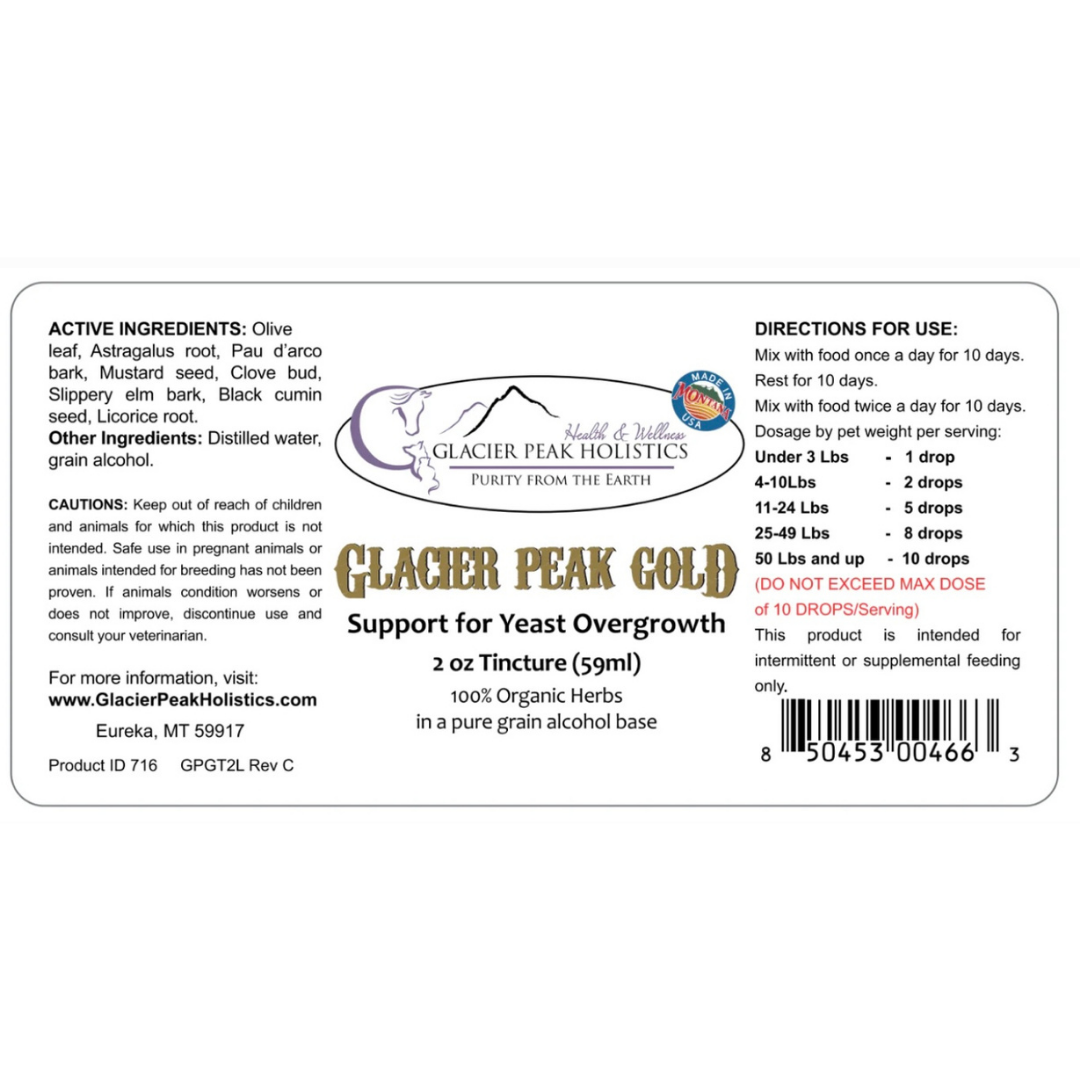
Glacier Peak Gold is a proprietary blend of nine 100% organic herbs in a base of distilled water and pure grain alcohol. The alcohol matters: the active antifungal compounds in herbs like pau d'arco and olive leaf are alcohol-soluble and cannot be fully extracted by water alone. Here is what each ingredient contributes, grouped by mechanism.
Layer 1 · The Four-Pronged Antifungal Attack
Four botanical antifungals that come at yeast cells from four different biochemical angles. Biofilms cannot defend against this many mechanisms at once.
Featured Ingredient
Organic Pau d'Arco Bark
This is the headline antifungal in the formula. Pau d'arco is the inner bark of a South American tree, used by indigenous peoples of the Amazon for centuries. The active compounds, called naphthoquinones (particularly lapachol and beta-lapachone), have demonstrated direct activity against Candida albicans and other fungal organisms.
Think of pau d'arco as the specialist that yeast cells cannot easily defend against. The naphthoquinones interfere with the energy production of fungal cells, essentially starving them at the cellular level. The formula uses pau d'arco inner bark, which is the premium part of the plant for antifungal compounds, not the easier-to-harvest outer bark or aerial parts.
If you have read any holistic vet's protocol for canine yeast, you have read about pau d'arco. It is consistently named as the single most important antifungal herb for dogs with chronic yeast issues. This formula includes it as one of nine ingredients, which means you do not need to source it separately.
Featured Ingredient
Organic Black Cumin Seed (Nigella sativa)
Black cumin, often called "the seed of blessing" in traditional Middle Eastern medicine, has been used for over three thousand years and is one of the most extensively studied herbs in modern integrative medicine. The active compound, thymoquinone, has documented antifungal, antibacterial, antiviral, and anti-inflammatory effects. This is not the cumin spice from your kitchen, which is a completely different plant.
Think of black cumin as a second antifungal that attacks yeast from a completely different chemical angle than pau d'arco. Where pau d'arco interferes with fungal energy production, black cumin disrupts fungal cell walls. Black cumin also has documented immune-modulating effects, supporting the same immune-recalibration that astragalus is doing later in the formula.
Why two featured antifungals matter: using pau d'arco and black cumin together means yeast cells are being attacked through multiple mechanisms simultaneously, which reduces the chance of any one resistant strain surviving. Single-ingredient antifungal supplements miss this principle entirely.
Organic Olive Leaf
Olive leaf has been used medicinally in the Mediterranean for thousands of years and is one of the most studied broad-spectrum antimicrobial herbs in modern phytomedicine. The active compound, oleuropein, has documented activity against bacteria, viruses, fungi, and parasites. Note that this is olive leaf, where the oleuropein is concentrated, not olive oil, which is a culinary ingredient with minimal medicinal value.
Think of olive leaf as a broad-spectrum botanical that does not care whether the invader is yeast, bacteria, or virus. Oleuropein disrupts microbial membranes and interferes with replication. For dogs with yeast overgrowth, this matters because chronic yeast often comes with secondary bacterial infections and other dysbiotic organisms. Olive leaf addresses the whole disrupted microbial landscape, not just yeast.
Organic Clove Bud
Clove buds are the dried flower buds of the clove tree, used in cooking and medicine across many cultures. The active compound, eugenol, has documented antifungal, antibacterial, and anti-parasitic properties. Eugenol is one of the most potent natural antimicrobials known.
Think of clove as a third antifungal mechanism, attacking yeast and fungal cells through eugenol while pau d'arco and black cumin attack through their respective compounds. Clove also has warming and digestive properties that traditional herbalists use to support nutrient absorption during the protocol.
Layer 2 · Gut and Tissue Protection During Die-Off
Three soothing herbs that make the protocol tolerable. This is what distinguishes Glacier Peak Gold from cheaper antifungal-only formulas.
Organic Plantain Herb
This is not the banana-like plantain from the produce aisle. This is Plantago, a common low-growing weed with broad ribbed leaves that has been used in Western herbalism for over two thousand years. Plantain contains allantoin, aucubin, and mucilage compounds that soothe inflamed tissue and support healing.
Think of plantain as aloe vera for the inside of the body. When yeast has been overgrowing in the gut for months or years, the intestinal lining is inflamed and the skin barrier is compromised. Plantain coats and soothes these irritated tissues while the antifungal herbs do their work. Aucubin, one of the active compounds, also has mild antimicrobial properties of its own.
Organic Slippery Elm Bark
Slippery elm is the inner bark of the American elm tree, traditionally used as a demulcent and gut-healing herb. It contains mucilage compounds that swell on contact with water to form a protective gel.
Think of slippery elm as a protective coating for the GI tract. During the yeast die-off, when dead yeast cells release toxins as the body clears them, slippery elm coats the gut wall and protects it from this temporary inflammatory storm. It also helps slow transit time enough that the body can properly process and eliminate what the antifungals are killing.
Organic Licorice Root
Licorice root is one of the most important herbs in both Chinese and Western herbal traditions. It is anti-inflammatory, demulcent, mildly adaptogenic, and has documented antiviral and antimicrobial properties. The active compounds include glycyrrhizin and several flavonoids.
Think of licorice root as a soothing harmonizer. It calms inflammation throughout the GI tract and respiratory system, supports adrenal function under the stress of the protocol, and traditional herbalists say it harmonizes the other herbs in a formula, helping them work together rather than against each other. In Chinese medicine, licorice is added to almost all multi-herb formulas for exactly this reason.
A note for transparency: licorice should not be used long-term in high doses because it can affect potassium balance and blood pressure. The 30-day pulse protocol with built-in rest days addresses this directly, which is part of why the formula is pulse-dosed rather than continuous.
Layer 3 · Immune Retraining and Elimination Support
Two herbs that retrain the immune system to resume yeast surveillance and help the body clear what the antifungals kill.
Organic Astragalus Root
Astragalus is the same immunomodulating root used in other Glacier Peak formulas, but in Glacier Peak Gold it plays a specific role. Yeast does not overgrow in dogs with strong immune surveillance. The body's macrophages and natural killer cells normally keep candida and Malassezia in check. When the immune system has been suppressed by steroids, by chronic stress, or by chronic inflammation, yeast takes the opportunity.
Think of astragalus as the immune retraining herb. While the antifungal herbs reduce the yeast population, astragalus supports the immune system so it can take over surveillance once the active treatment ends. Without this layer, dogs often relapse as soon as the antifungal pulse stops. Astragalus is what makes this protocol durable.
Organic Mustard Seed
Mustard seed contains glucosinolates, sulfur-containing compounds that have antimicrobial properties and stimulate the body's natural detoxification pathways. The same compounds that give mustard its sharp flavor are doing real biochemical work in the body.
Think of mustard seed as the elimination support. As yeast cells die and the body needs to clear the resulting debris and toxins through the liver, kidneys, and bowel, mustard seed supports those elimination pathways and helps prevent toxic backup that contributes to die-off symptoms. Together with the slippery elm and plantain, mustard seed makes the difference between a tolerable protocol and a miserable one.
What This Looks Like Across 30 Days
Five things happen inside a yeasty dog when the protocol begins
The gut wall is inflamed from chronic candida overgrowth. The skin is colonized with Malassezia, particularly in the warm folds, between the paw pads, and inside the ear canals. The immune system has been suppressed for so long that it has stopped patrolling for fungal organisms. There is a faint musty smell that no amount of bathing fully eliminates. Here is what changes when the 30-day Glacier Peak Gold protocol begins.
Yeast colonies protected by biofilms continue to multiply
Pau d'arco, olive leaf, black cumin, and clove begin attacking yeast cells through four distinct biochemical mechanisms. Biofilms cannot defend against this many angles at once, and resistant strains have nowhere to hide.
Dying yeast releases toxins (acetaldehyde, gliotoxin) into the bloodstream
This is the die-off or "Herxheimer" reaction that can cause temporary worsening of symptoms. Mustard seed supports liver and elimination pathways to clear the toxins. Slippery elm and plantain coat the gut and soften the inflammatory response.
Inflamed gut tissue is vulnerable during this process
Plantain coats and soothes. Slippery elm forms its mucilage gel barrier. Licorice calms the inflammation that yeast has been driving for months or years and helps the gut wall begin to heal.
Immune system has been depressed by chronic yeast and medications
Astragalus and black cumin retrain the immune cells, particularly the macrophages that should be policing for yeast. The immune system starts doing its surveillance job again, which is what makes the result durable instead of temporary.
The 10-day rest in the middle of the protocol is doing real work
During the rest, the body processes what was killed, the gut wall heals, and the immune system reorganizes. The twice-daily intensification in phase three then closes out any biofilm regrowth before relapse can establish.
Important Cautions Before Use
For dogs with suspected severe yeast overgrowth, start at a reduced dose or shorten the first phase to avoid an overwhelming die-off (Herxheimer) reaction. Worsening symptoms in the first three to five days are typically the die-off, not a bad reaction to the formula.
Do not use continuously. This formula is pulse-dosed for a reason. Continuous use can promote antifungal resistance, and reduces effectiveness against biofilm-protected colonies.
Not recommended for puppies or kittens under 12 weeks of age.
Safe use in pregnant or breeding animals has not been established.
Is This Right For Your Dog
Glacier Peak Gold is especially worth considering if your dog...
Has chronic itchy paws, particularly with red or rust-colored saliva staining between the toes, that have been treated as "allergies" without lasting resolution.
Gets recurring ear infections every few months that respond to medication and then return shortly after the medication stops.
Has a musty, yeasty, or "Frito feet" smell that you cannot fully eliminate through bathing, often noticed in the ears, paws, or skin folds.
Has visible greasy or oily skin, particularly along the belly, armpits, or hindquarters, sometimes with grayish discoloration where yeast has overgrown.
Has been on multiple courses of antibiotics in the past year and you suspect the antibiotics have disrupted the protective microbiome.
Has been on long-term steroids, Apoquel, Cytopoint, or other immunosuppressive medications and you understand the connection between immune suppression and yeast overgrowth.
Eats a starch-heavy commercial kibble and you suspect dietary sugar is feeding the yeast.
Has anal gland issues, scooting, or impacted glands that recur despite expression, which can be linked to yeast in the lower GI.
Develops hot spots in warm folds (groin, armpits, between toes) or anywhere there is friction and moisture.
Has a working diagnosis of "allergies" but the conventional protocol has not provided lasting relief, and your holistic vet has suggested looking at yeast as the underlying issue.
Is preparing to come off conventional allergy medication and you want a real protocol to address the underlying cause rather than just remove the suppressant.
How To Give It
The 30-day pulse protocol, weight by weight
Glacier Peak Gold runs in three phases across thirty days. The active treatment phase, the rest phase where the body processes what was killed, and the anti-relapse intensification phase that closes out biofilm regrowth. The protocol can be repeated until desired results are achieved.
The 30-Day Pulse Protocol
Weight-Based Dosing
1oz bottle: approximately 950 drops. A 50-pound dog completing one full 30-day protocol uses approximately 300 drops, so a 1oz bottle covers three full protocols for one large dog.
Managing Die-Off (Herxheimer Reaction)
If your dog shows worsening symptoms in the first three to five days (increased itching, lethargy, GI upset, runny stools), this is typically the die-off reaction. It means the protocol is working and yeast cells are dying faster than the body can clear the toxins they release.
Reduce the starting dose, shorten the initial phase, add more gut-soothing support (milk thistle for the liver and a probiotic for the gut both help), and continue at a slower pace. For dogs with suspected severe yeast overgrowth, starting at half the weight-based dose is a reasonable precaution.
How to give it: mix the daily dose with your dog's food. Do not add drops to the drinking water. The herbs need to be consumed with food for proper absorption, and you do not want to alter the taste of water your dog drinks throughout the day.
Inactive ingredients: the active herbs are extracted into distilled water and pure grain alcohol. Grain alcohol is the traditional solvent for the alcohol-soluble naphthoquinones in pau d'arco, the oleuropein in olive leaf, and the thymoquinone in black cumin seed, which water alone cannot fully extract. The alcohol content per dose is minimal, comparable to what is consumed in a slice of ripe fruit. That is the entire list: nine organic herbs in a clean extraction base, no fillers, no flavorings, no preservatives beyond what the alcohol naturally provides.
Works Well With
The full yeast protocol: kill, repopulate, protect, support
A complete yeast protocol is rarely one product. The systemic herbal attack is the foundation, but rebuilding the gut, supporting the liver during die-off, and addressing topical irritation are equally important. Here is what we typically pair Glacier Peak Gold with.
Four Leaf Rover Saccharomyces Boulardii
This is the cleverest pairing in the entire yeast protocol. Saccharomyces boulardii is itself a beneficial yeast, and it directly competes with Candida albicans for the same gut real estate, displacing harmful yeast from a completely different angle than Glacier Peak Gold's herbal attack. Where Gold kills the bad yeast, S. boulardii moves into the vacated space and prevents recolonization.
Adored Beast Fido's Flora Species-Specific Probiotic
Yeast overgrowth happens in dysbiotic guts, and once yeast is reduced, the beneficial bacteria need to be repopulated to permanently outcompete future growth. Fido's Flora uses bacterial strains naturally found in healthy canine digestive tracts, which means they actually colonize and persist rather than passing through. Begin this during the 10-day rest period of the Gold protocol and continue afterward as ongoing maintenance.
Animal Essentials Milk Thistle
When yeast cells die in large numbers, the liver has to process the toxins they release (acetaldehyde and gliotoxins are the main ones). Milk thistle's active compound, silymarin, is the gold standard herbal liver protector. Run it alongside Glacier Peak Gold to support the liver during the die-off phase and help reduce Herxheimer symptoms.
The Organic Dog Shop HOCL Rescue Spray
While Glacier Peak Gold works on the internal yeast, your dog still has active skin damage, hot spots, raw paws, and yeasty ear edges they have been scratching at for months. We built this rescue spray specifically for situations like this. HOCL is gentle enough to use on open skin and around the eyes, and it provides clean topical support without disrupting the skin barrier the way harsh chemical treatments do.
After the 30-day Gold protocol concludes, Daily Defense becomes the long-term terrain maintenance formula. Same brand, designed to layer with Gold. Its gentle daily detox, immune terrain support, and whole-food herbal nutrition is exactly what maintains the gains made during the active yeast protocol and helps prevent recurrence.
Frequently Asked Questions
The questions pet parents ask most
Are my dog's allergies actually yeast?
This is one of the most common patterns missed in conventional veterinary medicine. Many dogs diagnosed with environmental or food allergies actually have an underlying yeast or fungal overgrowth, particularly when the symptoms include itchy paws with rust-colored saliva staining, recurring ear infections, a musty or "Frito feet" smell, greasy skin, hot spots in warm folds, or symptoms that recur shortly after each round of conventional treatment. Yeast often follows a course of antibiotics, a steroid prescription, long-term immunosuppressive medication, or a starch-heavy diet. A holistic vet can help determine whether yeast is part of your dog's picture.
What do holistic vets recommend for chronic dog yeast?
Holistic veterinarians typically recommend a multi-layer protocol for chronic yeast that includes a herbal antifungal formula like Glacier Peak Gold, a beneficial yeast competitor like Saccharomyces boulardii, a high-quality canine-appropriate probiotic to rebuild the gut microbiome, liver support during die-off, dietary changes to reduce starch and sugar that feed yeast, and topical relief for active skin damage. The protocol typically runs for at least 30 days and is repeated as needed. Glacier Peak Gold is one of the most commonly recommended herbal foundations for this kind of protocol.
What is yeast die-off and what should I expect?
Yeast die-off, also called a Herxheimer reaction, happens when large numbers of yeast cells are killed and release toxic compounds (acetaldehyde, gliotoxins, glucan fragments) into the bloodstream faster than the liver can process them. The result can be temporarily worsening symptoms in the first three to five days of treatment, including increased itching, lethargy, GI upset, runny stools, or skin flare-ups. This is normal and indicates the protocol is working. If symptoms are severe, reduce the dose and add more gut-soothing support. Milk thistle for the liver and a probiotic for the gut both help reduce die-off intensity.
Can I give Glacier Peak Gold every day to prevent yeast?
No. This formula is pulse-dosed for several reasons. First, licorice root in high continuous doses can affect potassium balance and blood pressure, so the built-in rest periods address that concern. Second, continuous antifungal herb use can lead to resistance in yeast populations, similar to how continuous antibiotic use creates resistant bacteria. Third, yeast biofilms reform between pulses, and the cycle of attack-rest-attack is more effective than continuous low-grade pressure. For ongoing daily yeast prevention, the right approach is gut health (probiotics), diet (low starch), and immune support, not continuous antifungal use.
How long does it take to see results from Glacier Peak Gold?
Many pet parents report visible improvement in itching, paw licking, and ear inflammation within the first week to ten days. Some dogs experience temporary worsening (the die-off reaction) before improvement begins. Full resolution of chronic yeast typically requires the complete 30-day protocol, and many dogs benefit from repeating the protocol two or three times over the course of three to four months. Recurrence after the first protocol is common if the underlying gut microbiome has not been rebuilt, which is why the gut-rebuilding pairings matter.
Is the alcohol in this tincture safe for my dog?
The alcohol content per dose is minimal, comparable to what is consumed in a small piece of ripe fruit. A 50-pound dog at the maximum 10-drop dose is receiving a small fraction of a milliliter of grain alcohol. For pet parents who prefer to eliminate even trace alcohol, the manufacturer recommends placing the daily dose in a small bowl, adding a tablespoon of boiling water, and waiting a few seconds for the alcohol to dissipate before mixing into food. The remaining herbal extract is fully effective without the alcohol carrier.
Can I use Glacier Peak Gold while my dog is on conventional allergy medication?
This question is best answered by your veterinarian, since it depends on the specific medication. For dogs on immunosuppressive medications (Apoquel, Cytopoint, prednisone, cyclosporine), the immune-supporting herbs in Glacier Peak Gold may work against the medication's intended action and should not be added without veterinary guidance. For dogs on antibiotics, the protocol can usually be started after the antibiotic course completes, since the antibiotic itself often contributes to the underlying yeast problem. Many pet parents use Glacier Peak Gold specifically to address the underlying cause so they can eventually transition off conventional allergy medication, working with their holistic vet on the transition plan.
The Clean Formula Standard
A protocol, not a daily supplement.
For the pet parent who has spent thousands of dollars at the conventional vet and still does not have a real answer. For the pet parent who suspects there is something underneath the "allergy" diagnosis and wants to address it. For the pet parent who is ready to commit to a 30-day protocol rather than another temporary suppression. Glacier Peak Gold is built on a thoughtful understanding of how yeast actually behaves: the biofilms, the die-off, the immune dysfunction that allowed yeast to overgrow in the first place.
Nine organic herbs. Four antifungal mechanisms. Three protocol phases.
Yeast does not respond to wishful thinking. It responds to a formula that respects the biology.