

SynBiotic GB-01 Gut Balance | Vet-Formulated Single-Strain Probiotic + Prebiotic
Jope
Synbiotic GB-01 Gut Balance
One clinically studied probiotic strain. Two prebiotic fibers. EFSA authorized. From the veterinarian-founded brand built around clinical evidence, not marketing.
Why Holistic Households Reach For This
Better digestion in seven days. Long-term gut resilience for the dog whose system has been off.
Your dog's stool has not been right since the antibiotics. The boarding stays still mean a week of digestive recovery afterward. Maybe the vet keeps making the same note at every annual exam: stool quality not quite right, keep monitoring. Synbiotic GB-01 is the daily capsule built for exactly these moments. One clinically studied probiotic strain plus two prebiotic fibers, formulated by veterinarians who chose evidence over marketing.
What Changes When Your Dog Starts On It
Within 7 Days
Measurably better stool quality. The change you will see on the next walk.
2 To 4 Weeks
Bowel pattern stabilizes day to day. Food tolerance widens. Appetite settles into a reliable rhythm.
1 To 3 Months
Coat looks better. Skin is calmer. Energy is more consistent. Travel and stress are easier to handle.
Long Term
Built-in gut resilience that makes future antibiotics, boarding stays, and dietary changes shorter and less severe.
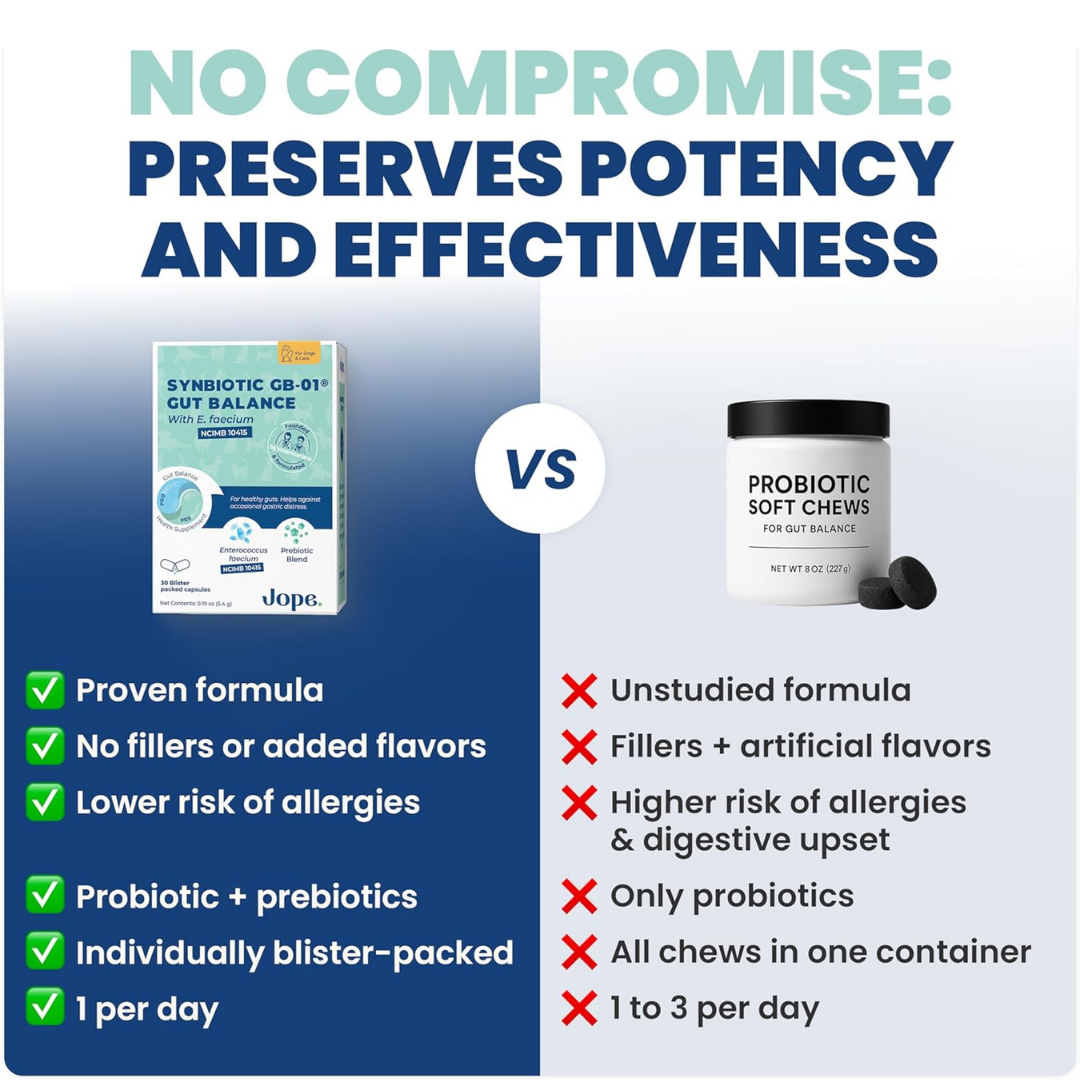
Why this probiotic over the rest of the shelf? One clinically studied strain (Enterococcus faecium NCIMB 10415) backed by three published canine trials covering 773 dogs. European Food Safety Authority regulatory authorization, not marketing certification. Founded by veterinarians Dr. Christine and Dr. Jeremy after reviewing 100+ studies and 20+ strain candidates. One inactive ingredient. Shelf-stable. One capsule daily for every size of dog. Backed by a 90-day satisfaction guarantee.
What this is: a daily clinically studied single-strain probiotic plus prebiotic capsule for routine gut microbiome support, antibiotic recovery, travel and boarding resilience, and the mild loose stool or sensitive stomach patterns your vet has been monitoring. What this is not: a substitute for vet diagnosis or treatment of serious GI conditions like inflammatory bowel disease (IBD), pancreatitis, parvovirus, or exocrine pancreatic insufficiency.
Most probiotics promise more strains. This one delivers more evidence.
The Probiotic Shelf Marketing Problem
Why bigger CFU numbers and longer strain lists are not what the research actually measures.
CFU stands for colony-forming unit, which is the way probiotics are counted. One CFU is one live bacterial cell that can grow and divide. When a probiotic box says 20 billion CFU, it is telling you there are 20 billion live bacterial cells in the bottle when the product left the factory. That number is the marketing surface most pet parents have been trained to compare. The clinical research literature on canine probiotics measures something different.
What actually matters is whether the bacteria survive long enough to colonize the gut. A probiotic has to do several things to be useful. It has to survive shipping and storage without dying. It has to survive your dog's stomach acid (one of their body's natural defenses against bacteria your dog swallows). It has to reach their intestines alive and in numbers large enough to establish a presence. It has to colonize their gut rather than just passing through. And it has to produce a documented effect on stool quality or other measurable outcomes. Most of the CFUs in commodity probiotic products do not survive to colonize. The 20 billion CFU number on the box can mislead because what reaches their gut is a fraction of what left the factory.
Multi-strain marketing has the same problem. Multi-strain blends are common in the pet probiotic market and look impressive on the label. Most of the individual strains in those blends have never been studied in dogs specifically. The doses per strain are often low enough that the clinical contribution of any one strain is hard to measure. And the marketing pressure to add more strains has come at the expense of the rigorous single-strain research the holistic probiotic field has built over the last two decades. A probiotic with one strain studied in 773 dogs across three published clinical trials has more documented evidence than a probiotic with ten strains where no individual strain has been meaningfully studied.
Jope chose the evidence path. The NCIMB 10415 strain has been tested through the EFSA's regulatory process, has been documented in three published canine clinical studies, has been shown to survive stomach acid and colonize the gut, and has been clinically validated at the 2 billion CFU daily dose. A 2 billion CFU dose of a clinically studied strain that actually reaches the gut alive is meaningfully different from a 20 billion CFU dose of unstudied strains where most of the bacteria do not survive the journey. CFU inflation is the marketing pattern. Strain-specific clinical evidence is the actual mechanism.
When To Reach For This
Six situations this capsule was built for.
After A Course Of Antibiotics
Your dog finished antibiotics and their stool quality has not returned to normal. The probiotic supports gut microbiome rebuilding for the two to four weeks after the course ends.
Chronic Loose Stool And Mild Diarrhea
Your vet has ruled out serious GI disease, and the diagnosis has settled on sensitive stomach, intermittent loose stool, or mild chronic diarrhea. This is one of the best clinically proven probiotic options for the routine daily support layer.
Travel And Boarding
Boarding, kenneling, and travel have produced predictable digestive disruption in the past. Shelf-stable capsules go in the suitcase without refrigeration.
Senior Dogs Whose Digestion Has Shifted
Your senior dog's digestive resilience has decreased with age. A daily clinical probiotic is part of many integrative senior wellness protocols.
Label-Reading Households
You compare ingredient lists. You read clinical research. You want strain-specific evidence and regulatory authorization rather than CFU marketing.
After Trying Multi-Strain Probiotics Without Results
You have rotated through multi-strain blends without seeing meaningful improvement. Households often try the single-strain validated approach next.
What Is In The Capsule
One named clinical strain plus two prebiotic fibers in one daily capsule.
Featured Ingredient
Enterococcus faecium NCIMB 10415 (2 Billion CFU)
This is the specific named bacterial strain at the heart of the formula. The NCIMB number is a regulatory deposit number, like a passport, that allows a specific bacterial culture to be tracked, tested, and verified across batches and across the published research. The 10415 strain has been studied in three published clinical trials in dogs covering 773 dogs total. It has earned the European Food Safety Authority's authorization for use in dogs after rigorous safety and effectiveness review. Dr. Christine and Dr. Jeremy, the brand's veterinarian founders, selected this strain from more than 20 probiotic candidates and more than 100 published studies.
Think of NCIMB 10415 as the named, regulator-cleared, clinical-study-backed probiotic strain. The mechanism in dogs is documented. The strain survives stomach acid. It colonizes their gut. It supports the natural balance between beneficial and less helpful bacteria. It helps stabilize their microbiome against the disruption caused by travel, dietary change, antibiotic courses, and stress. And it persists in their gut over time rather than passing through transiently the way many commodity probiotic strains do.
Featured Ingredient
FOS (Fructooligosaccharides)
FOS is the natural soluble prebiotic fiber found in foods like chicory root, Jerusalem artichoke, garlic, leeks, and onions. In supplement form, it is the fuel the probiotic strain needs once it reaches their gut. The fiber passes through their stomach and upper digestive tract intact because their own digestive enzymes cannot break it down. When it reaches their colon, the beneficial bacteria (including the NCIMB 10415 strain delivered in the same capsule) ferment it for energy and growth. This selective feeding of beneficial bacteria is what makes FOS a true prebiotic rather than just dietary fiber.
Think of FOS as the gentle prebiotic fiber that selectively feeds the bacteria you want more of, without feeding the less helpful microbes that compete for the same gut space. When the beneficial bacteria ferment FOS, they produce short-chain fatty acids (SCFAs) called butyrate, propionate, and acetate. These SCFAs are the primary energy source the cells lining their colon use to function. Higher SCFA production supports the natural integrity of their gut lining, the regulation of inflammation in the gut tissue, and the broader gut-immune connection that roughly 70% of their immune system depends on.
Acacia Gum
Acacia gum (also called gum arabic or acacia fiber) is the second prebiotic fiber in the formula. It comes from the acacia tree and has been used in traditional human and animal herbal medicine for centuries for digestive support. The mechanism is the same as FOS (selective feeding of beneficial bacteria) but the fermentation pattern is different. Where FOS ferments relatively quickly in the upper part of the colon, acacia gum ferments more slowly across the longer length of the colon. The two prebiotics together support SCFA production across the full length of their gut rather than just the section closest to their stomach.
What This Looks Like For Your Dog
From the first capsule to month three.
Picture your eight-year-old Labrador. Your dog finished a long course of antibiotics two weeks ago for a urinary tract infection. The infection is gone, but their stool quality has not returned to normal. Your dog has had loose stool most days since the antibiotics started. Their appetite has been slightly off. Their usual food sensitivity tolerance feels narrower than before. Your vet has cleared the underlying infection and the conversation has shifted to supporting the gut microbiome recovery that the antibiotics disrupted.
Here is what tends to happen across the first three months when one capsule joins their daily routine.
Days one to seven: the strain establishes a presence
The NCIMB 10415 cells survive their stomach acid and reach their intestines alive. The 2 billion CFU dose establishes a measurable presence in their gut microbiome. The FOS fiber starts feeding the beneficial bacteria in their upper colon. The acacia gum starts the slower fermentation across their lower colon. The published clinical research documents improvements in stool quality within this first week.
Weeks two to four: the bowel pattern stabilizes
Stool quality returns closer to the pre-antibiotic baseline. The fermentation patterns in your dog's gut start producing more consistent SCFA levels, which support the gut lining and the broader gut-immune connection. The narrow food sensitivity you noticed after the antibiotics starts to widen back out.
Months one to three: the microbiome stabilizes
The strain persists in their gut at low levels even between doses, supporting the long-term microbiome resilience that protects against future disruption. Their stool quality stays consistent across dietary variations your dog could not handle before the antibiotics. Their appetite normalizes. Many households also notice that their coat looks better and their skin is calmer, which reflects the gut-skin connection that integrative practitioners have been documenting for years.
Long term: built-in resilience for the disruptions you cannot predict
By the time the next stressor arrives (a boarding stay, a road trip, a dietary change, a future antibiotic course), their gut microbiome has the resilience to handle it more gracefully than it would have at baseline. This is the longer-term benefit of daily probiotic supplementation: not the resolution of any single episode, but the steady underlying stability that makes future episodes less severe and shorter when they do happen.
The Quality Standard
Veterinarian founded, single clinical strain, EFSA authorized, shelf stable.
Single Clinically Studied Strain
Enterococcus faecium NCIMB 10415 at 2 billion CFU. Three published canine clinical studies covering 773 dogs. One named strain, not a multi-strain marketing list.
EFSA Regulatory Authorization
The European Food Safety Authority authorized this specific strain for dogs after extensive safety and effectiveness review. More rigorous than most US supplement certifications.
Veterinarian Founded And Vet-Formulated
Founded by Dr. Christine and Dr. Jeremy, who reviewed 100+ studies and 20+ strain candidates before choosing NCIMB 10415 as the foundation of the formula. This is a true vet-formulated, EFSA-authorized probiotic capsule for dogs.
True Synbiotic (Probiotic Plus Prebiotic)
FOS and acacia gum prebiotic fibers in the same capsule as the probiotic strain. Synbiotics produce better stool quality results than probiotic-only or prebiotic-only products.
Clean Ingredient Profile
One inactive ingredient: magnesium stearate. No yeast, dairy, soy, wheat, meat flavoring, or artificial additives. Among the cleanest profiles in the canine probiotic category.
Shelf Stable, Blister Packed
Individual blister-pack capsules protect viability without refrigeration. Travel-friendly. One capsule daily for all sizes from toy to giant.
Why Label-Reading Households Trust This Brand
The genus-level disclosure most probiotic brands skip, paired with the strain-specific EFSA authorization that makes it safe.
Most natural pet probiotic brands either avoid Enterococcus faecium entirely (because of the genus-level concerns about antibiotic resistance and opportunistic pathogens) or include it without addressing those concerns directly on the label. Jope chose the third path. The brand selected one specific strain (NCIMB 10415) that has been cleared through the EFSA's rigorous regulatory review of those exact concerns, paid for the regulatory authorization that proves the strain's safety profile, then disclosed the genus-level concerns openly on the listing so households can see why the strain selection matters. This is what veterinarian-formulated, evidence-led pet probiotics look like when the founders care about the regulatory work, not just the marketing. The brand also offers a 90-day satisfaction guarantee. The chew is the right answer for most households with routine gut concerns. The open disclosure is the right answer for the label-reading households who want to know why.
Is This Right For Your Dog
Who this capsule was built for.
Dogs recovering from a course of antibiotics.
Antibiotics save lives, but they kill the beneficial gut bacteria alongside the harmful ones, and the disruption to your dog's gut microbiome can take weeks to recover from on its own. If your dog just finished a course (for a urinary tract infection, a skin infection, a dental procedure, anything) and their stool quality, appetite, or food tolerance has not returned to baseline, this capsule was built for exactly this protocol. Start during the second half of the antibiotic course (with the 2-to-3-hour timing separation) and continue for 2 to 4 weeks after the course ends.
Label-reading households tired of multi-strain marketing.
You compare ingredient lists. You read the clinical research. You want strain-specific evidence and regulatory authorization rather than CFU numbers and strain counts that have no clinical meaning. You have rotated through multi-strain commercial probiotics without seeing meaningful improvement in your dog and you are ready to try the opposite approach. This is the probiotic the veterinarian founders built specifically as their answer to the modern probiotic shelf.
Chronic loose stool the vet has been monitoring. Serious GI disease has been ruled out and the diagnosis has settled on sensitive stomach or intermittent loose stool. A daily clinical probiotic is a common holistic addition to the protocol.
Travel, boarding, and kenneling households. The shelf-stable blister-pack format goes in the suitcase. Many households start a few days before the travel event and continue through the trip.
Senior dogs whose digestion has shifted with age. Daily clinical probiotic support is part of many integrative senior wellness protocols. The strain is suitable for senior dogs with normal immune function.
Existing gut-axis-product households. If you already use ION Gut Support, ThorneVet Digestive Enzyme Formula, or other gut-focused products, this is the clinical single-strain probiotic that completes the gut protocol at a different layer.
Households that can do the safety checks. Not for dogs in active chemotherapy, recent transplant recipients, or dogs on strong immunosuppression without vet supervision. Not for puppies under 12 weeks. Loop in your vet for any dog with diagnosed serious GI disease, on prescription medication, or with chronic conditions under management.
How To Give It
One capsule daily for all sizes of dogs, 12 weeks and older.
The dosing is intentionally simple. One capsule per day for every dog regardless of body weight. The 2 billion CFU dose has been calibrated to be effective across the body weight range without weight-based adjustment. The single-capsule-daily approach is the practical advantage of a clinically validated single-strain probiotic over weight-dosed multi-strain blends.
Daily dosing by body weight.
Use daily as the standard rhythm. The clinical research base supports continuous daily use rather than pulse protocols. Short-term use is also appropriate for specific events like travel, boarding, or antibiotic recovery.
Three ways to give the capsule.
Whole capsule into the mouth. For dogs who accept capsules readily, place the capsule on the back of their tongue and gently close their mouth. Fastest method.
Powder sprinkled onto food. Open the blister-pack, twist the capsule apart, and sprinkle the powder directly onto a small portion of wet food, kibble moistened with bone broth, or a meal topper. Mix gently. The powder is neutral-tasting and mixes readily.
Hidden in a treat. Tuck the whole capsule into organic peanut butter (verified xylitol-free), a piece of cooked chicken, or a hollow training treat. Most dogs accept the capsule readily this way.
Avoid mixing the open-capsule powder into hot food or hot water. High temperatures can damage the live probiotic bacteria. Room-temperature or cool food only.
For antibiotic recovery. Give the probiotic and the antibiotic 2 to 3 hours apart during the course. Continue the probiotic for 2 to 4 weeks after the course ends to support full gut microbiome rebuilding.
For travel and boarding. Start the probiotic a few days before the event, continue through the event, and continue for a few days afterward. Shelf-stable blister-packed capsules travel without refrigeration.
Storage. Cool, dry place out of direct sunlight. Refrigeration is not required but may extend freshness in hot climates. Do not use past the printed expiration date.
Works Well With
Three companions for a complete gut wellness protocol.
A complete gut wellness protocol works at multiple layers. The capsule handles the microbiome layer (the beneficial bacteria your dog's gut needs and the prebiotic fiber that feeds them). The three companion products below address different layers of the same gut picture: the structural integrity of the gut lining itself, the upstream digestive process that determines what reaches the gut in the first place, and the gut-brain axis that connects your dog's stress level to digestive function.
ION Gut Support for Pets
The mineral-rich liquid that supports the natural integrity of your dog's gut lining at the tight-junction level (the microscopic seals between the cells of the gut wall that determine whether the gut barrier is intact). Where the Jope synbiotic delivers the probiotic bacteria and the prebiotic fiber, ION Gut Support addresses the physical structure of the gut lining itself. The two products work at different layers of the same picture and stack cleanly. Most gut work feeds the garden. ION rebuilds the soil. Jope plants the right seeds.
ThorneVet Digestive Enzyme Formula Powder
The nine-enzyme digestive support powder that breaks down food at the upstream end of the digestive process before it reaches the gut microbiome the probiotic supports. Where the Jope synbiotic supports the beneficial bacteria, the ThorneVet enzymes ensure that the food arriving in that gut has been properly broken down into the simpler molecules their body can absorb and their microbiome can productively ferment. The two products address different sides of the digestive equation and complement each other meaningfully.
Animal Essentials Tranquil Times Soft Chews
The gut-brain axis is one of the most overlooked connections in chronic canine gut imbalance. Cortisol from chronic stress is a documented driver of leaky gut and microbiome disruption. Supporting your dog's daily calming layer often produces improvements in stool quality and gut consistency over weeks of consistent use, even before any direct gut work. The Animal Essentials calming chew is the daily nervous-system layer that complements the daily probiotic at the foundational stress-gut intersection. Many integrative practitioners now recommend the pairing for dogs whose stress and gut patterns appear linked.
Frequently Asked Questions
The questions pet parents ask before buying.
Is Enterococcus faecium safe for dogs?
The specific strain in this product (NCIMB 10415) is one of the few Enterococcus faecium strains authorized for use in dogs by the EFSA after rigorous safety and effectiveness review. The genus broadly has known concerns in research literature, including antibiotic resistance patterns in certain hospital strains and opportunistic infection potential in severely immune-compromised animals. The genus-level concerns are real, which is why responsible probiotic formulation requires choosing a specific tested strain rather than the genus broadly. For healthy dogs and dogs with the routine digestive concerns this product was built to support, the NCIMB 10415 strain has the cleanest safety profile in the Enterococcus faecium category. For severely immune-compromised dogs (active chemotherapy, recent organ transplant, advanced immunosuppression), any probiotic carries theoretical concern and needs your vet on board regardless of strain.
What is a synbiotic and how is it different from a probiotic?
A probiotic delivers beneficial bacteria. A prebiotic provides the fiber the gut bacteria need to thrive. A synbiotic combines both in one product. Research shows synbiotic formulations produce better stool quality results than either ingredient alone, because the combination ensures the probiotic has the food source it needs to colonize and produce short-chain fatty acids that support your dog's gut lining. This formula combines E. faecium NCIMB 10415 with two prebiotic fibers (FOS and acacia gum) in a single daily capsule.
Is 2 billion CFU enough for a dog probiotic?
CFU count is one of the most misunderstood elements of probiotic selection. What matters more than the raw number is whether the specific strain survives stomach acid, reaches the gut alive, colonizes the gut environment, and produces a documented effect. A 2 billion CFU dose of a clinically studied strain that has been validated at exactly that dose can outperform a 20 billion CFU dose of unstudied strains where most of the bacteria do not actually survive the journey. The NCIMB 10415 strain has been tested at 2 billion CFU daily in the published clinical research base, and that is the dose the brand chose to use in this formula. CFU inflation is a marketing pattern. Strain-specific clinical validation at the right dose is the actual mechanism.
What does the EFSA authorization mean for a dog probiotic?
The European Food Safety Authority is one of the most rigorous food and supplement regulatory bodies in the world, with particular care taken in evaluating probiotic strains for safety, effectiveness, and consistency. The NCIMB 10415 strain has earned EFSA's specific authorization for use in dogs after extensive review. This means the strain has been independently tested for safety, has demonstrated documented benefits in clinical studies, and has been cleared of the antibiotic resistance and opportunistic pathogen concerns that apply to certain other strains in the broader Enterococcus faecium genus. The regulatory clearance is meaningfully more rigorous than the National Animal Supplement Council (NASC) certification that many US pet supplements carry, because NASC is a quality manufacturing standard rather than a strain-specific safety review.
How do I support my dog's gut after a course of antibiotics?
Start the probiotic during the second half of the antibiotic course, giving the probiotic and the antibiotic 2 to 3 hours apart so the antibiotic does not kill the probiotic bacteria. Continue the probiotic for 2 to 4 weeks after the course ends, which is the window when the gut microbiome is most actively rebuilding. Many households also add a digestive enzyme support like ThorneVet Digestive Enzyme Formula and a gut lining support like ION Gut Support during the recovery window. If your dog's stool quality, appetite, or food tolerance is significantly worse three to four weeks after the antibiotics end, your vet should evaluate for any complications.
What is the difference between multi-strain and single-strain dog probiotics?
Multi-strain probiotics include several different bacterial species in one formula, often five to fifteen strains. The implicit marketing promise is that more strains deliver more benefit. The clinical research literature does not actually support this premise. What the research supports is that specific named strains with specific documented clinical evidence produce specific documented benefits. A probiotic with one strain studied in 773 dogs across three clinical trials has more evidence than a probiotic with ten strains where no individual strain has been studied in any significant clinical trial. The single-strain validated approach in this formula is the practical answer to the multi-strain marketing problem. That said, multi-strain blends are not necessarily wrong; they just carry less strain-specific accountability.
How does Jope compare to FortiFlora or Proviable?
All three are clinically validated probiotic options used in veterinary practice. FortiFlora (made by Purina) uses a different E. faecium strain (SF68) in a sprinkle-on-food powder format with animal digest flavoring. Proviable (made by Nutramax) uses a multi-strain blend with prebiotic fiber. Jope uses the E. faecium NCIMB 10415 strain (a different specific strain than FortiFlora's SF68) with two prebiotic fibers in a clean capsule format with one inactive ingredient. The choice among the three depends on your vet's recommendation, your dog's response to specific strain options, and your household's preferences around format and inactive ingredient profile. Each has its place.
Why does the formula not require refrigeration?
Many probiotic products require refrigeration to maintain potency, which signals fragility in the bacterial preparation. The Jope formula is shelf-stable at room temperature for two reasons. The NCIMB 10415 strain itself is more robust than many commodity probiotic strains, partly because of its natural acid tolerance. And the individual blister-pack format protects each capsule from moisture and oxygen exposure that degrade probiotic potency in conventional bottle packaging. The shelf-stable nature makes the daily routine more convenient and supports travel use without specialized storage.
How do I give probiotic capsules to my dog?
Three methods work for most dogs. The first is whole-capsule on the back of their tongue, which is the fastest method for dogs who accept capsules readily. The second is hiding the capsule in a small piece of organic peanut butter (verified xylitol-free), cooked chicken, or a hollow training treat. The third is opening the blister-pack, twisting the capsule apart, and sprinkling the powder directly onto their food. The powder is neutral-tasting and mixes readily into wet food, moistened kibble, or a meal topper. Use room-temperature or cool food only; high temperatures damage the live probiotic bacteria.
Is Jope GB-01 safe for daily long-term use in dogs?
Yes, for healthy dogs. The formula is designed for indefinite daily use as a baseline gut microbiome support, and the published clinical research base supports continuous daily use rather than pulse cycles. The strain persists in the gut at low levels even between doses. Senior dogs, dogs recovering from antibiotics, dogs with sensitive stomachs, and dogs whose households want a daily resilience layer all use the product long-term. The honest cautions remain (immune-compromised dogs need vet supervision, antibiotic timing matters, puppies under 12 weeks need vet guidance), but for the routine population of healthy dogs, this strain has one of the strongest long-term safety profiles in the probiotic category.
How long until I see results?
The published clinical research base documents improvements in stool quality and digestive comfort within the first seven days of consistent daily use. Many households report meaningful improvement in the first two weeks. The broader gut-immune connection benefits (skin and coat improvements, stress resilience, more consistent appetite) tend to show up over weeks and months of continued use as the gut microbiome stabilizes. Acute use for specific events like travel or boarding often shows benefit within a few days of starting.
Why this probiotic over the others on the market?
Three meaningful differences. First, the clinical evidence base. The NCIMB 10415 strain has been studied in three published clinical trials covering 773 dogs, with the EFSA regulatory authorization backing the safety review. Most multi-strain commercial probiotics cannot demonstrate this evidence base for any single strain in their formula. Second, the single-strain accountability over multi-strain marketing. The veterinarian founders chose evidence over diffusion. Third, the honest disclosure profile, including the Enterococcus faecium genus-level discussion and the CFU comparison context, which most other probiotic listings do not address. The brand also backs the product with a 90-day satisfaction guarantee.
The Daily Clinical Probiotic
One named, studied, regulator-cleared probiotic strain in a daily capsule.
Enterococcus faecium NCIMB 10415 at 2 billion CFU per capsule. Three published clinical studies in dogs covering 773 dogs total. EFSA regulatory authorization for use in dogs after extensive safety and effectiveness review. Paired with FOS and acacia gum prebiotic fibers in a true synbiotic formula. One inactive ingredient: magnesium stearate. Shelf-stable blister-packed format. Founded by Dr. Christine and Dr. Jeremy, who reviewed 100+ studies and 20+ probiotic candidates before selecting this strain.
One capsule daily for all sizes of dogs, 12 weeks and older. Pet parents typically notice stool quality improvements within the first week. The broader gut-immune benefits build over weeks and months of continued daily use. Backed by a 90-day satisfaction guarantee.
Not the right choice for dogs in active chemotherapy, recent organ transplant recipients, dogs on strong immunosuppression without vet supervision, or puppies under 12 weeks. Honest disclosure of the broader Enterococcus faecium genus concerns lives on the listing because that is the trust signal label-reading households recognize. The specific NCIMB 10415 strain has been cleared of those concerns through the EFSA review process.
Most probiotics promise more strains. This one delivers more evidence.