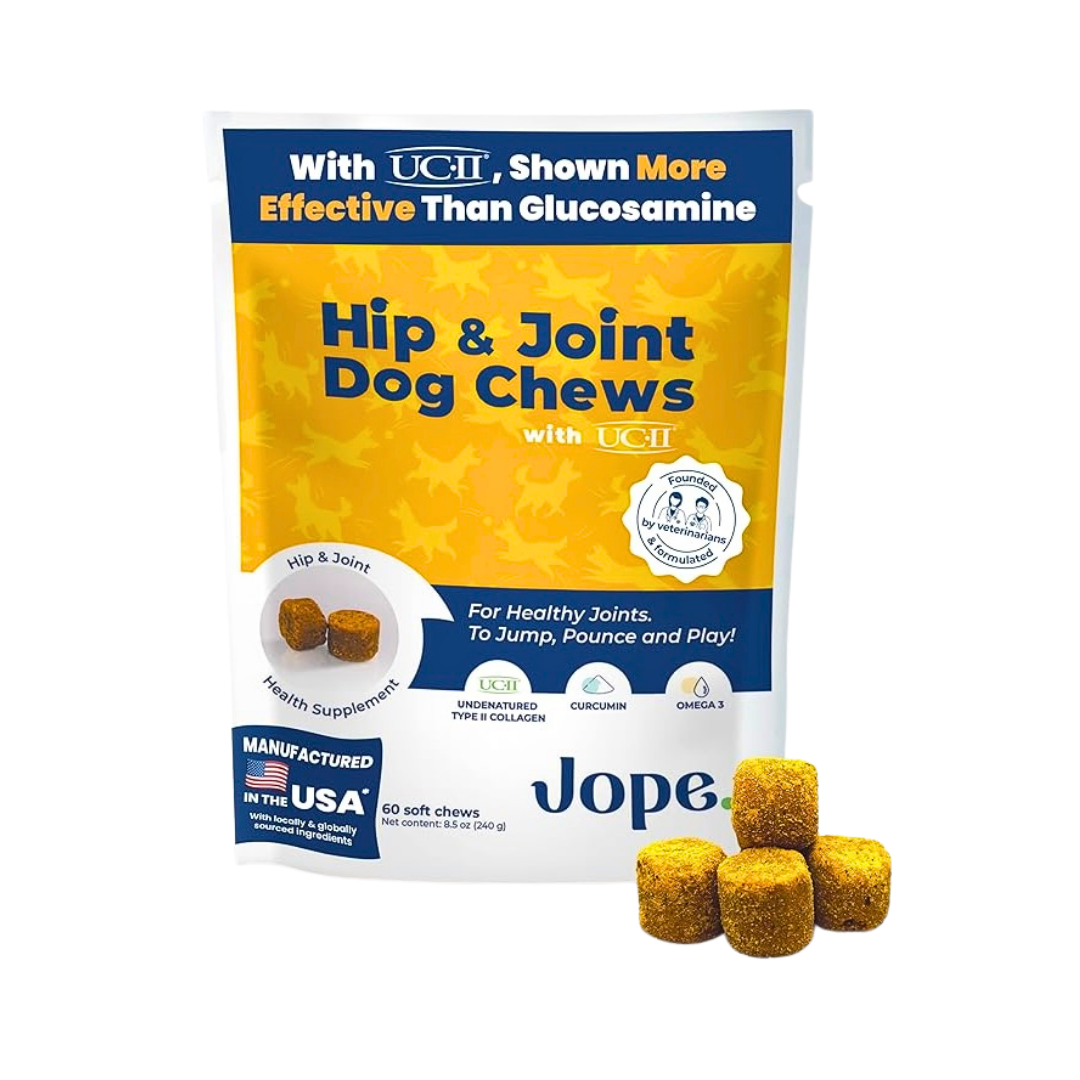
A vet-formulated daily soft chew built on UC-II undenatured type II collagen, anchovy-sourced omega-3, and curcumin. Three research-backed natural ingredients working on three different layers of joint inflammation. Cold-pressed for ingredient integrity. 60 soft chews per bag, approximately a 30-day supply for medium dogs.
Your dog used to bound up the stairs without thinking. Now there is a pause at the bottom, and you can see them measure the climb before they start. If you have been watching this happen, Jope was built for them.
You see it in the small things first. The hesitation before a jump that used to be effortless. The longer time it takes to get up from a nap on a cold morning. The stiffness for the first ten minutes of a walk that loosens up as they move. The favorite spot on the couch that has become a calculation. You know they are slowing down. You know the joints are part of it. You have probably already tried glucosamine and chondroitin, or fish oil, or a chewable from the vet's office. Either you saw no difference or you saw a small one that did not hold up.
Here is what the older joint supplements missed. Cartilage damage in dogs is not just a supply problem. It is also an immune problem. The body's defense system, mistaking damaged cartilage proteins for threats, keeps the inflammation alive long after the original injury is gone. The joint stays inflamed. The cartilage stays under attack. The glucosamine keeps arriving with no permission to do its work. This is the part of the conversation that the last generation of joint supplements skipped, and it is the reason so many dogs plateau on them.
Jope works on that overreaction. The central ingredient, UC-II, is a patented and naturally derived form of undenatured type II collagen that teaches the immune system to recognize cartilage as friend rather than foe. Published canine plate-force studies (a method that measures how evenly dogs distribute weight on each leg, the gold-standard objective test for canine mobility) show 81% mobility improvement over baseline and clinical superiority over the glucosamine and chondroitin combination that has dominated the joint aisle for thirty years. The chew adds two more research-backed natural compounds to that core: anchovy-sourced omega-3 to shift the body's inflammatory chemistry, and curcumin to scavenge the free radicals that compound damage over time. Three ingredients, three mechanisms, working on three layers of the same problem.
Drs. Christine and Jeremy built Jope because they were unsatisfied with the joint options they had to offer in the exam room. The clinical experience shaped the formulation choices. The 20 mg UC-II per chew matches the dose used in the published canine studies, not the lower dose many competing products settle for. The omega-3 sits at 98 mg combined EPA and DHA per two chews, which is two to four times what most joint supplements deliver. The chew is cold-pressed because heat denatures both UC-II and omega-3 fatty acids, which would defeat the entire point. The 19,660+ verified pet parent reviews on the manufacturer's site reflect what happens when the formulation honors what the research actually showed.
Three Ingredients, Three Mechanisms
Three layers of joint protection working on three different pathways, all in one daily chew
Permission (UC-II)
Teaches the immune system to stop attacking the type II collagen in your dog's cartilage. The mechanism is called oral tolerance, the same natural pathway food allergists use to desensitize patients. The cartilage stops being treated like a foreign invader. The autoimmune layer of joint damage quiets down.
Chemistry (Omega-3)
EPA and DHA from anchovy oil incorporate into cell membranes throughout the body, including the synovial cells lining the joints (the cells that make and maintain joint fluid). Over four to eight weeks of consistent use, this shifts the body's inflammatory chemistry away from the strong inflammatory signals that omega-6 fats produce, toward gentler signals the body can resolve more easily.
Cleanup (Curcumin)
Curcumin scavenges the free radicals that chronic joint inflammation produces faster than the body can clear them, blocks the COX-2 enzyme that prescription NSAIDs also target, and inhibits the NF-kB master switch for chronic inflammation. The ongoing cleanup that prevents inflammatory damage from compounding.
What Jope Helps With
Seven joint situations these chews were built for, from diagnosed dysplasia to early mobility decline
Hip Dysplasia
Diagnosed structural hip conditions where the immune response is making the joint damage worse
Arthritis & Joint Pain
Diagnosed degenerative joint disease and the chronic pain that follows years of cartilage breakdown
Morning Stiffness
The slow start that fades by mid-morning but returns earlier and earlier as the months go on
Stair & Jumping Hesitation
The pause before climbs and the reluctance to jump on the couch that was not there a year ago
Aging Mobility Decline
The gradual slowing that started a year or two ago and has gotten harder to ignore each season
Active Dog Joint Maintenance
Working dogs, agility athletes, and busy young dogs whose joints take real wear-and-tear daily
Post-Injury Joint Support
Recovery after sprains, surgical procedures, or the setbacks that need rebuilding from the cartilage up
The Full Formula
Three ingredients, dosed at the levels the research actually used
Most joint chews on the market are formulated around marketing dosages rather than research dosages. Jope is the exception. Here is what is in the chew, what each ingredient does, and why the doses matter.
Featured Ingredient
UC-II Undenatured Type II Collagen, 20 mg per chew
UC-II is a patented, naturally derived form of chicken-sourced cartilage protein that has not been heated or chemically processed. The word "undenatured" matters here. Most collagen on the market has been hydrolyzed, broken into amino acid fragments your dog absorbs and uses as raw material. UC-II is left structurally intact, in its naturally occurring molecular form, which means it passes through the stomach largely undigested and arrives at the Peyer's patches in the small intestine, which are the immune system's command centers for deciding what the body should attack and what it should leave alone.
When the immune system encounters intact type II collagen at the Peyer's patches, it registers this protein as safe. As food. And because joint cartilage is also made of type II collagen, the immune system gradually stops launching inflammatory attacks on the cartilage tissue it had been mistakenly targeting. The clinical name is oral tolerance. It is the same natural mechanism food allergists use when desensitizing patients to peanuts.
Think of UC-II as a peace treaty delivered to the immune system once a day. Cartilage stops being treated like a foreign invader. The autoimmune layer of joint damage quiets down. Multiple plate-force studies (which measure how evenly a dog distributes weight on each leg, the most objective measure available in veterinary joint research) show UC-II outperforms the standard glucosamine and chondroitin combination, with dogs in these trials improving 81% over baseline.
The dose with the evidence behind it. The 20 mg per chew matches the dosing used in the published canine studies that demonstrated the 81% mobility improvement. Many competing products use lower doses to keep their cost-per-bag down. This is the dose the research actually used. One note worth flagging: UC-II is derived from chicken sternum cartilage. Dogs with confirmed chicken allergies should not take this chew.
Featured Ingredient
Omega-3 EPA and DHA from Anchovy Oil, 98 mg combined per two chews
The omega-3 in this formula is naturally sourced from anchovies, a small forage fish that sits low on the food chain. That matters for heavy metal load. Larger fish like salmon accumulate mercury, PCBs, and dioxins over their longer lifespans. Anchovies, with their two-year lifespan and plankton diet, carry a fraction of that burden, which is why we prefer them as a clean natural source for daily long-term use.
EPA and DHA are the two fatty acids that move the needle on inflammation. They incorporate into cell membranes throughout the body, including in the synovial cells that line the joints (the cells that make and maintain joint fluid). Once incorporated, they shift the body's inflammatory chemistry away from the strong inflammatory signals that omega-6 fats produce, toward gentler signals the body can resolve more easily. The American Animal Hospital Association lists omega-3 as a first-tier natural intervention for canine osteoarthritis.
Think of EPA and DHA as new firefighters joining the team. The body has been responding to joint signals with the same inflammatory chemicals for years. Adding omega-3 changes the inventory in the response truck. The new chemicals it has access to put out fires faster and start smaller fires to begin with.
A meaningful dose, not a marketing dose. The 98 mg of combined EPA and DHA in two chews is two to four times what you find in most joint-supplement labels, where fish oil often appears as a marketing claim rather than a meaningful natural dose. For large dogs with significant inflammation, layering a dedicated omega-3 product alongside Jope is still the right move, and the Works Well With section below covers that.
Curcumin from Turmeric Root, 50 mg per chew
Curcumin is the bright yellow polyphenol naturally found in turmeric root (polyphenols are the same family of antioxidant plant compounds found in green tea, blueberries, and red wine), and it is one of the most studied natural anti-inflammatory compounds in the world. It blocks the COX-2 enzyme, the same enzyme prescription NSAIDs target, but through a gentler plant-based mechanism. It quiets the master switch the body uses to keep chronic inflammation going (a signaling pathway called NF-kB). And it scavenges the free radicals that chronic joint inflammation produces faster than the body can clear them. Inside an inflamed joint, those free radicals are doing additional damage to cartilage cells every day. Curcumin neutralizes them naturally before the damage compounds.
Think of curcumin as a sponge wrung out daily inside the joint capsule. It mops up the inflammatory byproducts the body cannot keep up with on its own.
A transparent note on bioavailability. Standard curcumin has low bioavailability on its own. The 50 mg in this chew is therapeutic when combined with the fat from the omega-3 oil and the cold-pressed delivery, because curcumin plus fat is the absorption pairing that works in whole food. For dogs with significant chronic inflammation, however, this is not a phytosome curcumin (a fat-bound version of curcumin engineered for much higher absorption than the standard form). Pairing Jope with a phytosome curcumin product is the next step up for those cases.
What This Looks Like Inside The Joint
Seven things happen between starting the chew and the pause at the bottom of the stairs disappearing
Imagine a nine-year-old retriever who used to bound up the stairs and now pauses at the bottom step. The pause is not laziness. It is the cumulative weight of years of low-grade joint inflammation that has been quietly degrading cartilage, irritating synovial tissue, and reinforcing the body's protective stiffness response. The joint hurts a little. The dog avoids the movement that hurts. The cartilage that needed loading to stay healthy gets less of it. The cycle compounds. Here is what changes once the chew is added to the daily routine.
UC-II reaches the Peyer's patches in the small intestine
These are the immune system's training centers in the gut wall. The intact type II collagen signals immune tolerance, gradually reducing the autoimmune component of cartilage attack. This work begins on day one but the tolerance shift takes weeks to translate into visible mobility change.
Omega-3 fatty acids incorporate into joint cell membranes over four to eight weeks
The body's inflammatory chemistry shifts as EPA and DHA replace omega-6 fats in cell membrane structure. The chemicals available for inflammatory signaling change. This is why the 6-week mark matters for evaluating the chew.
Curcumin enters the bloodstream and concentrates in inflamed tissues
The free radicals that chronic joint inflammation produces faster than the body can clear them get neutralized. COX-2 pathways quiet. The ongoing tissue damage that compounds week over week begins to slow.
The joint fluid becomes less viscous over weeks of consistent use
Synovial fluid (the fluid that lubricates the joint capsule) thins to a more workable consistency. Lubrication between cartilage surfaces improves. The joint moves more smoothly. The friction that contributes to ongoing cartilage wear decreases.
Your dog tests a movement they had been avoiding
The cost is lower than it had been. They try it again the next day. This is usually the first visible-to-owner change, and it tends to show up between weeks three and four.
Cartilage cells return to their natural repair cycles
No longer under constant inflammatory pressure, the cartilage cells (called chondrocytes) resume the maintenance work they were designed to do. Repair shifts from a losing battle to a sustainable cycle.
The bottom-of-the-stairs pause shortens, then disappears
Then it becomes something the owner has to actively remember used to happen. This is the moment most pet parents describe when they write the reviews that have built Jope's reputation.
Important Notes Before Starting
Not for dogs with chicken allergies. UC-II is derived from chicken sternum cartilage. Dogs with confirmed chicken protein allergies should not take Jope. The natural flavor in the chew is sunflower and rosemary based with no chicken protein, but the UC-II active ingredient itself is chicken-derived, and that is the relevant exposure.
Contains soy lecithin as an emulsifier. Soy lecithin is a binder, not a meaningful soy protein exposure, but for households committed to a fully soy-free protocol or dogs with documented soy sensitivities, it is worth knowing about. The amount is small and functions to keep the cold-pressed chew texture stable.
Drug interactions. Generally well tolerated alongside prescription veterinary anti-inflammatories like carprofen or meloxicam. Omega-3 at high cumulative doses (when combined with separate omega-3 supplements) can have mild blood-thinning effects, worth discussing with your veterinarian if your dog is on anticoagulant medication. Disclose all supplements at your vet visits.
Not studied in young puppies or pregnant dogs. Safety has not been established for puppies under six months for large breeds, under twelve months for small breeds, or for pregnant or lactating dogs. For early joint support in young large-breed dogs, talk to your veterinarian about appropriate timing.
If condition worsens or no improvement at three months. Stop use and consult your veterinarian. The manufacturer recommends a minimum four-month evaluation window, but a dog who is getting worse on the protocol or showing zero change at three months warrants veterinary investigation for what else may be going on.
Is This Right For Your Dog
Jope is especially worth considering if your dog...
✓
Used to bound up the stairs and now hesitates at the bottom step, particularly on cold mornings, with stiffness that loosens up after the first ten minutes of movement.
✓
Has been on glucosamine and chondroitin for months without meaningful improvement, and you are ready to try a different mechanism that addresses the immune layer of joint damage.
✓
Is a sporting, working, or athletic breed and you want to protect the joints before damage shows up on imaging.
✓
Is a large or giant breed (Labrador, Golden Retriever, German Shepherd, Rottweiler, Great Dane) where hip and elbow dysplasia rates are statistically high.
✓
Recently came through orthopedic surgery and your vet wants long-term joint maintenance to protect the repair from compensatory wear.
✓
Is showing the early signs your vet has flagged as pre-arthritic: stiffness after lying down, reluctance to jump, slower to rise.
✓
Is a young large-breed dog whose breeder or veterinarian recommended early joint support based on genetic risk.
✓
Has been diagnosed with osteoarthritis and you want to layer a natural supplement protocol alongside any prescribed medication, with the goal of reducing the medication dose over time.
✓
Refuses powders, hates capsules, and will only take a supplement that actually tastes like a treat.
✓
Lives an active life (agility, dock diving, hunting, long-distance hiking) and needs cumulative cartilage protection that keeps up with the workload.
✓
Is approaching the eight-year mark, when 70% of dogs begin to show joint changes whether or not the owner can yet see them.
✓
Has tried other joint chews that looked good on the label and produced no visible difference in your dog.
✓
Belongs to a holistic, label-reading household that wants natural, research-backed ingredients without prescription medication as the first line.
How To Give It
Dose by weight, give daily for at least four months
The chew can be given directly as a treat or mixed into food. The texture is soft and crumbly, which makes it easy to break apart for picky dogs or to hide inside a meal. Most dogs accept it as a treat without coaxing. Splitting the daily dose between morning and evening is fine if that fits your routine better.
Weight-Based Dosing
Dog's Weight
Daily Dose
Bag Duration
Under 25 lbs
1 soft chew daily
60 days per bag
25 to 75 lbs
2 soft chews daily
30 days per bag
Over 75 lbs
3 soft chews daily
20 days per bag
What The Four-Month Window Looks Like
Weeks 1 to 2 · The work begins inside
Some dogs show early energy or comfort changes. Many show nothing visible yet. UC-II is reaching the Peyer's patches, omega-3 is beginning cell-membrane incorporation, curcumin is moving into circulation. The mechanism work is happening before the mobility change shows up.
Weeks 3 to 4 · First visible mobility shifts
The early responders begin to show change. Easier rising in the morning. More willingness to play. A test of a movement they had been avoiding. The first signs that something is shifting underneath.
Weeks 6 to 8 · The change becomes consistent
The omega-3 has finished incorporating into cell membranes. The immune tolerance has had time to build. More consistent comfort, more confidence on the stairs they had been avoiding, longer walks without the stiffness that used to start by mile two.
Week 12+ · The full effect
The pause at the bottom of the stairs is gone. The leap onto the couch happens without thinking. The dog you have been watching slow down is now moving like a younger version of themselves. Continued daily use sustains the benefit.
Plan for the four-month window. The manufacturer recommends giving the chew for at least four consecutive months to evaluate the full effect. Joint conditions are progressive and chronic. The work is daily, cumulative, and long-term. Most pet parents who report disappointment stopped at six weeks, before the omega-3 had finished incorporating into cell membranes and before the UC-II had finished training the immune response.
Storage: keep the resealable bag closed in a cool, dry place. Avoid direct sunlight and humidity. The cold-pressed soft texture and the omega-3 content both benefit from consistent storage conditions.
Subscribe and save: consistent monthly delivery removes the supply gap that breaks joint protocols. The four-month evaluation window is the minimum for a fair assessment, and a subscription makes that window automatic without you having to remember a reorder.
Works Well With
The companion products that complete the holistic joint protocol
Jope is the daily foundation. Here is what stacks well on top of it for specific situations, in the order most pet parents tend to add them.
Jope is the chew you give every day. HerbAprin is the herbal tincture you give on the days the chew is not enough. White willow bark (the same plant family aspirin was originally derived from), comfrey leaf, alfalfa, and yucca provide acute pain relief on flare days. Daily preventive plus as-needed herbal rescue is the cleanest holistic joint protocol structure.
The 98 mg of EPA and DHA in two Jope chews is a meaningful natural dose for a small or medium dog. For a 70-pound retriever with significant inflammation, or for dogs with skin involvement alongside their joint issues, more omega-3 is often better. Nordic Naturals provides high-purity natural fish oil with the third-party freshness and heavy-metal testing that matters when you are dosing omega-3 daily for years.
Every active ingredient in Jope has to cross the intestinal barrier to reach the joint. ION is a naturally derived soil-based extract that strengthens the tight junctions in the gut lining, the protein bonds that determine how well nutrients pass through and how much inflammatory material leaks out. For dogs on long-term holistic joint protocols, gut integrity is the foundation the entire intervention stands on.
PEA (palmitoylethanolamide) is a naturally occurring compound, a fatty acid the body produces in response to inflammation, that operates on a completely separate inflammation pathway from UC-II, omega-3, or curcumin. It works on mast cells (immune cells that drive chronic inflammation) and the endocannabinoid system (the body's own pain-modulating network, the same one CBD targets). Both of those pathways drive the chronic nerve-mediated pain layer of joint conditions. For dogs whose pain seems to outsize their structural damage on imaging, PEA fills a gap that even the best traditional joint formulas miss.
Long-term anti-inflammatory use, whether prescription NSAIDs, repeated HerbAprin courses, or daily curcumin, asks more of the liver than the average diet supports. This natural herbal extract delivers silymarin (the active compound that gives milk thistle its liver-protective effect), which reinforces liver cell membrane integrity and regeneration. For dogs over seven on continuous joint protocols, milk thistle is the quiet holistic maintenance work that prevents bigger problems years down the line.
Frequently Asked Questions
The questions pet parents ask most
How is this different from glucosamine and chondroitin?
Glucosamine and chondroitin work by supplying the raw materials cartilage uses to repair itself. The premise is sound. The clinical results have been mixed, and a large body of research has questioned whether the doses commonly used in supplements actually produce meaningful change in dogs. UC-II works on a different natural mechanism entirely. Instead of supplying building blocks, it teaches the immune system to stop attacking the cartilage proteins it has been mistakenly treating as threats. Plate-force studies (a testing method that measures how evenly a dog distributes weight on each leg, considered the gold-standard objective measure in canine mobility research) show UC-II outperforms glucosamine and chondroitin in head-to-head comparisons. That said, glucosamine is not useless, and some dogs do well on combination formulas. UC-II is a different tool. For dogs who have plateaued on glucosamine, it is often the right next step in a holistic joint protocol.
How long until I see a difference?
Most pet parents see early changes between weeks three and four. Some dogs respond faster. Some take eight to twelve weeks for the full effect to be visible. The manufacturer recommends a minimum four-month evaluation window. Joint conditions are chronic and the work is cumulative. Natural protocols work gradually as the body's chemistry shifts, and the most common reason pet parents miss the actual benefit is stopping at six weeks because nothing is happening, when the omega-3 has not yet finished incorporating into cell membranes and the immune tolerance is still building.
My dog is three years old and seems fine. Is this overkill?
One of the better questions we get. The truthful answer is that joint changes begin years before they show up as visible stiffness. UC-II has published data supporting its use in young, healthy, active dogs, particularly for sporting and large breeds where flexibility and recovery are part of long-term joint protection. The earlier you start, the more cartilage you preserve. For a three-year-old large breed with genetic risk for hip or elbow dysplasia, this is investment, not overkill.
Can I give this with my dog's prescription NSAIDs?
Yes. UC-II, omega-3, and curcumin are generally well tolerated alongside prescription anti-inflammatories like carprofen or meloxicam, and many integrative veterinarians actively recommend the combination because layering natural anti-inflammatories can reduce NSAID dose over time. Disclose all supplements to your prescribing vet, especially if your dog is on long-term medication or has known liver or kidney concerns.
My dog has chicken allergies. Can he still take this?
No. The UC-II in this chew is derived from chicken sternum cartilage. Dogs with documented chicken protein allergies should not take this product. The natural flavor is sunflower and rosemary based with no chicken protein, but the active ingredient itself is chicken-derived, and that is the relevant exposure.
Why this over a chewable joint supplement from my vet's office?
Many veterinary-channel joint chews are still glucosamine and chondroitin formulations, often with similar dosing to over-the-counter brands at a higher price. Some have added MSM or green-lipped mussel. UC-II appears in some prescription-channel products but rarely at the 20 mg clinically studied dose. The fair comparison is to read the active ingredient panel on whatever your vet recommends. If it is glucosamine and chondroitin without UC-II, Jope is operating on a different and better-evidenced natural mechanism. If it is a UC-II formula at the studied dose, both products are valid, and your vet's recommendation carries the advantage of someone who has examined your dog in person.
How does Jope compare to a green-lipped mussel supplement?
Green-lipped mussel and UC-II are not the same thing, and they are not redundant. Mussel supplies ETA omega-3 (a fatty acid that is not present in regular fish oil), naturally occurring glycosaminoglycans (joint-building compounds your dog's body uses to make and repair cartilage), and chondroitin sulfate. UC-II teaches the immune system to stop attacking type II collagen. Some holistic pet parents stack both, particularly for dogs with significant osteoarthritis where layering different natural mechanisms is more effective than maxing the dose of any single one.
The label says soy lecithin. I have been told to avoid soy. Is this a problem?
A fair question and one we appreciate. Soy lecithin is an emulsifier, used to keep the cold-pressed chew texture stable. It is not the same as soy protein, which is the inflammatory concern most pet parents are trying to avoid. The amount is small and functions as a binder rather than as a meaningful protein exposure. For dogs with documented soy sensitivities, or for households committed to a fully soy-free protocol, it is worth considering. For most dogs, the soy lecithin here is not a meaningful issue.
The Clean Formula Standard You Expect
Clinical 20 mg UC-II DoseAnchovy-Sourced Omega-3Vet-FormulatedThird-Party Tested Every LotNASC and FDA RegisteredMade in the USA
For the dog who used to bound up the stairs without thinking, this is the formula that earns its place in the daily routine.
There is a generation of joint supplements behind us, and a different generation ahead of us. The old generation followed the logic that joint damage is a supply problem: provide the building blocks and the body will repair. That logic gave us decades of glucosamine and chondroitin formulas, some of which worked, many of which did not. The new generation, of which UC-II is the cleanest example, follows a different logic. Joint damage is also an immune problem. The body's defense system, mistaking damaged cartilage proteins for threats, keeps the inflammation alive and the cartilage under attack. Until that overreaction quiets, no amount of building blocks gets through. Jope puts UC-II at the clinical 20 mg dose alongside two natural anti-inflammatory partners that operate on completely different pathways, formulated by practicing veterinarians who were frustrated by the gap between label promises and exam-room outcomes.
UC-II for permission. Omega-3 for chemistry. Curcumin for cleanup. Three layers of joint protection, one daily soft chew, four months to evaluate the full effect.
Joint repair is not always a supply problem. Sometimes it is a permission problem.
I have been hearing about this product for a while and have wanted to try it. I first heard about it when I was watching an interview with a panel of experts on joint health for dogs and it was recommended by one of the top specialists in the field. I didn’t have a significant need to try it until recently when my puppy injured her back. We tried a few different treatments, along with other joint/tissue support supplements and I didn’t see much improvement for any extended period of time. She has been on Jope for less than two weeks and I already see a huge improvement in her pain levels. I am beyond grateful this product and will recommend it highly to anyone in need. It can be used as a daily supplement or as needed for injuries. It can take up to three months to see the full results so I am very excited to see where she is at when we are at that point.
A
Alessandra S.
A unique joint support formula worth the price tag!
I have just completed our 6th bag of these and I have found them to be a good choice for my 3 year old dogs. The formula includes UC-II collagen and omega 3 fatty acids, and while it doesn't necessarily replace the other Omega 3 product I include in their food (Nordic), I do think the trifecta of ingredients is a sound approach to joint protection at this stage of their lives. The chews are soft and crumbly, I could easily break them up and hide them in food but surprisingly they do not mind eating these straight, which is highly unusual for them as chews are normally viewed as poison.
Choosing a selection results in a full page refresh.