Skip to product information
1 of 7
Proactive Paws

Proactive Paws Primitive Probiotics | Wolf-Derived + Species-Specific Probiotic

Regular price $39.99
Regular price Sale price $39.99
Sale Sold out
Shipping calculated at checkout.

Proactive Paws Primitive Probiotics | Wolf-Derived + Species-Specific Probiotic

Regular price $39.99
Regular price Sale price $39.99
Sale Sold out

ProActive Paws · Primitive Probiotics

The Probiotic With The Bacterial Strains Your Dog's Wolf Ancestors Actually Carried. Four Species-Specific Microbial Blends In Organic Pumpkin, Formulated By Dr. Karen Becker.

Four microbial ecosystems totaling 1 billion CFU per scoop. Canine heritage strains, wolf-derived ancestral strains, established clinical probiotics including Saccharomyces boulardii and Lactobacillus rhamnosus GG, and resilient soil-based organisms, all delivered in a 92% organic pumpkin powder carrier that doubles as natural prebiotic fiber.

Dr. Karen Becker Formulated Wolf-Derived Ancestral Strains 3-Ecosystem Blend Organic Pumpkin Carrier

Every Dog Owner Recognizes These Gut Signals

The soft stool. The post-antibiotic disruption. The gas. The gut-skin link your vet has not been worried about.

Canine gut microbiome disruption shows up in a lot of different ways. Soft or intermittent stools that the vet team has noted as routine concerns. Excessive gas you have started timing your walks around. The digestive disruption that follows a course of antibiotics. The gradual coat and skin changes that hint at the gut-skin connection modern research has been documenting. The travel-and-boarding pattern where your dog comes home with a gut that needs days to recover. Whatever form your dog's gut signals are taking, what they share is a microbial community that benefits from species-specific support.

Soft or loose stools

Intermittent loose stools that come and go. The vet has noted it but not been worried enough to investigate further. The household has come to recognize the pattern.

Excessive gas

The gut is producing more gas than feels normal. You have started timing your walks and your living-room seating around it.

Post-antibiotic gut disruption

The antibiotic cleared the infection but the gut microbiome has not bounced back. The loose stool and digestive sensitivity have lingered for weeks.

Senior gut diversity loss

The senior dog's gut microbiome has gradually narrowed with age. Less digestive resilience. More sensitivity to small changes in food or routine.

Coat and skin changes

Coat dullness, dander, or skin sensitivity that has emerged alongside the gut signals. The gut-skin axis that modern research has been documenting.

Why Holistic Households Reach For This

Better stool quality in one to two weeks. Microbial diversity that builds over months.

Your nine-year-old Australian Shepherd just finished a long course of antibiotics for a tick-borne illness and the loose stools have not bounced back. Your raw-fed Belgian Malinois has been on heartworm preventatives for years and you have started reading about the microbiome impact. Your senior Lab's gut has been gradually narrowing with age and the household has noticed it in stool quality and in subtle coat changes. You have tried two or three commodity multi-strain probiotics and the results have been underwhelming. Primitive Probiotics is the powder Dr. Karen Becker built for exactly those households. Four microbial ecosystems totaling 1 billion CFU per scoop, sourced specifically for dogs.

What Changes When Your Dog Starts On It

1 To 2 Weeks

Stool quality begins improving. Reduced gas. Initial digestive comfort. The first visible difference pet parents report.

2 To 4 Weeks

The Saccharomyces boulardii post-antibiotic support reaches full effect. Soil-based organisms have colonized the lower gut. Stool quality steadies.

1 To 3 Months

Microbial diversity broadens. The canine heritage strains and the wolf-derived ancestral strains establish a sustained presence. Coat and skin secondary benefits emerge through the gut-skin axis.

6 To 12 Months

Full ecosystem maturity. Gut-skin and gut-brain axis benefits at full effect. Travel, boarding, and stress disruptions become easier for the gut to absorb without the digestive crashes that used to follow.

Why this probiotic over the rest of the shelf? Canine heritage strains (K9-1, K9-2, PCR7, PCLL01) sourced from healthy domestic dogs, not from humans. Wolf-derived ancestral strains (WF-1, WF-1B) unique to this product in the modern pet probiotic market. Saccharomyces boulardii, the only probiotic yeast with documented clinical evidence for canine acute diarrhea and antibiotic-associated diarrhea. Lactobacillus rhamnosus GG, one of the most-studied probiotic strains in the world. OptiBiome BS50 and MuniSpore CS108 soil-based spore-formers that survive stomach acid in viable form. 92% organic pumpkin powder carrier as natural prebiotic fiber rather than synthetic excipient. Formulated by Dr. Karen Becker, one of the most recognized functional medicine veterinarians in modern integrative pet care.

What this is: a daily species-specific multi-ecosystem probiotic powder for dogs, built around four distinct microbial communities and a natural prebiotic pumpkin carrier. What this is not: a substitute for veterinary evaluation of acute severe diarrhea, a treatment for diagnosed inflammatory bowel disease, or a replacement for the integrative veterinary support that chronic GI patterns need. If your dog has severe acute diarrhea (with blood, dehydration, or rapid progression) or has been diagnosed with serious chronic GI disease, this is the daily maintenance layer that joins the veterinary protocol, not the one that replaces it.

Four safety flags before you keep reading. Severely immunocompromised dogs (post-chemotherapy, post-organ transplant, advanced immunosuppressive protocols) should not use any probiotic without veterinary supervision, including this one. Dogs with confirmed Malassezia dermatitis or recurrent yeast issues should consult their integrative vet team before introducing the Saccharomyces boulardii component. Separate the probiotic from oral antibiotic doses by at least 4 hours. The extremely rare dog with a pumpkin or cucurbit family allergy should not use this product because of the 92% organic pumpkin powder carrier. Full safety architecture is in the Honest Disclosures section below.

Most pet probiotics borrow human strains. This one delivers strains nature designed for dogs.

The Most Important Thing To Know

Most pet probiotics use bacterial strains originally isolated from humans, not from dogs.

This is the small secret of the pet probiotic shelf that most listings will not address directly. The bacterial strains in commodity pet probiotics were typically isolated from healthy humans, then tested in the lab for their ability to survive stomach acid and colonize the gut. The gut they were optimized for is the human gut, not the canine gut.

The two gut environments are meaningfully different. The dog's GI tract runs hotter than the human's. It processes more protein. It produces different bile acids. It supports a different microbial community at every level of the small and large intestine. When a bacterial strain optimized for human biology gets administered to a dog, the result is often a supplement that delivers fewer measurable benefits than the label suggests because the strain was never optimized for the host species it is being marketed for.

Primitive Probiotics was built as the species-specific answer. The Canine Heritage Blend was sourced from healthy domestic dogs, providing strains adapted to the canine gut over thousands of years of domestication. The Canine Ancestral Blend was sourced from wild wolves, providing rare strains that co-evolved with the canine genome long before domestic life. The K9-1, K9-2, PCR7, PCLL01, WF-1, and WF-1B strain designations are not marketing language. They indicate the canine and wolf sources of the specific strains in the formula.

Species-specific strain selection over commodity human strains. This is the foundational philosophical difference between Primitive Probiotics and most other pet probiotics on the market. The species-specific strains have biological relationships with the dog's gut that human-derived strains cannot replicate. Combined with the established clinical strains (S. boulardii, L. rhamnosus GG) and the resilient soil-based organisms, the result is the multi-ecosystem probiotic that the modern microbiome research literature increasingly supports as the more effective approach.

The Full Formula

Four microbial blends plus a natural prebiotic carrier. 1 billion CFU per scoop.

Because canine gut microbiome support is not a single-strain problem but a multi-ecosystem one, the formula brings together four distinct microbial communities, each chosen for its specific evolutionary or clinical relationship to the canine body, plus a natural prebiotic fiber carrier that supports them all. Each blend does work the others cannot do alone.

Canine Heritage Blend · 600 Million CFU

Species-Specific Strains From Healthy Domestic Dogs

The Canine Heritage Blend is sourced from healthy domestic dogs and represents the species-specific strains that modern canine gut biology has adapted to over thousands of years of domestication. The blend includes Lactobacillus casei K9-1, Lactobacillus fermentum K9-2, Lactobacillus reuteri PCR7, Pediococcus acidilactici PCLL01, Bifidobacterium bifidum, and Bacillus subtilis. The K9-1 and K9-2 designations refer to canine-specific strain identifications, which is the practical distinction between strains optimized for dogs and strains adapted from human gut isolates.

Think of the canine heritage strains as your dog's own microbiome partners, selected from healthy dogs and adapted to the metabolic, immune, and thermal environment of the canine body in ways that human-derived strains cannot match. Strains that evolved alongside the dog's GI tract have stronger colonization potential and better survival rates than strains optimized for a different host environment. The 600 million CFU dose is the largest blend in the formula because the canine heritage strains are the foundational layer of the species-specific approach. Honest cautions are mild. The Lactobacillus and Bifidobacterium genera are among the most broadly safe probiotic genera in the research literature, with extensive use in dogs across decades of clinical practice.

Canine Ancestral Blend · 50 Million CFU

The Wolf-Derived Ancestral Signature

The Canine Ancestral Blend is the unique signature ingredient of Primitive Probiotics, sourced from wild wolves and providing the rare ancestral strains that co-evolved with the canine genome long before domestication. The blend includes Lactobacillus reuteri WF-1 and Lactobacillus brevis WF-1B, with the WF designations indicating the wild wolf source of the strain isolation. These are the only commercially available probiotic strains in the modern pet supplement market derived from wild wolves.

Think of the wolf-derived strains as your dog's ancestral microbial allies, the original gut companions that co-evolved with the canine genome long before domestication introduced the gut disruptions of modern life. The dog's gut still carries the genetic blueprint of its wolf ancestor, and the bacterial strains that thrived in the ancestral wolf microbiome have biological relationships with the canine gut that modern human-derived strains cannot replicate. The 50 million CFU dose is the smallest blend in the formula because these ancestral strains are rare and difficult to source, not because their contribution is small. Honest cautions are mild. The Lactobacillus genus is broadly safe across all dog populations. The novelty of the wolf-derived source is the meaningful brand differentiator rather than a safety concern.

Non-Spore Forming Probiotics And Yeast Blend · 200 Million CFU

The Established Clinical Probiotic Layer

This blend is the established clinical layer of the formula, anchored by two of the most-studied probiotic agents in the entire research literature. Saccharomyces boulardii is the only probiotic yeast (not a bacterium) with documented clinical evidence for canine acute diarrhea, antibiotic-associated diarrhea, and inflammatory bowel disease patterns. Lactobacillus rhamnosus GG is one of the most-studied probiotic strains in the world, with decades of human and animal research behind its inclusion. Lactiplantibacillus plantarum LP815 is a trademarked strain selected for its specific colonization properties.

The yeast component is particularly meaningful for dogs recovering from antibiotic courses. S. boulardii's documented ability to support gut function during and after antibiotic exposure is one of the most clinically established benefits of any probiotic agent. The yeast nature is also why S. boulardii is unaffected by most antibacterial antibiotics, which means it can colonize during the antibiotic course while the bacterial strains in the blend wait for the antibiotic to clear.

Soil-Based Probiotics Blend · 150 Million CFU

Stomach-Acid-Resistant Spore-Formers

The Soil-Based Probiotics Blend provides the spore-forming bacteria that the dog's ancestors would have ingested through soil, raw food, and environmental contact. The blend includes OptiBiome BS50 Bacillus subtilis and MuniSpore Bacillus clausii CS108, both trademarked spore-forming strains with documented stability through stomach acid and bile salt exposure. Spore-forming probiotics are the modern probiotic frontier because they survive the harsh upper digestive environment far better than non-spore-forming probiotic strains.

Think of soil-based organisms as the spore-forming probiotic layer that survives stomach acid and bile far better than non-spore probiotics, reaching the gut in viable form where most fragile probiotic strains would be killed in transit. The spore form is a dormant survival state, protected by a thick coat that resists the acidic and enzymatic pressures of the stomach and proximal small intestine. Once the spores reach the lower digestive tract, they germinate into active bacteria that can colonize and produce the metabolic byproducts that benefit the gut environment. Honest cautions are mild. Spore-forming bacteria in the Bacillus genus are broadly well-tolerated by dogs. The OptiBiome BS50 and MuniSpore CS108 trademarked designations indicate specific characterized strains documented for safety in veterinary use.

Organic Pumpkin Powder Carrier · 1.38g of 1.5g Scoop

Natural Prebiotic Fiber, Not Synthetic Filler

The carrier base for the four probiotic blends is organic pumpkin powder (Cucurbita moschata), which makes up 92 percent of the scoop by weight. This is not just a filler. Pumpkin is one of the most well-known natural digestive support foods in canine wellness, with a long traditional use in supporting stool quality, soothing mild GI upset, and providing the soluble fiber that the gut microbiome ferments for beneficial short-chain fatty acid production.

Think of the organic pumpkin powder carrier as the natural prebiotic fiber foundation that complements every probiotic strain in the blend, providing the fermentable substrate that beneficial bacteria need to thrive in the gut. The combination of probiotic and prebiotic in the same scoop produces meaningfully better results than probiotic-only products at the same nominal CFU dose, because the prebiotic fiber feeds the beneficial bacteria immediately upon delivery to the gut. Honest cautions are mild. Pumpkin is broadly well-tolerated by dogs. The extremely rare exception is dogs with confirmed cucurbit family allergies (pumpkin, squash, cucumber, melon), who should not use this product.

Why all five blends are needed

The Canine Heritage Blend provides the species-specific foundational strains adapted to the modern canine gut over thousands of years of domestication. The Canine Ancestral Blend provides the rare wolf-derived strains that engage the evolutionary microbial relationships the dog's genome still carries. The Non-Spore Forming Probiotics and Yeast Blend provides the established clinical strains with documented research evidence, including the Saccharomyces boulardii yeast that works during and after antibiotic courses. The Soil-Based Probiotics Blend provides the spore-forming bacteria that survive stomach acid in viable form, reaching the gut where fragile probiotic strains would be killed in transit. The organic pumpkin powder carrier provides the natural prebiotic fiber substrate that feeds the probiotic strains upon arrival in the gut. Each one does a job the others cannot do.

What Happens Step By Step

You sprinkle the scoop on food. Here is how the gut story unfolds.

1

Day 1: The first scoop meets the food

You sprinkle the body-weight-appropriate scoop directly onto your dog's regular meal. The probiotic strains begin transit through the digestive tract. The soil-based spore-formers and Saccharomyces boulardii survive the stomach acid intact. The organic pumpkin powder begins providing immediate prebiotic fiber to feed beneficial gut bacteria upon arrival.

2

Week 1 to 2: First visible improvements

Stool quality begins improving. Gas reduces. Digestive comfort steadies. The household notices the difference in the daily bowel pattern. This is the window where most pet parents first realize the species-specific blend produces results that commodity multi-strain products did not.

3

Week 2 to 4: Antibiotic-recovery support at peak

The Saccharomyces boulardii post-antibiotic support reaches full effect. Soil-based organisms have colonized the lower gut. The canine heritage strains and wolf-derived ancestral strains have begun establishing biological relationships with the dog's gut chemistry that human-derived strains never could.

4

Months 1 to 12: Cumulative microbial diversity

Microbial diversity broadens. The four ecosystems establish a sustained presence in the gut. Gut-skin axis benefits emerge in coat softness and skin barrier health. Gut-brain axis benefits show in calmer digestion during stress, travel, and routine disruption. The full ecosystem maturity that single-strain and commodity multi-strain products cannot deliver.

When To Use It

Built for post-antibiotic recovery, chronic gut signals, and daily foundational wellness.

Post-antibiotic recovery

Your dog finished a course of antibiotics for an infection or skin condition, and the gut microbiome has been disrupted. The Saccharomyces boulardii component is particularly meaningful here because it is unaffected by most antibacterial antibiotics and can colonize during the antibiotic course. Separate from the antibiotic dose by 4 hours.

Chronic soft stools or excessive gas

Your dog has chronic intermittent loose stools, soft stools, or excessive gas that the vet team has noted as routine but not investigated further. The three-ecosystem multi-strain approach addresses the gut microbial diversity that underlies these patterns better than single-strain or commodity products.

Dogs on heartworm or flea medications

Probiotic for dogs on heartworm preventative or flea medication exposure is one of the strongest use cases. These medications alter the gut microbial community over time, and the daily probiotic layer supports the ongoing microbiome rebuild during continuous use.

Travel, boarding, daycare disruption

Households where travel, boarding, kenneling, or daycare produces predictable digestive disruption. The daily probiotic builds the kind of microbial resilience that makes routine disruptions easier for the gut to absorb without the digestive crashes that used to follow.

Holistic gut health powder for senior dogs and as foundational daily wellness

Senior dogs whose gut microbiome diversity has decreased with age benefit particularly from the multi-ecosystem approach, and Primitive Probiotics works as foundational daily gut support for any dog regardless of specific health concerns. The three-ecosystem species-specific blend produces the kind of cumulative microbial diversity and resilience that single-strain and commodity multi-strain products cannot deliver, supporting the broader holistic wellness picture that ties the gut to skin, coat, immune function, and behavioral balance over months and years of consistent daily use.

Why Label-Reading Households Trust This Brand

Species-specific strain disclosure where most pet probiotic brands hide behind generic Lactobacillus and Bifidobacterium labels.

Most pet probiotic brands list bacterial genera without explaining the species or strain source. The label says "Lactobacillus acidophilus" without addressing whether the strain was isolated from a human, a dog, or a wolf. Primitive Probiotics surfaces every strain designation directly, including the K9-1 and K9-2 canine-specific identifications and the WF-1 and WF-1B wolf-derived strain markers. The species-specific approach gets named on the listing. The yeast component (Saccharomyces boulardii) gets disclosed with the yeast-sensitivity caution that responsible probiotic brands include. The pumpkin powder carrier gets named as 92% by weight rather than hidden as "other ingredients." And the Dr. Karen Becker functional medicine veterinarian formulation backs the brand. This is the level of label transparency label-reading households recognize as the difference between marketing-led and clinically-led pet supplement brands.

Is This Right For Your Dog?

This powder belongs in your cabinet if your dog meets any of these.

Has finished a course of antibiotics and the gut microbiome has been disrupted

Has chronic intermittent loose stools, soft stools, or excessive gas

Is on regular heartworm preventatives, flea and tick medications, or other microbiome-disrupting protocols

Has predictable digestive disruption from travel, boarding, kenneling, or daycare events

Is a senior dog whose gut microbiome diversity has decreased with age

Has coat dullness, dander, or skin sensitivity that has emerged alongside the gut signals (gut-skin axis)

Has tried single-strain or commodity multi-strain probiotic products and the results have been underwhelming

Lives in a raw-fed or label-reading household that values species-specific strain selection over commodity multi-strain marketing

How To Give It

One body-weight-appropriate scoop daily, sprinkled directly onto food.

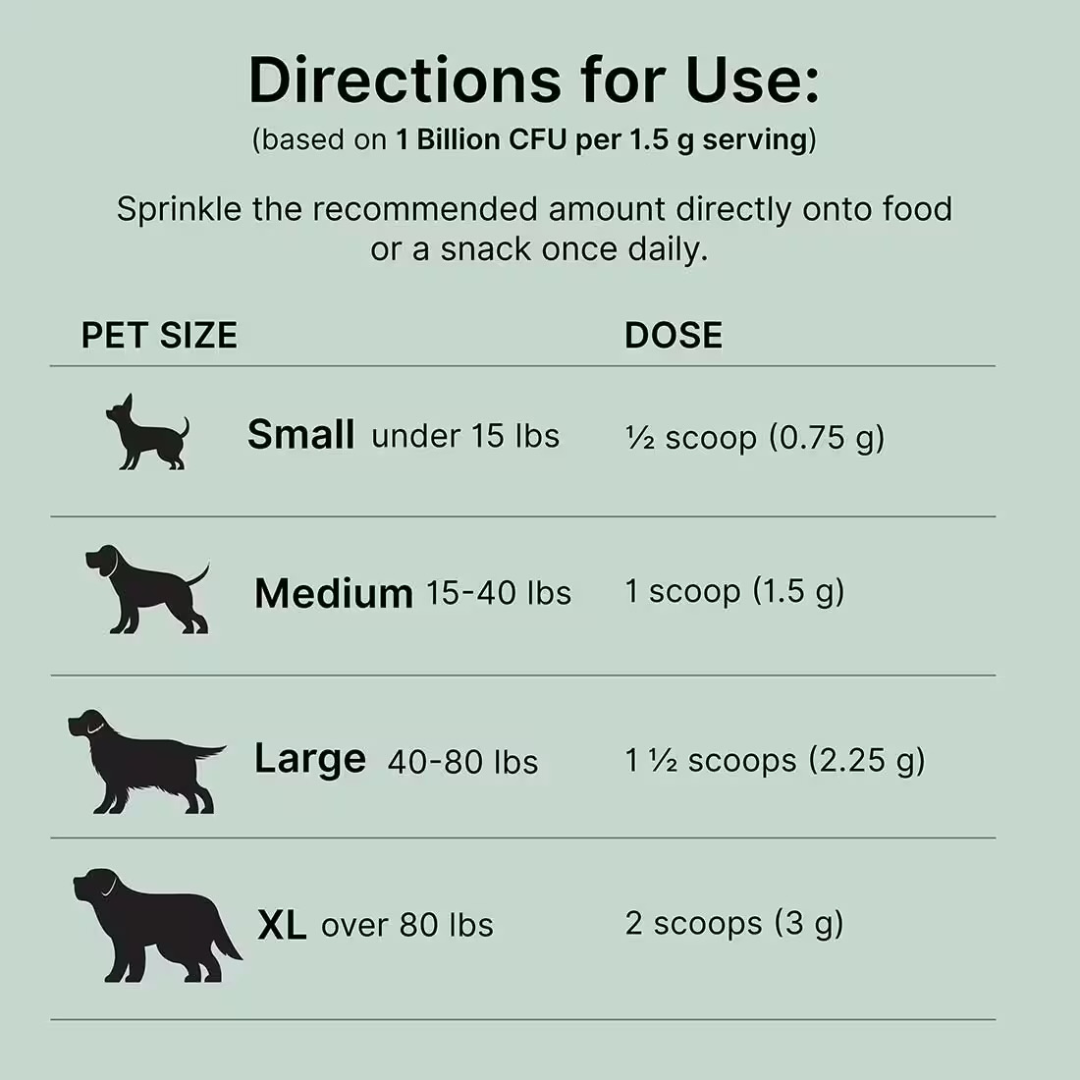
Each 1.5g scoop provides 1 billion total CFU across the four microbial blends, in an organic pumpkin powder carrier that doubles as natural prebiotic fiber. The body-weight dosing keeps the daily routine simple. ProActive Paws Primitive Probiotics dosing for medium dogs (15 to 40 lbs) is one full scoop per day. For sensitive stomachs, start with half the suggested dose for the first few days and gradually increase to the full body-weight dose over the first week to allow the gut microbiome to adjust without temporary GI upset.

Dog Size
Body Weight
Daily Use
Small
Under 15 lbs
1/2 scoop (0.75g) once daily
Medium
15 to 40 lbs
1 scoop (1.5g) once daily
Large
40 to 80 lbs
1.5 scoops (2.25g) once daily
Extra Large
Over 80 lbs
2 scoops (3g) once daily

How to give the powder. The standard method is to sprinkle the appropriate scoop directly onto your dog's regular meal and mix gently. The natural pumpkin flavor and orange color make the powder visibly distinct on top of the food, which most dogs accept readily. The powder mixes cleanly into wet food, raw food, fresh food, or kibble. For pre-meal delivery, mix the scoop into a tablespoon of bone broth and offer as a pre-meal treat.

Do not mix the powder into hot food or hot water. Heat damages the live probiotic bacteria and the yeast. Use room-temperature or cool food only.

Antibiotic timing. When your dog is on a course of oral antibiotics, separate the probiotic and the antibiotic by at least 4 hours to protect the beneficial bacteria. Standard pattern: antibiotic with morning meal, probiotic with evening meal. The Saccharomyces boulardii component is unaffected by most antibacterial antibiotics regardless of timing because it is a yeast, not a bacterium.

Gradual introduction for sensitive stomachs. Start with half the body-weight dose for the first three to seven days, then gradually increase to the full dose over the second week. This allows the gut microbiome to adjust to the new strains without producing temporary GI upset.

Storage. Store the bag in a cool, dry place away from direct sunlight. The probiotic strains are stable at room temperature in the original sealed packaging. In very hot or humid climates, refrigeration may help maintain freshness. Close the bag tightly after each use. Use the product within the printed expiration date for optimal CFU viability.

Works Well With

Primitive Probiotics is the gut microbiome layer. These products extend the gut wellness protocol.

The same-brand Dr. Karen Becker formulated phospholipid omega-3 from herring caviar oil, sardine, anchovy, and mackerel, with natural astaxanthin antioxidant protection. Where Primitive Probiotics provides the gut microbiome layer through species-specific strain colonization, Roe Mega provides the cellular membrane and anti-inflammatory layer that supports the gut barrier and the broader inflammatory regulation. The two products represent the layered Dr. Becker approach to canine wellness and stack cleanly without mechanism overlap.

The mineral-rich liquid that supports the natural integrity of the gut lining at the tight-junction level. Where Primitive Probiotics delivers the probiotic bacteria, yeast, and prebiotic fiber, ION Gut Support addresses the physical structure of the gut lining itself, supporting the tight junctions between cells that determine whether the gut barrier is intact. The two products work at different layers of the same gut wellness picture and stack cleanly without mechanism overlap.

The clinical-grade nine-enzyme digestive support powder that breaks down food at the upstream end of the digestive process before it reaches the gut microbiome the probiotic supports. Where Primitive Probiotics supports the beneficial bacteria in the gut, the ThorneVet digestive enzymes ensure that the food arriving in that gut has been properly broken down into the simpler molecules the body can absorb and the microbiome can productively ferment.

Questions And Answers

Everything you want to know before you buy.

What is the best dog probiotic with wolf-derived strains?

ProActive Paws Primitive Probiotics is the only commercially available pet probiotic with wolf-derived ancestral strains. The Canine Ancestral Blend contains Lactobacillus reuteri WF-1 and Lactobacillus brevis WF-1B, sourced from wild wolves. These wolf-derived Lactobacillus strains for dog gut health represent the rare ancestral microbial allies that co-evolved with the canine genome long before domestication. No other commercial pet probiotic on the market currently sources strains from wild wolves. The 50 million CFU dose is the smallest blend in the formula because the strains are rare and difficult to source, not because their contribution is small. The wolf-derived strains pair with the canine heritage strains (sourced from healthy domestic dogs), the soil-based spore-formers, and the established clinical strains to create the three-ecosystem probiotic that the brand was built around.

Are most dog probiotics actually made from human strains?

Yes, in many cases. Most commercial pet probiotics use bacterial strains originally isolated from healthy humans, then tested in the lab for their ability to survive stomach acid and colonize the gut. The gut they were optimized for is the human gut, not the canine gut. The two are meaningfully different at the metabolic, immune, thermal, and bile-environment level. The pet probiotic shelf has been built around this small secret that most listings will not address directly. Dr. Karen Becker's choice to source the Canine Heritage Blend from healthy domestic dogs (K9-1, K9-2, PCR7, PCLL01 strain designations) and the Canine Ancestral Blend from wild wolves (WF-1, WF-1B strain designations) represents the species-specific departure from the human-strain commodity approach.

What is a species-specific probiotic and why does it matter for dogs?

A species-specific probiotic uses bacterial strains that were isolated from the host species the supplement is intended for. A species-specific dog probiotic uses strains isolated from healthy dogs or wolves, rather than strains isolated from humans and adapted for dogs. The reason it matters is that the dog's GI tract runs hotter than the human's, processes more protein, produces different bile acids, and supports a different microbial community than the human gut does. Bacterial strains optimized for human biology often deliver fewer measurable benefits than the label suggests when given to dogs, because the strain was never optimized for the host species it is being marketed for. Primitive Probiotics is the species-specific answer with canine-specific K9 strains and wolf-derived WF strains as the foundation.

Does Dr. Karen Becker recommend a specific probiotic for dogs?

Yes. Dr. Karen Becker formulated Primitive Probiotics as her own specific probiotic recommendation for dogs. The formula reflects her functional medicine veterinary philosophy: choose strains based on species-specific relevance rather than commodity availability, address the multi-ecosystem diversity that modern microbiome research increasingly emphasizes, source the ingredients from clean and ethical origins, deliver the formula in a natural prebiotic carrier rather than a synthetic excipient base, and produce the supplement under human-grade ingredient standards. The ProActive Paws line is built around the Dr. Karen Becker functional medicine philosophy and Primitive Probiotics is her specific multi-ecosystem probiotic recommendation.

What is the difference between Primitive Probiotics and other probiotic powders?

Four meaningful differences. First, the species-specific strain selection. The K9-1, K9-2, PCR7, PCLL01 canine heritage strains and the WF-1, WF-1B wolf-derived ancestral strains are not used in commodity pet probiotics. Second, the three-ecosystem blend approach. Most pet probiotics use one or two strain types. Primitive Probiotics combines canine heritage, wolf ancestral, established clinical, and soil-based spore-formers in one scoop. Third, the organic pumpkin powder carrier as 92% of the scoop by weight, providing natural prebiotic fiber rather than synthetic excipient filler. Fourth, the Dr. Karen Becker functional medicine veterinarian formulation that backs the brand. The 1 billion CFU per scoop is intentionally lower than the 10 to 20 billion CFU advertised by some commodity products because strain quality and species-specificity matter more than the raw CFU count.

How do I support my dog's gut after antibiotics?

Probiotic for dogs after antibiotics is one of the strongest use cases for Primitive Probiotics. The Saccharomyces boulardii component is particularly meaningful because it is the only probiotic yeast (not a bacterium) with documented clinical evidence for canine acute diarrhea and antibiotic-associated diarrhea. As a yeast, S. boulardii is unaffected by most antibacterial antibiotics, which means it can colonize the gut during the antibiotic course while the bacterial strains in the blend wait for the antibiotic to clear. The standard protocol is to start the probiotic during the final week of the antibiotic course (with 4-hour timing separation from the antibiotic dose) and continue daily for at least four to six weeks after the antibiotic course ends to support the microbiome rebuild. Probiotic with Saccharomyces boulardii for dog antibiotic recovery is the documented research-backed approach.

Is Saccharomyces boulardii safe for dogs?

For most dogs, yes. Saccharomyces boulardii is the only probiotic yeast (not a bacterium) with documented clinical evidence for canine acute diarrhea and antibiotic-associated diarrhea. It is broadly well-tolerated and has decades of clinical use in veterinary medicine. The exception is dogs with confirmed Malassezia dermatitis, recurrent yeast ear infections, or severe yeast-related gut dysbiosis, who sometimes have reactions to S. boulardii. Reactions are typically self-limiting and dose-dependent. Households with yeast-sensitive dogs should consult their integrative veterinary team before introducing the supplement. Severely immunocompromised dogs (post-chemotherapy, post-organ transplant, advanced immunosuppressive protocols) should not use any probiotic including S. boulardii without veterinary supervision.

How many billion CFU does my dog actually need in a probiotic?

What matters more than the raw CFU number is the specific strain's ability to survive stomach acid, reach the gut alive, colonize the gut environment, and produce documented clinical effects. A 1 billion CFU dose of species-specific and ancestral strains can outperform a 20 billion CFU dose of unstudied multi-strain blends with human-derived strains. The CFU count conversation in the pet probiotic market has become a marketing arms race that has very little to do with the actual functional outcomes the household cares about. Dr. Becker's formulation philosophy prioritizes strain quality, species-specificity, and multi-ecosystem diversity over raw CFU numbers. Primitive Probiotics delivers 1 billion total CFU per scoop across four distinct microbial blends, which is the dosing the brand built around the strain selection rather than around the marketing optics.

What does the wolf strain in Primitive Probiotics do?

The Canine Ancestral Blend contains Lactobacillus reuteri WF-1 and Lactobacillus brevis WF-1B, sourced from wild wolves. The wolf strains do what no human-derived probiotic strain can do: they engage the evolutionary microbial relationships that the dog's gut still carries from its wolf ancestor. The dog's gut still carries the genetic blueprint of its wolf ancestor, and the bacterial strains that thrived in the ancestral wolf microbiome have biological relationships with the canine gut that modern human-derived strains cannot replicate. The wolf-derived strains support the kind of microbial diversity that domestication has eroded, providing the gut-microbiome diversity that single-strain or commodity multi-strain products cannot match.

How does the three-ecosystem probiotic approach work for dogs?

The three-ecosystem probiotic blend for canine gut microbiome works by combining three distinct microbial communities, each chosen for a specific evolutionary or clinical relationship to the canine body. The canine heritage strains (from healthy domestic dogs) provide the species-specific foundation that recognizes the modern canine gut environment. The wolf-derived ancestral strains engage the evolutionary microbial relationships that the dog's genome still carries from its wolf ancestor. The soil-based spore-forming bacteria provide the resilient strains that survive stomach acid and reach the gut in viable form. The yeast component (Saccharomyces boulardii) provides the documented clinical layer with antibiotic-recovery evidence. The combination addresses canine gut biology from multiple angles in ways that single-ecosystem products cannot match. Modern microbiome research increasingly emphasizes diversity over single-strain depth, and the three-ecosystem approach is the practical translation of that research insight into a pet probiotic formula.

Can I give this with my dog's antibiotics?

Yes, with timing. The manufacturer's guidance is to separate the probiotic and oral antibiotics by at least 4 hours, which is more conservative than the typical 2 to 3 hour separation common in other pet probiotic listings. The longer separation provides more reliable protection for the bacterial strains in the blend against the antibacterial action of the medication. The Saccharomyces boulardii component is unaffected by most antibacterial antibiotics regardless of timing because it is a yeast, not a bacterium. The standard pattern is to give the antibiotic with the morning meal and the probiotic with the evening meal, or to adjust based on the antibiotic's dosing schedule.

How long until I see results?

Many households notice improvements in stool quality, reduced gas, and digestive comfort within the first one to two weeks of consistent daily use. The Saccharomyces boulardii post-antibiotic support reaches full effect around weeks 2 to 4. The cumulative benefit of the three-ecosystem approach builds over months as the gut microbial diversity establishes. Some households report broader holistic benefits (skin, coat, behavioral balance) at the two-to-three month mark, reflecting the gut-skin and gut-brain axis pathways the probiotic supports. The fullest ecosystem maturity arrives over 6 to 12 months of consistent daily use.

Is this safe for puppies and senior dogs?

Senior dogs are one of the strongest use cases for this probiotic, especially senior dogs whose gut microbiome diversity has decreased with age. The body-weight dosing applies to senior dogs without modification. For puppies, loop in your veterinary team before starting any new supplement. Puppies under 12 weeks of age should have the gut microbiome assessed by the veterinary team before introducing a multi-ecosystem probiotic. Puppies over 12 weeks generally tolerate the formula at the body-weight-appropriate dose, though dogs at very young life stages benefit from gradual introduction (half dose for the first week, full dose thereafter).

Why this probiotic over the others on the market?

Three meaningful differences. First, the species-specific strain selection. The canine heritage strains (K9-1, K9-2, PCR7, PCLL01) and the wolf-derived ancestral strains (WF-1, WF-1B) represent a meaningful departure from the human-derived strains used in most commodity pet probiotics. Second, the three-ecosystem diversity. The combination of canine heritage, wolf-derived ancestral, soil-based, and established clinical strains addresses canine gut biology from multiple angles in ways that single-philosophy products cannot match. Third, the Dr. Karen Becker functional medicine formulation philosophy that backs the brand, with human-grade ingredient standards and the organic pumpkin powder carrier as natural prebiotic fiber rather than synthetic excipient base.

The Clean Formula Standard You Expect

1 Billion CFU per scoop 3-ecosystem multi-strain blend Wolf-derived ancestral strains Canine-specific K9 strains S. boulardii + L. rhamnosus GG Organic pumpkin powder carrier Dr. Karen Becker formulated Human-grade ingredient standards

A multi-ecosystem probiotic built around the species-specific biology of the canine gut.

Every dog deserves a probiotic that respects the species-specific biology of the canine gut rather than borrowing bacterial strains optimized for human biology. The three-ecosystem approach is the meaningful upgrade and most pet parents do not know to ask for it.

Canine Heritage Blend for species-specific foundational strains · Canine Ancestral Blend for wolf-derived signature strains · Non-Spore Forming Probiotics and Yeast Blend for established clinical evidence · Soil-Based Probiotics Blend for stomach-acid-resistant spore-formers · Organic Pumpkin Powder Carrier for natural prebiotic fiber

Post-antibiotic recovery. Chronic soft stools or excessive gas. Dogs on heartworm or flea medications. Senior dogs with declining gut diversity. Travel and boarding disruption. Whatever shape your dog's gut signals are taking, Primitive Probiotics addresses the underlying microbial community through the four-blend species-specific approach Dr. Karen Becker built around the actual biology of the canine gut.

Most pet probiotics borrow human strains. This one delivers strains nature designed for dogs.