

Connective Tissue Formula | Natural ACL and CCL Support
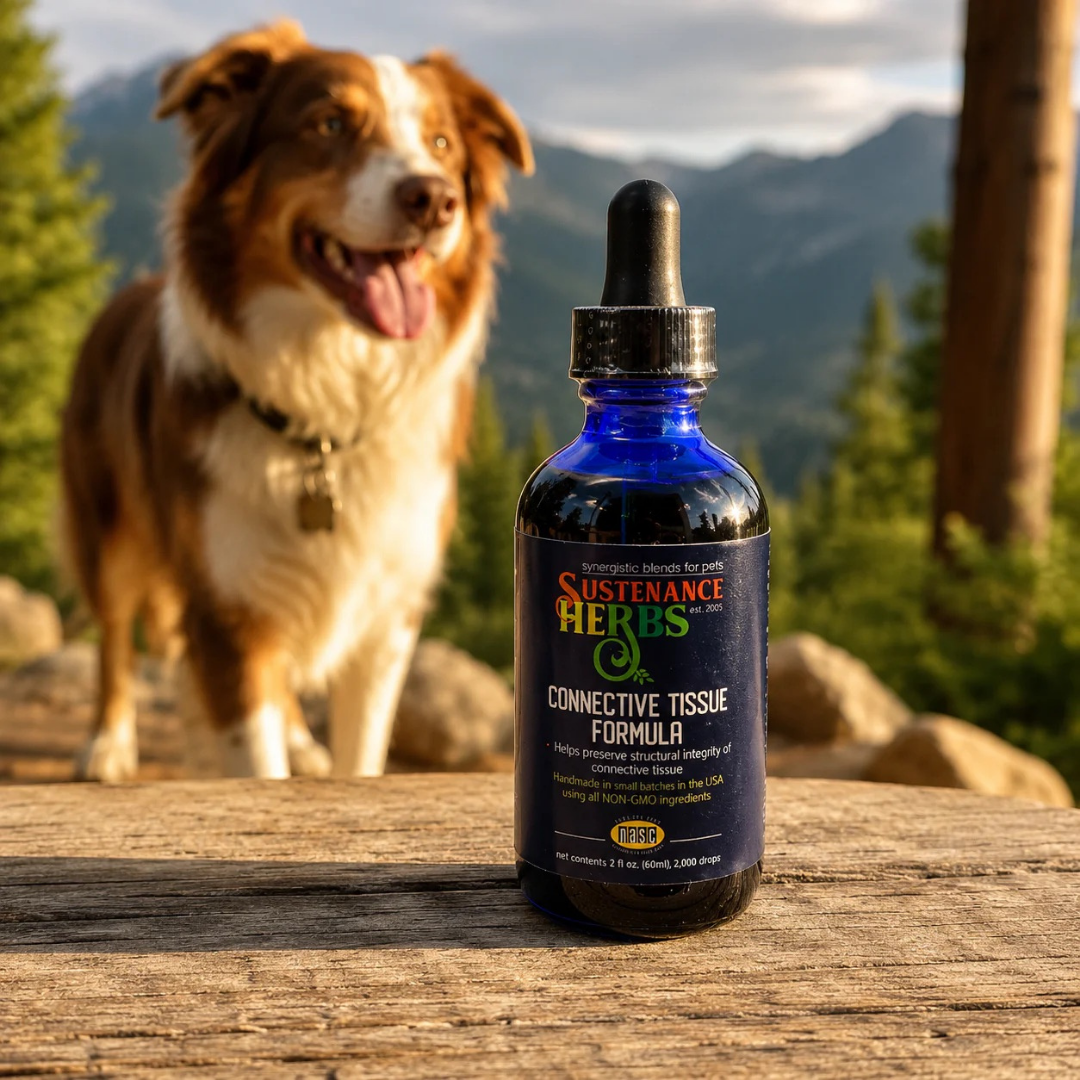
Sustenance Herbs · Connective Tissue Formula
Give the Ligament That Holds Your Dog Together Everything It Needs to Heal.
Six certified organic and wildcrafted ingredients built specifically for ligament repair, tendon healing, and connective tissue recovery. For dogs with ACL and CCL injuries, soft tissue damage, and the breeds prone to them.
The diagnosis that stops every dog owner in their tracks
You notice your dog holding one back leg up. Then comes the diagnosis: suspected CCL tear.
The cranial cruciate ligament, what vets call the CCL and most people know as the ACL, is the most commonly torn ligament in dogs. It is the small but critically important band of tissue inside the knee joint that stabilizes every step, preventing the tibia from sliding forward under the femur. When it tears, partially or completely, that stability is gone. The knee becomes painful and unstable. The cartilage absorbs forces it was never designed to handle. And without intervention, the joint degenerates progressively.
85%
of all orthopedic injuries in dogs involve the ACL or CCL
$3K to $6K
typical surgical cost, followed by months of restricted activity and rehabilitation
2x
elevated risk in the other leg after a CCL tear in one leg
For many dogs, surgery is the right answer. But what happens before the surgery, during recovery, and in the longer term afterward determines how well the joint heals, how quickly function returns, and whether the other leg holds up. And for dogs with partial tears, older dogs who are not surgical candidates, or dogs whose owners are exploring every natural option alongside conventional intervention, what you give the ligament to support its own healing matters enormously.
Why ligaments need different support
Ligaments are not cartilage. Joint supplements were not designed for them.
Cartilage damage and ligament damage are not the same biological problem, and they do not respond to the same botanical support. A ligament is made almost entirely of dense, organized collagen fibers arranged in a specific pattern that gives the tissue its tensile strength and elasticity. When that structure is torn, the body must lay down new collagen in the right organizational pattern to restore mechanical function. That process is slow, nutritionally demanding, and sensitive to the inflammatory environment around the injury.
Standard joint supplements
Glucosamine and chondroitin build cartilage. Ligaments have very little cartilage. The structures that need repair, dense collagen fibers, require completely different nutritional and botanical support.
Connective Tissue Formula
Comfrey stimulates new cell growth in fibrous tissue. Solomon's Seal nourishes and hydrates connective tissue. Boswellia protects fibrous tissue from the inflammatory compounds most damaging to it. None of these actions are provided by standard joint supplements.
The full formula
Six ingredients. Every job that connective tissue repair requires.
Comfrey to actively stimulate the new cell growth that ligament repair depends on. Solomon's Seal to nourish and hydrate the fibrous tissue doing the healing. Boswellia to protect it from the specific inflammatory mechanism most damaging to connective tissue. Eleuthero and Ashwagandha to support the muscle strength, hormonal balance, and stress resilience that determine how well recovery proceeds.
Cell proliferation · the herb traditionally known as knitbone
Used in European and Ayurvedic healing traditions for centuries specifically for soft tissue injuries, ligament damage, and tendon injuries. Its traditional name was knitbone. Its primary active compound, allantoin, stimulates cell proliferation, meaning it actively promotes the growth of new cells in damaged tissue. For a torn or damaged CCL, this cell-proliferative activity directly supports the formation of new collagen fibers at the tear site, helping the body rebuild structural integrity from within. Comfrey is one of the most specifically relevant herbs available for ligament and tendon healing. The Elixir form used here preserves the full spectrum of bioactive compounds in a concentrated, highly bioavailable liquid.
Holistic integration · supporting recovery at a systemic level
Flower essences are not essential oils and they are not herbal extracts. They are energetic preparations made from plant flowers, used in the tradition of Dr. Edward Bach, and they work through a mechanism that is distinct from biochemical botanical compounds. The Flower Essence of Comfrey is included for its traditional role in supporting the integration of physical trauma, helping the body process and recover from injury at a systemic level. Alongside the biochemical repair activity of the Comfrey Elixir, it works on healing from a complementary direction that integrative practitioners recognize as meaningful.
Connective tissue nourishment · hydration and whole-joint support
The most specific trophorestorative botanical available for fibrous connective tissue. For a torn or damaged CCL, Solomon's Seal nourishes and hydrates the connective tissue that is trying to repair itself. Injured ligaments are often dried out, poorly circulated, and nutritionally depleted at the injury site. Solomon's Seal addresses those conditions directly. It also supports the joint structures surrounding the injured ligament, including the meniscus, joint capsule, and surrounding tendons, all of which experience increased stress when the CCL tears. It benefits the whole joint environment simultaneously.
Anti-inflammatory · calibrating healing inflammation without suppressing it
When a ligament tears, the resulting inflammatory cascade is both necessary and potentially harmful. Initial inflammation recruits the healing cells that begin repair. But if that inflammation persists beyond its productive window, it actively degrades surrounding connective tissue structures, damages knee cartilage, and impairs the quality of new collagen being laid down. Boswellia's active compounds target the leukotriene pathway specifically, reducing the damaging excessive inflammation without shutting down productive healing activity. In synergy with Comfrey and Solomon's Seal: Comfrey rebuilds, Solomon's Seal nourishes, Boswellia protects what is being rebuilt.
Adaptogen · recovery and resilience for the whole body doing the healing
Recovering from a CCL injury is physically and emotionally exhausting for a dog. Restricted activity, pain, altered movement patterns. That chronic stress elevates cortisol, and elevated cortisol impairs tissue repair, reduces immune function, and slows the healing process. Eleuthero regulates the hormonal stress response and supports physical stamina and recovery, which becomes directly relevant during rehabilitation when carefully managed exercise is being reintroduced. Think of it as the ingredient that helps the rest of the formula work better by keeping the whole body in the most favorable state for repair.
Adaptogen · muscle strength and anti-inflammatory resilience
Ashwagandha's particular value in an injury recovery formula is twofold. First, it has documented anti-inflammatory and antioxidant properties that add another layer to Boswellia's inflammatory management, approaching inflammatory balance from a different molecular direction. Second, it supports muscle strength and physical recovery, which is critically relevant here: when a dog injures their CCL, the muscles supporting that knee atrophy rapidly due to reduced activity and pain-driven reluctance to bear weight. That muscle loss increases joint instability and slows recovery. Ashwagandha has specific documented effects on maintaining and rebuilding muscle mass during injury recovery.
What this formula does, simply put
Think of your dog's injured ligament as a frayed rope that needs to be repaired.
Every ingredient in this formula has a specific job in that repair. Every job is directly relevant to what a dog with a CCL or ACL injury needs. Nothing is here without a reason.
Comfrey Elixir provides the stimulus for the body to grow new rope fibers at the tear site, actively promoting the cellular proliferation that repair requires.
Solomon's Seal keeps the rope fibers hydrated, supple, and nourished, supporting the health of the tissue actively doing the repairing.
Boswellia manages the inflammatory environment around the repair site, keeping it calm enough that new fibers can form properly without being degraded by excessive inflammation.
Eleuthero and Ashwagandha support the whole body doing this repair work: managing the stress that injury produces, maintaining the hormonal balance that healing requires, and supporting the muscle strength that keeps the joint stable while the ligament recovers.
Is this right for your dog?
This formula is especially worth considering if your dog meets any of these.
A note on Comfrey and internal use
Comfrey is used responsibly, at therapeutic doses, with clear guidance.
Comfrey contains compounds called pyrrolizidine alkaloids, which in very high doses over extended periods have been associated with liver stress. This is why responsible sourcing and appropriate dosing matter, and it is the reason this formula carries a caution not to use it in dogs with liver disease.
At the doses specified in the weight-based dosing chart and when used as directed, Connective Tissue Formula is safe and well-tolerated by healthy adult dogs. Traditional herbal medicine has always used Comfrey at appropriate therapeutic doses, which is exactly how it is used here. If your dog has any history of liver disease or elevated liver enzymes, consult your veterinarian before use.
How to give it
Twice daily, directly into the mouth or mixed into food.
Administer orally using the included dropper, directly into the mouth or mixed into food. For active recovery periods following surgery or acute injury, maintaining consistent twice-daily dosing throughout the recovery phase provides the most meaningful benefit. 40 drops equals approximately 1.2ml or one-quarter teaspoon.
Important notes: Not for use in pregnant or lactating animals. Not for use in puppies. Connective tissue repair is a slow biological process. Consistent daily supplementation over weeks and months produces the most meaningful benefit. Discontinue and consult your veterinarian if condition worsens or does not improve. Always inform your veterinarian of any supplements your dog is taking alongside prescription medications.
Questions and answers
Everything you want to know before you buy.
What does Comfrey do for dog ligament injuries?
Comfrey has been used in traditional herbal medicine for centuries specifically for soft tissue injuries, ligament damage, tendon injuries, and bone repair, earning the traditional name knitbone. Its primary active compound, allantoin, stimulates cell proliferation, meaning it actively encourages the growth of new cells in damaged tissue. For a torn or strained ligament, this cell-proliferative activity directly supports the formation of new collagen fibers at the injury site, helping the body rebuild the structural integrity of the ligament from within. It is one of the most specifically relevant herbs available for ligament and tendon healing.
How is this different from a standard joint supplement?
Standard joint supplements are primarily designed to support cartilage through glucosamine and chondroitin. Ligaments and tendons are not cartilage. They are dense fibrous connective tissue made primarily of organized collagen fibers, requiring completely different nutritional and botanical support to repair. Comfrey stimulates new cell growth in fibrous tissue. Solomon's Seal nourishes and hydrates connective tissue structures. Boswellia specifically protects fibrous tissue from the inflammatory compounds most damaging to it. None of these actions are provided by standard joint supplements, which is why Connective Tissue Formula produces results in ligament and tendon injuries that joint supplements cannot replicate.
Can natural supplements help a dog with a partial CCL tear avoid surgery?
The honest answer depends on the severity of the tear, the dog's size, age, and activity level, and the specific presentation. Partial tears in smaller dogs sometimes stabilize with conservative management including rest, physical therapy, and supportive supplementation. In larger breeds, partial tears frequently progress to complete tears without surgical intervention. Natural supplementation supports the best possible healing environment and connective tissue health regardless of whether surgery is ultimately performed, but the decision about surgery should always be made with your veterinarian based on the individual dog's situation.
Can I give this formula during CCL surgery recovery?
Yes, and the post-surgical recovery period is one of the most important applications for this formula. Surgery repairs the mechanical instability of the joint, but the connective tissue healing, collagen remodeling, and tissue integration that follow surgery take months and benefit significantly from targeted nutritional support. Comfrey supports healing of the surgical site and surrounding tissue. Solomon's Seal nourishes the connective tissue structures supporting the joint during recovery. Boswellia helps manage post-surgical inflammatory balance. Ashwagandha supports muscle maintenance during restricted activity. Always inform your veterinarian of any supplements given during the post-surgical period.
What breeds are most prone to CCL tears in dogs?
Labrador Retrievers are statistically the most commonly affected breed, but Rottweilers, Golden Retrievers, German Shepherds, Newfoundlands, Mastiffs, American Staffordshire Terriers, and English Bulldogs all have elevated risk. Overweight dogs of any breed are at significantly higher risk because excess body weight increases the force on the cruciate ligament with every step. Neutered dogs also have elevated risk compared to intact dogs, a factor increasingly recognized in orthopedic research. For any high-risk breed, beginning Connective Tissue Formula as a preventive daily support before any injury occurs provides the most meaningful long-term protective benefit.
How long does it take for Connective Tissue Formula to work?
Connective tissue repair is one of the slowest biological processes in the body. Significant improvements in comfort and function typically become noticeable within four to eight weeks of consistent twice-daily use. The deeper structural benefits from collagen remodeling and tissue regeneration develop over three to six months of sustained supplementation. The most important factor is consistency. Missing doses interrupts the sustained botanical support that connective tissue repair depends on.
What do holistic vets recommend for dogs with ligament injuries?
Holistic and integrative veterinarians consistently recommend addressing ligament injuries through a combination of appropriate conventional care, including surgical evaluation when indicated, and natural support targeting the specific biological processes of connective tissue repair. Comfrey is consistently recognized as the most historically and biochemically relevant herb for soft tissue and ligament healing. Solomon's Seal is increasingly recommended for its connective tissue trophorestorative properties. Boswellia is recommended for its connective tissue-protective anti-inflammatory mechanism. Adaptogens are recommended for the physical and hormonal recovery support they provide. Connective Tissue Formula reflects exactly this integrative approach.
The clean formula standard you expect
This is the supplement we would give our own dog the day they received a disc diagnosis. Or ideally, the day before they ever needed one.
A CCL diagnosis is one of the most stressful things a dog owner faces. The cost of surgery. The months of restricted activity. The worry about the other leg. Most guidance focuses on the surgical decision, which is important, but leaves the question of what you can do nutritionally to support the healing process largely unanswered. Connective Tissue Formula answers that question.
Comfrey to stimulate new cell growth · Solomon's Seal to nourish and hydrate fibrous tissue · Boswellia to protect it from leukotriene inflammation · Eleuthero and Ashwagandha to support muscle strength, hormonal balance, and recovery resilience
Give the ligament that holds your dog together everything it needs to heal.