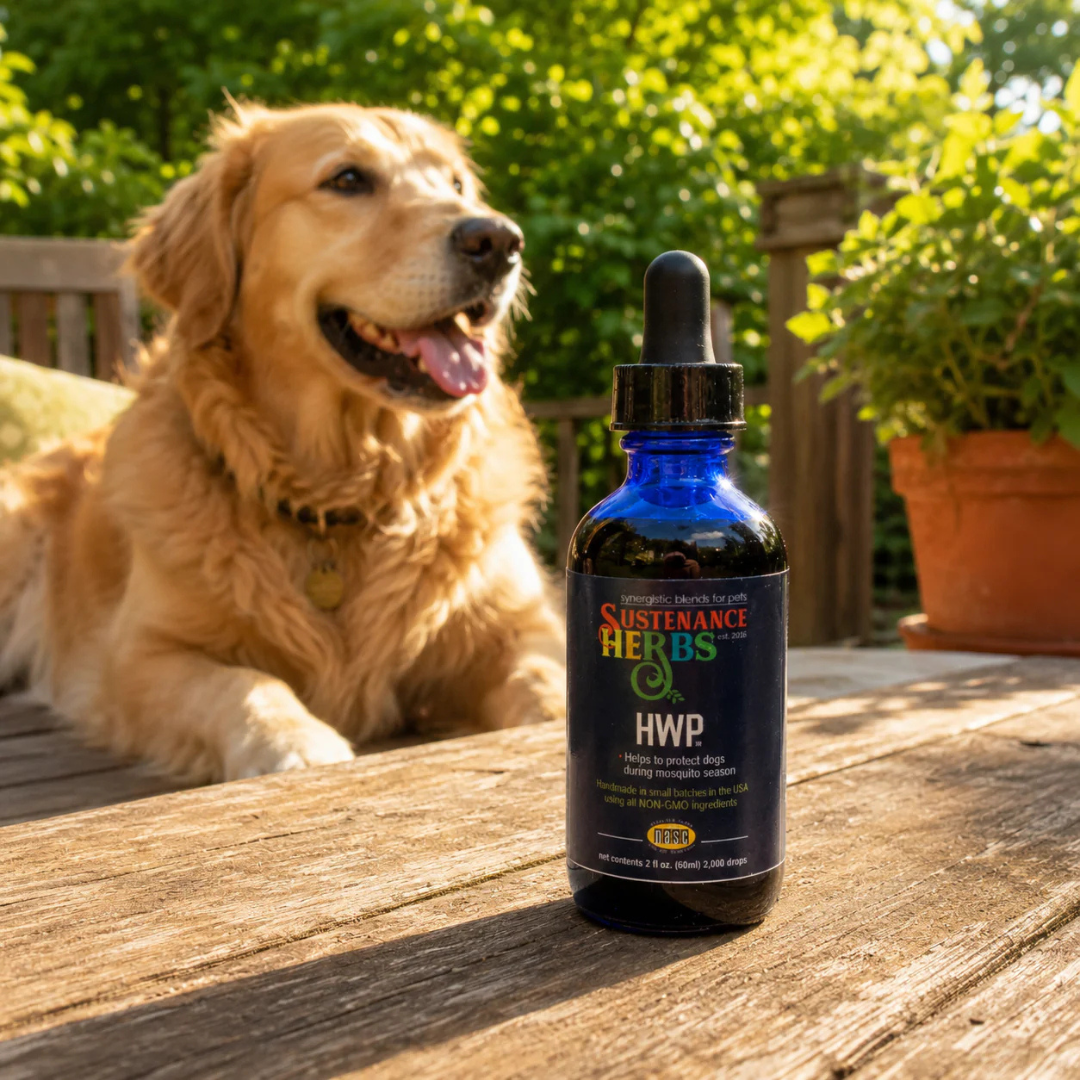


HWP Tincture | Seasonal Herbal Heartworm Support
Sustenance Herbs · HWP · Seasonal Herbal Support
Protect Your Dog From Heartworm, With Every Tool the Integrative Approach Makes Available.
Five certified organic and wildcrafted botanicals in a grain-free organic tincture. The seasonal herbal layer of a six-part integrative heartworm protocol designed around your dog's actual risk, not a one-size-fits-all annual recommendation.
What your vet may not be telling you
Here is the data on heartworm risk that changes everything about this conversation.
1.15%
of dogs in the US test positive for heartworm, according to the Companion Animal Parasite Council
10
of 50 states are considered high-risk, concentrated primarily in the Southeast
5 to 7
months for heartworm larvae to become detectable on a blood test after transmission
There is something else most pet parents are not told. Heartworm preventive medications are not preventives in the way that word implies. They do not stop a mosquito bite from occurring. They do not block larvae from entering the body. What they do is poison heartworm larvae at a specific developmental stage inside the body, killing them before they mature. They are chemical insecticides, and like all pharmaceutical interventions, they come with a risk-benefit equation that is worth understanding before deciding how and when to use them.
Dr. Karen Becker, one of the most respected integrative veterinarians in the country, has been making this point for years. Recommending the same year-round chemical insecticide protocol to every dog everywhere, regardless of geographic location or individual risk, is neither logical nor in the dog's best interest. The risk of chronic chemical exposure needs to be weighed against the actual risk of heartworm disease in your specific location.
This context is the foundation of everything that follows. Once you understand the real risk landscape, the integrative protocol that thoughtful holistic veterinarians recommend, and where HWP fits honestly within it, the picture becomes much clearer.
Honest first
What herbal supplements can and cannot do for heartworm.
Herbal supplements including HWP have not been clinically proven to prevent heartworm infection. Holistic Veterinarians’ note that antiparasitic herbs like wormwood and black walnut work in the gastrointestinal tract. Heartworm larvae, however, live in the bloodstream after a mosquito bite, not in the GI tract. Herbs that are effective against intestinal parasites are operating in a different biological territory than the one heartworm occupies after transmission.
HWP is not a replacement for appropriate heartworm prevention. In moderate to high-risk areas, some level of pharmaceutical prevention remains the only proven intervention for interrupting heartworm larval development. What HWP is, is a carefully formulated herbal component of a broader integrative protocol: one that supports immune function, provides antiparasitic botanical activity, offers natural deterrence, and helps the body function at its most resilient during the mosquito season window.
The integrative approach
How an integrative veterinarian actually thinks about heartworm prevention.
The integrative approach starts with one question that conventional prevention guidelines rarely ask: what is this individual dog's actual risk? That question is answered primarily by geography. A dog in coastal Mississippi faces a genuinely different risk than a dog in the Oregon mountains. The CAPC heartworm prevalence map allows pet parents to look up their specific county to assess actual local risk, and the difference can be substantial.
Use prevention seasonally
Most of the US has three to six months of meaningful mosquito season. Only a small number of areas along the Gulf Coast warrant year-round prevention. Using seasonal maps to determine the appropriate window reduces total pharmaceutical exposure without creating meaningful additional risk in most of the country.
Choose the simplest option
All-in-one products combining heartworm prevention with flea, tick, and intestinal parasite coverage multiply chemical burden without a proportionate increase in benefit for most dogs. Dr. Becker recommends the least amount of chemical that successfully addresses heartworm, ideally a single-compound preventive.
Consider a six-week interval
Because heartworm larvae take longer than four weeks to reach the stage pharmaceutical prevention targets, some integrative veterinarians work with compounded formulations at six-week intervals rather than monthly, reducing the total number of doses over a season while maintaining efficacy.
Support the liver after each dose
Dr. Becker specifically recommends following heartworm medication with liver supportive agents including milk thistle and SAMe for a week after treatment. ThorneVet Liver Support Formula and Detox Liver Cleanse are exactly the products designed for this application.
The full formula
Five botanicals. The traditional antiparasitic triad, plus immune and circulatory support.
Wormwood, Black Walnut Hull, and Clove form the traditional antiparasitic herbal triad used together because each addresses parasites at different life stages. Neem adds natural mosquito deterrence and antiparasitic immune support. Yarrow rounds out the formula with immune and cardiovascular support for a period of elevated exposure.
Traditional antiparasitic · adult parasite stage support
One of the most historically significant antiparasitic herbs in human and veterinary herbal medicine. Its active compounds have documented antiparasitic properties studied specifically for their effects on parasitic organisms. Certified organic because wormwood is a high pesticide-risk crop when conventionally grown. Must be used at weight-based doses, seasonally only. Not for use in dogs with preexisting liver disease, hypothyroidism, or hypoglycemia.
Traditional antiparasitic · larval stage support
Used in traditional herbal medicine for centuries for intestinal parasite support. Its primary active compound, juglone, has documented antimicrobial and antiparasitic properties. The Wormwood and Black Walnut Hull combination is one of the most recognized traditional antiparasitic herb pairings, formulated and dosed here specifically for dogs rather than adapted from a human formula. Responsibly wildcrafted from sustainably managed natural populations for consistent potency.
Natural deterrence · antiparasitic and immune modulation
Neem's most relevant properties in a mosquito season formula are its natural ability to make dogs less hospitable to mosquitoes as hosts, its broad-spectrum antimicrobial and antiparasitic activity, and its immune-modulating properties that support the body's own defenses during elevated exposure risk. Neem also has documented activity against microfilariae, the larval stage that circulates in the bloodstream after transmission, contributing botanical support during the developmental window where pharmaceutical prevention is also working.
Immune and circulatory · cardiovascular system support
The immune-modulating and circulatory support ingredient in this formula. While Wormwood, Black Walnut, and Neem address antiparasitic activity, Yarrow supports the body's systemic immune response and cardiovascular health, which is directly relevant when any parasitic pressure is present. Its anti-inflammatory properties, immune-activating effects, and traditional use for fever response make it a meaningful addition that broadens the formula's support beyond pure antiparasitic action.
Traditional antiparasitic · egg stage support
The third leg of the traditional antiparasitic triad. Wormwood addresses adult organisms, Black Walnut Hull the larval stage, and Clove the egg stage, making the three-herb combination more complete than any single herb alone. Clove's active compound eugenol also provides broad-spectrum antimicrobial activity throughout the formula. Certified organic because clove is a high pesticide-risk crop in conventional cultivation.
Why the triad works
Wormwood, Black Walnut Hull, and Clove have been used together in traditional herbal medicine because each targets parasites at a different life cycle stage. Using all three simultaneously creates broader coverage than any single herb can provide. This formula combines them in doses specifically calibrated for dogs, not adapted from a human formula, which makes the distinction between this product and generic human adaptations meaningful.
The complete integrative protocol
Six layers working together. HWP is Layer Five.
Understanding where HWP fits within a complete integrative protocol is more important than understanding any single ingredient. This is the framework Dr. Becker and integrative veterinarians use with their patients.
Know Your Real Risk
Use the CAPC heartworm prevalence map for your county to understand your dog's actual geographic risk. This is the most important first step and the one most conventional recommendations skip entirely. A dog in Bozeman, Montana and a dog in Baton Rouge, Louisiana do not have the same risk profile and should not be on identical protocols.
Risk-Appropriate Pharmaceutical Prevention, Seasonally
In moderate to high-risk areas, use a single-compound pharmaceutical preventive during the actual mosquito season window for your location, not necessarily year-round. Avoid combination products that add chemical burden beyond what heartworm prevention requires. Discuss compounded dosing and interval options with an integrative veterinarian if you want to minimize pharmaceutical exposure while maintaining efficacy.
Regular Testing, Every Six Months · This layer may be the most important of all.
Here is the biology that changes how you think about heartworm testing. After an infected mosquito bites your dog, the transmitted larvae take five to seven months to mature into adult heartworms detectable on a blood test. That means the annual heartworm test most veterinarians recommend creates a window where an infection acquired early in one mosquito season could be missed entirely until the following year, by which point the worms have had months to establish themselves in the heart and pulmonary arteries.
Dr. Becker recommends testing every six months in mosquito-endemic areas, and every three to four months for dogs on a natural protocol. Ask for the SNAP-4Dx or Accuplex panel, which simultaneously checks for Lyme disease, ehrlichiosis, and anaplasmosis alongside heartworm, giving you comprehensive vector-borne disease monitoring with a single test. Early identification is one of the most meaningful things you can do for a dog on any heartworm protocol.
Daily Immune Foundation
A dog whose immune system is genuinely well-supported handles every challenge more effectively. A fresh food diet rich in B vitamins and antiparasitic whole foods like small quantities of fresh garlic builds the immune resilience that is your dog's primary natural defense throughout the season.
Seasonal Herbal Support · This is where HWP fits.
Used three times weekly during mosquito season, HWP provides the botanical antiparasitic and immune support layer that integrative veterinarians include alongside pharmaceutical prevention in their protocols. It is not the foundation of the protocol. The foundation is honest risk assessment, appropriate pharmaceutical prevention, six-month testing, and a strong daily immune system. HWP supports and complements those layers from a botanical angle.
Liver Support Around Every Medication Dose
Following each heartworm medication dose with five to seven days of liver supportive supplementation is one of Dr. Becker's specific recommendations. Liver support supplements used after each pharmaceutical dose supports the organ responsible for processing the medication and reduces the cumulative hepatic burden of seasonal pharmaceutical use.
Why the base matters
The grain-free organic alcohol base is a meaningful distinction for dogs.
Many herbal tinctures use a grain-based alcohol that can trigger reactions in grain-sensitive dogs, which is a significant portion of this community. The grain-free organic alcohol base in HWP eliminates that concern while providing the most effective solvent for extracting and preserving the bioactive compounds in these herbs.
The alcohol content per dose at the recommended weight-based amounts is extremely small and not a concern for dogs at proper dosing levels. The grain-free base also produces a more potent and more stable tincture than water-based or glycerin-based extraction, which directly affects the quality of bioactive extraction from these herbs.
Is this right for your dog?
This supplement is especially worth having if your dog meets any of these.
Important cautions
Read these before you start.
This formula contains potent herbs requiring precise weight-based dosing and seasonal, not year-round, use. Sustenance Herbs discloses contraindications clearly because responsible herbal formulation demands it.
How to give it
Three times per week during mosquito season. Seasonal use only.
Administer orally using the dropper directly into the mouth or mixed into a small amount of food. Begin at the start of mosquito season in your area and continue through the end of the season. Do not use year-round. One drop is approximately 0.03 mL.
Questions and answers
Everything you want to know before you buy.
Do all dogs really need year-round heartworm prevention?
According to integrative veterinarian Dr. Karen Becker and the heartworm prevalence data from the Companion Animal Parasite Council, the answer for most dogs is no. Only about 1.15% of dogs in the US test positive for heartworm, and only ten states are considered high-risk. Only areas along the Gulf Coast in South Texas and South Florida may warrant true year-round prevention. The rest of the US has three to six months of meaningful mosquito season. The appropriate protocol depends on your specific geographic location and your dog's individual circumstances.
Can herbal supplements prevent heartworm in dogs?
No herbal supplement has been clinically proven to prevent heartworm infection. As Dr. Becker specifically notes, antiparasitic herbs like wormwood and black walnut work in the gastrointestinal tract. Heartworm larvae travel through the bloodstream after a mosquito bite, which is outside the territory these herbs can effectively reach. HWP is a seasonal herbal support supplement used alongside risk-appropriate pharmaceutical prevention, not a replacement for it.
Why does heartworm testing frequency matter so much?
The biology is the reason. After an infected mosquito bites your dog, the transmitted larvae take five to seven months to mature into adult heartworms detectable on a blood test. An annual test creates a window where an infection acquired early in mosquito season goes undetected for over a year, during which time adult worms are establishing themselves in the heart and pulmonary arteries. Testing every six months in mosquito-endemic areas ensures that if an infection occurs it is caught within the detectable window when it is most manageable. Testing every three to four months for dogs on a natural protocol is even more conservative. Early identification is one of the most important parts of any heartworm protocol.
What test should I ask for at my vet?
Ask for the SNAP-4Dx or Accuplex panel. Both check for heartworm alongside Lyme disease, ehrlichiosis, and anaplasmosis simultaneously. For dogs spending time outdoors where ticks are also present, this comprehensive testing approach means you are monitoring for the full spectrum of vector-borne diseases with a single test rather than running separate panels. It is one of the most practical and most valuable things you can do for an outdoor dog.
What is an integrative heartworm prevention protocol?
An integrative heartworm protocol starts by honestly assessing your dog's actual geographic risk using the CAPC heartworm prevalence map. It uses risk-appropriate pharmaceutical prevention seasonally rather than automatically year-round, with the simplest single-compound option at the lowest effective dose. It tests every six months using the SNAP-4Dx or Accuplex panel to catch any infection early given the five-to-seven-month detection window. It builds a strong daily immune foundation through diet and foundational supplements. It adds seasonal herbal support during mosquito season. And it protects the liver around each pharmaceutical dose with liver support supplements.
Can I use HWP if my dog is on conventional heartworm prevention?
Yes, and this is the intended use. HWP is specifically designed as a complement to conventional prevention, not a replacement. Using HWP during mosquito season alongside your dog's prescribed prevention adds the herbal support dimension that many integrative veterinarians include in their protocols. The one consideration: if your dog is on monthly heartworm prevention and has any indication of liver stress, discuss with your veterinarian before adding any supplement that includes wormwood, which places its own hepatic processing demand.
Is wormwood safe for dogs?
At appropriate weight-based doses for seasonal windows as specified in HWP's dosing chart, wormwood is well-tolerated by healthy adult dogs. The critical contraindications are preexisting liver disease, pregnancy or lactation, hypothyroidism, and hypoglycemia. Overdosing can cause gastrointestinal irritation. The dosing chart must be followed precisely. Wormwood should never be used year-round.
What do integrative vets recommend for heartworm prevention in dogs?
Integrative veterinarians consistently recommend starting with an honest assessment of actual geographic risk, using seasonal rather than automatic year-round pharmaceutical prevention where risk warrants it, choosing the simplest single-compound preventive option, testing every six months with a comprehensive panel like SNAP-4Dx, building a strong immune foundation through diet and supplementation, supporting the liver around each medication dose, and using seasonal herbal support as a complementary layer. HWP fits naturally within that framework as the seasonal botanical component.
The clean formula standard you expect
Know your risk. Build your protocol. Test frequently enough that the biology works in your favor.
The conversation around heartworm prevention deserves more nuance than it usually gets. The data on actual heartworm prevalence, the geographic concentration of real risk, the five-to-seven-month window between infection and detectability, and the pharmaceutical nature of conventional preventives are all facts that informed pet parents deserve to understand. That nuance does not mean dismissing the risk. It means responding to it intelligently, proportionately, with the least pharmaceutical burden necessary, and with testing frequent enough to catch anything early.
Wormwood, Black Walnut Hull, and Clove for the traditional antiparasitic triad · Neem for natural deterrence and larval stage support · Yarrow for immune and circulatory support
Give every layer the attention it deserves. That is what a genuinely integrative heartworm protocol looks like.