

IncontinX | Natural Organic Bladder Tone Support
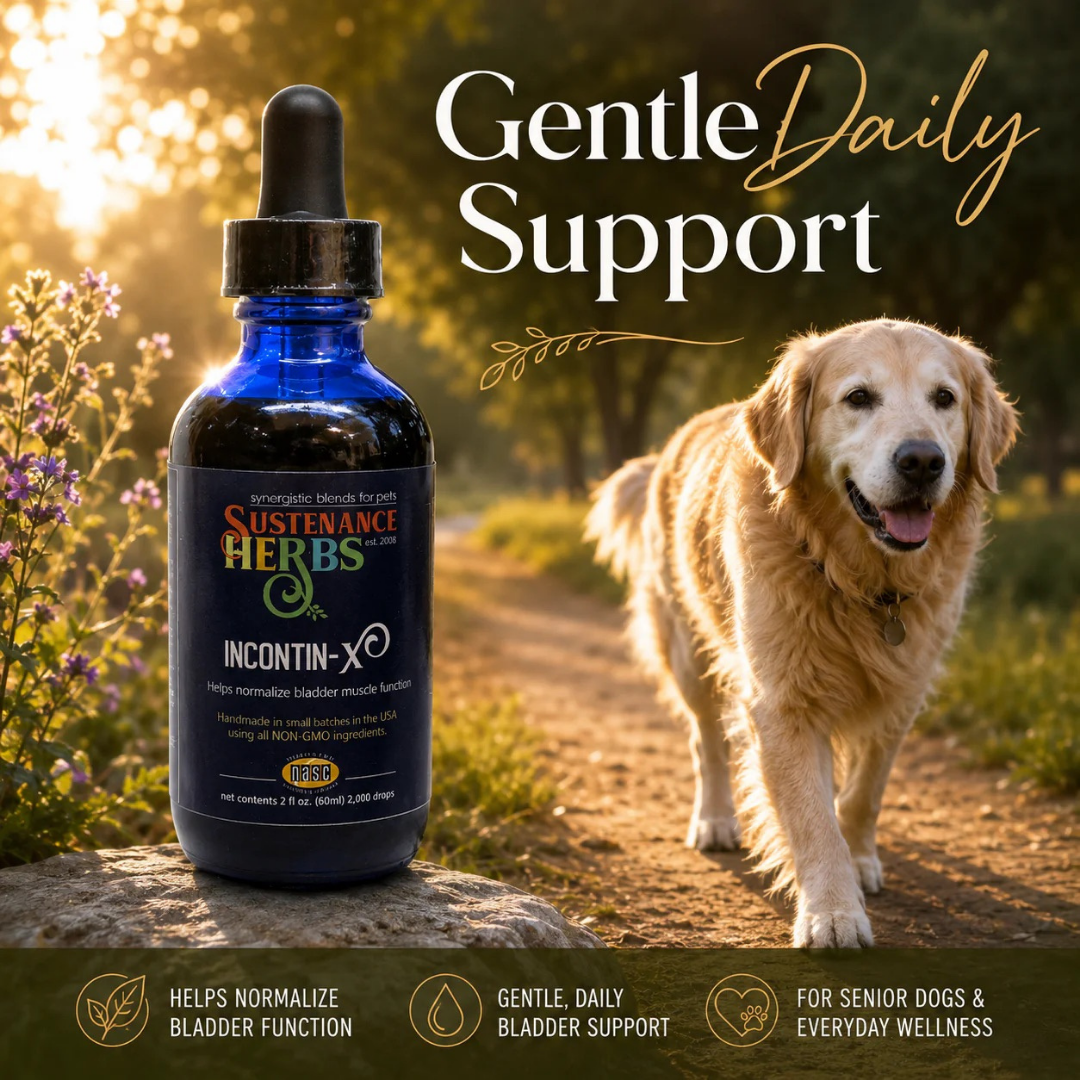
Sustenance Herbs · IncontinX Tincture
For the Wet Spot on the Bed and the Worried Look on Your Dog's Face. Eight Certified Organic Herbs for Natural Bladder Tone and Urinary Incontinence Support.
Mullein root for the specific bladder tone loss that most pet products completely miss. Saw palmetto for the hormone-responsive sphincter weakness most common in spayed females. Horsetail's silica for the connective tissue that holds everything together. St. John's Wort for the stress component that makes incontinence worse. Eight herbs covering every layer of why it happens.
Before reaching for any supplement: Urinary incontinence has multiple distinct causes — urinary tract infections, bladder stones, anatomical issues, Cushing's disease, diabetes, spinal problems, and hormone-responsive incontinence among them. The treatment is completely different for each. A UTI needs antibiotics. An ectopic ureter may need surgery. Missing a serious underlying condition while treating with supplements does not help the dog. Always get a veterinary diagnosis first. This formula is appropriate once the cause has been identified as hormone-responsive incontinence, bladder muscle tone weakness, or stress-related bedwetting.
What is actually happening — and why it is so common
The bladder is held closed by a ring of muscle called the urethral sphincter. When that muscle loses tone — from hormonal changes after spay, from age, from stress — urine leaks out, usually when the dog is relaxed and lying down.
You probably recognized the pattern before you knew its name. A damp patch on the dog bed. A wet circle in the sunroom. Morning puddles on the kitchen floor. Your dog looking worried each time you find it — sometimes hiding, sometimes watching you with that expression that says they did not mean to. This is one of the most common issues in middle-aged and senior dogs, particularly spayed females, and one of the least talked about.
The most common cause in spayed females is called hormone-responsive incontinence. When a female dog is spayed, her estrogen levels drop dramatically, and estrogen plays a role in maintaining the tone of the urethral sphincter. Over months or years, some spayed females develop weakening of this muscle as a consequence of that hormonal change. The result is involuntary leaking, especially during rest when the muscle is most relaxed.
The pharmaceutical option most commonly used for this is phenylpropanolamine (sold under the brand name Proin), which works by stimulating the urethral sphincter to contract more tightly. It works well for many dogs but has side effects (restlessness, appetite loss, blood pressure changes) and is not appropriate for every dog. Many pet parents want a natural option to try first, or alongside pharmaceutical treatment at a reduced dose.
IncontinX is the formula for that situation. Eight certified organic herbs addressing bladder muscle tone, connective tissue integrity in the urinary tract, the hormonal component of sphincter weakness, the irritation that makes urgency worse, and the stress layer that almost every physical bladder formula misses entirely.
Why urinary incontinence is not just a muscle problem
Three distinct layers all contribute to why urine leaks when it should not. Addressing only one — as most pharmaceutical and natural products do — leaves the others unaddressed.
Layer 1: Muscle and tissue tone
The urethral sphincter is a ring of muscle. When it loses tone — through hormonal changes after spay, through age, or through the gradual deterioration of the connective tissue that supports it — it cannot maintain a tight enough seal. Saw palmetto, mullein root, and nettle root each support bladder and urethral tone through different pathways. Horsetail provides the silica building blocks for the collagen and elastin that give these tissues their structural integrity.
Layer 2: Hormonal and adrenal
In spayed females, the drop in estrogen after surgery has removed one of the biological signals that maintains sphincter tone. Saw palmetto has mild hormone-modulating effects that partially address this layer. Schisandra supports adrenal function — the adrenal glands sit on top of the kidneys and influence the broader hormonal and stress-response picture that affects urinary control. These are the layers that purely mechanical bladder herbs cannot touch.
Layer 3: Stress and irritation
Many incontinence cases have a clear stress component — the dog who leaks during thunderstorms, whose nighttime accidents worsen when they are anxious, whose bedwetting eased when they finally felt safe. St. John's Wort addresses the mood-regulating neurotransmitters that modulate this stress-incontinence connection. Corn silk and goldenrod soothe the urinary tract mucous membranes, calming the irritation and urgency that make control harder to maintain.
The full formula
Eight certified organic herbs. Three from Western herbalism. Two from Traditional Chinese Medicine. Two in the nettle plant. One that most people only know for the wrong thing. Extracted in distilled water and organic grain alcohol.
No filler herbs. Every ingredient addresses something the others cannot.
The root, not the leaf — completely different medicinal herb from the same plant · the traditional Western herbal medicine for loss of bladder tone · almost no other pet incontinence product contains it
The specific bladder-tone herb — addresses the structural loss of tone that most incontinence formulas completely ignore
Most people who know mullein know it as the tall fuzzy-leafed plant used for respiratory health — coughs, congestion, lung support. Mullein LEAF is famous for this. Mullein ROOT is a completely different medicinal herb from the same plant, with completely different traditional uses. Western herbalists working with generations of practice in the classical tradition have documented mullein root specifically for what they call "the loss of tone in the bladder" — the kind of weakening of bladder muscle structure that contributes to incontinence in spayed females and senior dogs. The exact biochemical mechanism is not fully characterized in modern research, but the traditional use is consistent across decades and generations of professional herbalists working with both human and animal patients.
Mullein root is the ingredient that most distinguishes this formula from every other natural pet incontinence product on the market. Almost none of them include it. Its traditional action on bladder tone is specific to the type of weakness that causes most canine urinary leakage — the physical structural loss of tone, not just the muscular contraction problem that pharmaceutical PPA addresses.
Small palm-like tree native to the southeastern United States · berries used by Native Americans for centuries · known for prostate support but its mechanisms apply equally to female canine urinary health
The most direct natural support for hormone-responsive incontinence — the most common form in spayed female dogs
Saw palmetto is best known for prostate support in men, but its active compounds — fatty acids and plant sterols — support bladder muscle tone and urethral sphincter integrity through mechanisms that apply equally to female anatomy. For the spayed female dog whose incontinence is directly related to the hormonal changes after her spay, saw palmetto provides the most directly relevant natural action: mild hormone-modulating effects that partially address the estrogen-related component of sphincter weakness, alongside direct support for bladder and urethral muscle tone.
Safe and well-tolerated in both female and male dogs at appropriate doses. The hormone-modulating effects that make saw palmetto relevant for spayed female incontinence are appropriate for this use case, but should be considered if your dog has any other hormonal conditions or is intended for breeding.
The mood herb in a bladder formula — and here is why that makes complete sense
Addresses the stress component that makes incontinence worse — and that no purely physical bladder herb can touch
Traditional herbalists have used St. John's Wort for centuries specifically for bedwetting, and the connection to bladder function makes biological sense. Many incontinence cases have a stress and anxiety component layered on top of the physical issue. The dog who leaks during thunderstorms. The senior dog whose nighttime accidents worsen when the household is disrupted. The rescue dog whose incontinence eased once they felt safe. St. John's Wort addresses the mood-regulating neurotransmitters (serotonin, dopamine, norepinephrine) that influence this stress-incontinence connection — the grey cloud underneath the anxiety that makes the physical weakness harder to manage.
Drug interaction note: St. John's Wort affects the CYP3A4 liver enzyme system that processes many prescription medications. If your dog is on any prescription drugs — including Proin/PPA — discuss with your veterinarian before starting. Also not appropriate for dogs with hypothyroidism. See full cautions below.
Certified Organic Horsetail (Equisetum arvense)
The silica source — collagen and elastin for the connective tissue that holds the urinary system together
One of the oldest plant species on Earth, with fossil records going back over 300 million years. What makes horsetail unique medicinally is its extraordinarily high content of silica — the mineral that is essential for producing collagen and elastin, the two proteins that give connective tissue its strength and stretchiness. The urethra and its surrounding connective tissue depend on collagen and elastin integrity, and weakening of these structures contributes to incontinence in ways that muscle tone alone cannot address. Horsetail provides the raw structural building blocks the body needs to maintain healthy connective tissue throughout the urinary system. It also has mild natural diuretic action and traditional urinary tract support.
Certified Organic Nettle Root
The bladder root — not the leaf or the seed
The third part of the stinging nettle plant to appear in this catalog. The leaf is mineral-rich and nutritive. The seed supports glomerular kidney function. The root — a completely different medicinal herb — contains specific plant compounds called lectins and lignans that interact with hormonal pathways involved in urinary function and bladder muscle tone. In human herbal medicine, nettle root is used for prostate and urinary health. In dogs of any sex, it supports overall urinary tract function and bladder tone.
Certified Organic Corn Silk
Soothes the urinary tract from the inside
The silky threads that most people peel off and discard from an ear of corn are one of the gentlest and most respected herbs in traditional Western and Native American medicine for urinary tract support. Corn silk contains allantoin and maysin — compounds that soothe the mucous membranes lining the urinary tract, calming irritation and reducing the urgency that makes bladder control harder to maintain. It also acts as a gentle diuretic that supports normal bladder function, and has mild natural antimicrobial properties.
Certified Organic Schisandra (Wu Wei Zi)
Five-flavor adaptogen — astringent, adrenal-supporting
The berry of a flowering vine from East Asia, called Wu Wei Zi ("five-flavor fruit") in TCM because it is uniquely said to contain all five flavors recognized in traditional medicine. Schisandra is an adaptogen — it helps the body adapt to and recover from stress. For incontinence specifically, schisandra contributes through two channels: its astringent properties (which gently tighten tissues and have been used in TCM specifically for urinary incontinence and bedwetting), and its support of adrenal function, which affects the broader hormonal and stress-response picture that influences urinary control.
Certified Organic Goldenrod (Solidago virgaurea)
Traditional urinary anti-inflammatory and gentle diuretic
A tall wildflower used in traditional European and Native American herbalism specifically for urinary tract health. Note: goldenrod is often wrongly blamed for hay fever — that is ragweed, which blooms at the same time. They are different plants and goldenrod does not trigger allergic reactions. The flavonoids and saponins in goldenrod provide gentle natural anti-inflammatory action targeted to urinary tract tissues, traditional support for chronic urinary tract irritation, and gentle diuretic action that supports normal bladder and kidney function.
What this does in your dog's body
Every layer of why the leaking happens. A specific herb addressing it.
The urethral sphincter has lost structural tone — the muscle that holds the bladder closed is not holding as tightly as it should
Mullein root addresses the structural loss of bladder tone that most pet products completely miss. Saw palmetto supports urethral sphincter integrity and bladder muscle tone through a different pathway. Nettle root contributes additional urinary tract tone support through its unique hormonal pathway interactions.
The connective tissue around the urethra has weakened, losing the structural support that keeps the urinary system intact
Horsetail's silica provides the mineral building blocks the body needs to produce collagen and elastin in urinary tract connective tissue — the structural scaffolding that holds the urethra and surrounding tissues in proper position.
In spayed females, the post-spay drop in estrogen has removed one of the biological signals that maintained sphincter tone
Saw palmetto provides mild hormone-modulating effects that partially address the estrogen-related component. Schisandra supports adrenal function and contributes astringent tissue-tightening action through its TCM adaptogenic pathways.
Stress and anxiety are making the incontinence measurably worse — the leaking that tracks with thunderstorms, nighttime anxiety, or household disruption
St. John's Wort addresses the mood-regulating layer of incontinence — the stress-incontinence connection that traditional herbalists have treated with this herb for centuries and that physical bladder formulas alone cannot reach.
Urinary tract irritation is adding urgency to the control problem, making the leaking episodes more frequent
Corn silk soothes the mucous membranes lining the urinary tract, calming irritation. Goldenrod adds targeted anti-inflammatory action to urinary tract tissues. Reducing irritation reduces urgency, and reducing urgency makes control more achievable.
Cumulative result over four to eight weeks of consistent twice-daily use
Fewer leaking episodes, smaller wet spots, or both. Bladder muscle tone better supported through multiple complementary pathways. Connective tissue better nourished. The stress layer addressed. Many pet parents report meaningful reduction in incidents, with some achieving dry nights consistently after several weeks of use.
Cautions before starting
Is this right for your dog?
Worth trying once your veterinarian has identified the cause and confirmed it is appropriate.
How to give it
Twice daily. Four to eight weeks for meaningful evaluation. Do not restrict water intake — that makes incontinence worse, not better.
Important: always provide free access to fresh water. Restricting water concentrates urine, irritates the urinary tract, and worsens incontinence. The solution is better bladder control — not less urine production.
Mix the dose into food — wet food or strongly flavored food helps with the earthy bitter taste. Can also be given directly into the cheek pouch with the dropper to bypass taste entirely.
What to expect: 40 drops equals approximately 1.2 mL or about one-quarter teaspoon. Allow four to eight weeks of consistent twice-daily use before fully evaluating effectiveness. Bladder muscle tone, connective tissue health, and tissue restoration all require sustained support to produce meaningful change. Most pet parents notice initial improvements — fewer incidents, smaller wet spots, or both — within two to three weeks. For dogs starting alongside Proin/PPA, discuss with your veterinarian before adjusting any pharmaceutical dose.
Works well with
IncontinX addresses the bladder and urethral layers directly. These formulas support the stress, spine, urinary nutrition, and infection layers that often exist alongside.
Sustenance Herbs Pet Calming Formula
For dogs whose incontinence has a clear stress component, this acute calming elixir provides additional support during specific stressful situations (thunderstorms, vet visits, household disruptions) on top of the daily St. John's Wort layer in IncontinX. The two formulas address the stress-incontinence connection from different angles — ongoing baseline (IncontinX) and acute spike (Pet Calming Formula).
ThorneVet Kidney Support Formula Powder
Daily urinary and kidney system nutritional support that provides the vitamins, minerals, and renal-specific nutrients the broader urinary system needs. Where IncontinX is the targeted herbal support for bladder tone, Kidney Support Formula is the daily nutritional foundation for overall urinary health.
Sustenance Herbs Spinal Formula
For dogs whose incontinence has a neurological or spinal component — which sometimes occurs in older dogs with back issues, certain breeds prone to disc disease, or after spinal trauma — Spinal Formula provides connective tissue support for the spine that complements the bladder-specific work of IncontinX.
ThorneVet Probiotic Support Formula Powder
The urinary tract has its own community of beneficial bacteria that contribute to urinary health. Quality probiotic support is one of the most important long-term steps in maintaining urinary tract health and reducing the vulnerability to recurring urinary tract infections that can complicate incontinence management.
Questions and answers
Everything you want to know before you buy.
Why is my spayed female dog leaking urine?
The most common cause in spayed females is hormone-responsive incontinence — sometimes called urethral sphincter mechanism incompetence. After a female dog is spayed, her estrogen levels drop dramatically, and estrogen plays a role in maintaining the tone of the urethral sphincter (the ring of muscle that keeps the bladder closed). Over time, some spayed females develop weakening of this muscle as a consequence of that hormonal change. The result is involuntary leaking, especially during rest when the muscle is most relaxed. Other possible causes — urinary tract infections, bladder stones, Cushing's disease, diabetes, spinal issues — need to be ruled out by your veterinarian before treatment, because each requires a different approach.
What is mullein root and why is it different from mullein leaf?
Mullein leaf and mullein root come from the same plant but are completely different medicinal herbs. Mullein leaf is famous for respiratory support — coughs, congestion, lung health. Mullein ROOT is used in classical Western herbal medicine specifically for urinary incontinence and what traditional practitioners called "the loss of tone in the bladder." Most people only know the leaf. Most pet incontinence products only contain the leaf, if they include mullein at all. Mullein root is the ingredient in this formula that addresses the bladder-tone layer that almost no other pet product reaches — and it is one of the main reasons experienced herbalists who work with animals choose IncontinX over other natural incontinence formulas.
Can natural herbs replace Proin/PPA for my dog?
Proin works well for many dogs by stimulating the urethral sphincter to contract more tightly. The herbal approach works through multiple complementary mechanisms — tone, connective tissue integrity, hormonal modulation, stress layer, mucous membrane soothing. For some dogs, natural support is sufficient on its own. For others, the combination of natural support with reduced PPA dose works well. For others, PPA remains the appropriate primary treatment with natural support as an adjunct. This is a conversation to have with your veterinarian, ideally one familiar with integrative approaches who can help assess whether a gradual Proin reduction makes sense as natural support builds over several weeks.
Why is there a mood herb (St. John's Wort) in a bladder formula?
Traditional herbalists have used St. John's Wort specifically for bedwetting for centuries — in children and in animals — and the connection makes biological sense. Many incontinence cases have a measurable stress component. The dog who leaks during thunderstorms. The senior whose nighttime accidents worsen when the household is disrupted. The rescue dog whose incontinence eased once they felt safe. These are not coincidences. The nervous system and the urinary system are connected, and the stress-incontinence pathway is real. St. John's Wort addresses the mood-regulating neurotransmitters that modulate this connection — the layer that a purely physical bladder formula cannot reach.
Should I limit my dog's water to reduce the leaking?
No — this is one of the most important things to get right. Restricting water leads to dehydration and concentrated urine, which irritates the urinary tract, worsens incontinence, and increases the risk of urinary tract infections and kidney problems. Always provide free access to clean fresh water. The goal of incontinence support is better bladder control — not less urine production. More frequent walks and bathroom opportunities throughout the day help more than water restriction ever would.
What do holistic vets recommend for canine urinary incontinence?
Integrative veterinarians typically recommend a layered approach: proper diagnosis to identify the specific cause; addressing specific conditions that need targeted treatment; for hormone-responsive incontinence in spayed females, considering conventional options (Proin or estriol) and/or natural herbal options like IncontinX; addressing the stress component when present; supporting overall urinary system health with nutritional and probiotic support; and addressing contributing lifestyle factors (walking schedule, water access, environmental stress). IncontinX fits the natural herbal support layer of this approach — most effective as part of a complete integrative protocol.
How long until we see results?
Bladder muscle tone and connective tissue health take time to shift. Most pet parents notice initial improvements — fewer leaking episodes, smaller wet spots — within two to three weeks of consistent twice-daily use. Meaningful change — substantially fewer incidents or dry nights consistently — typically emerges between four and eight weeks. This is significantly slower than Proin (which produces effects within days) but the herbal approach addresses the underlying tissue health rather than just muscle stimulation, which often produces more lasting results as consistency continues.
The clean formula standard you expect
Your dog deserves to wake up in a dry bed. This is the natural organic support that addresses every layer of why that has stopped happening.
Eight herbs covering the physical, hormonal, connective tissue, and stress layers that together explain most canine urinary incontinence — in a formula that most pet supplement companies have not thought to build because it requires knowing about mullein root, understanding the stress-incontinence connection, and recognizing that different parts of the nettle plant do completely different things.
Mullein root for the bladder tone that most products miss entirely · Saw palmetto for the hormone-responsive sphincter weakness most common in spayed females · Horsetail's silica for the connective tissue that holds the urinary system together · St. John's Wort for the stress layer that makes every physical weakness worse · Schisandra tightening tissues and supporting the adrenal-urinary connection · Nettle root, corn silk, and goldenrod covering the supporting layers
Veterinary diagnosis first. Then this formula, consistently, for the weeks it takes to build meaningful change.