ThorneVet Digestive Enzymes | Natural Broad-Spectrum Enzyme Blend
Couldn't load pickup availability
ThorneVet
Digestive Enzyme Formula Powder for Dogs and Cats
Nine natural broad-spectrum enzymes covering carbohydrates, fats, proteins, plant fibers, and the legume sugars that cause gas. One scoop in the food, once a day.
Holistic Digestive Enzyme Support
Nine natural enzymes for the meals the body's own production has stopped quite keeping up with.
Picture the senior dog who walks away from his dinner with a low rumble of digestive complaint, or the middle-aged cat who leaves half her meal in the bowl. The food itself is good food. The body just is not breaking it down the way it used to. Stools have gotten bigger and softer. Gas has become part of the evening routine. Coat condition has slipped slightly. The natural enzyme production that turns food into nutrition has declined, and the meal is no longer landing where it needs to land at the rate it once did.
Digestive enzymes are the protein catalysts that cut food molecules into pieces small enough for the gut to absorb. The body produces its own enzymes, but production drops with age, with reduced pancreatic reserve, with chronic digestive stress, and with diets that lean heavier on plant matter than the body is naturally equipped to process. Modern grain-free kibbles often list peas, lentils, and chickpeas in the first ten ingredients, and cats and dogs do not produce alpha-galactosidase (the specific natural enzyme that breaks the sugars in those legumes apart) on their own. The result is gas, bloating, and food that ferments in the gut rather than feeding the body.
ThorneVet's Digestive Enzyme Formula Powder closes that gap with nine natural enzymes covering carbohydrates, fats, proteins, plant fibers, and the legume sugars that cause gas. The 300mg per scoop is enzyme content, not bulked-up powder. The brand sits on the Thorne Research science platform that produces human-grade supplements for medical professionals, and the veterinary version carries the NASC Quality Seal plus third-party testing transparency that label-reading households have come to expect.
What is not in the scoop: no GMOs, no artificial colors, no synthetic flavors, no fillers in the active blend, no proprietary commodity padding. The 300mg per scoop is natural enzyme content, calibrated by ThorneVet's veterinary advisors to deliver clinically meaningful activity at the daily dose.
One product, two species. Dosed by body weight for dogs and by a small fixed amount for cats. The senior cat, the small dog, and the large dog all get the same trusted holistic formula at the right amount for their body, which simplifies the daily routine in multi-pet households considerably.
Nine natural enzymes. The work that finishes the meal.
Why Broad-Spectrum Coverage Matters
The natural digestion of a meal is five different jobs running in parallel. Nine enzymes cover all five.
The natural breakdown of a meal is not one job. It is five jobs happening at once. Starches have to be cut into glucose units small enough to absorb. Fats have to be emulsified and broken into fatty acids and monoglycerides (the small fat molecules the small intestine can absorb). Proteins have to be dismantled into individual amino acids. The structural cell walls of vegetables, grains, and plant proteins have to be opened so the natural nutrients trapped inside become accessible. And the specific legume sugars in modern plant-forward kibbles have to be broken apart before they reach the colon, where they would otherwise ferment into gas.
Each one of these jobs requires a specific natural enzyme or enzyme family. Amylase and glucoamylase handle the starches. Lipase handles the fats. Protease and peptidase handle the proteins. Beta-glucanase, cellulase, and hemicellulase handle the plant cell walls. Alpha-galactosidase handles the legume sugars. When any one of these enzymes is missing or insufficient, that part of the meal is left undigested, and the body absorbs what it can while losing the rest, often producing the visible signals holistic households recognize: gas, soft stools, undigested food in the bowl, post-meal sluggishness.
Many commodity natural enzyme blends cover three or four enzymes and leave the rest of the work uncovered. ThorneVet's nine-enzyme formula is built around the natural recognition that a meal is a multi-component matrix, and broad-spectrum coverage is what makes the daily enzymatic work meaningful at the tissue level. The featured ingredient section directly below walks through what each enzyme does and why the combination is the right answer for a senior pet, a plant-forward diet household, or a pet with reduced pancreatic reserve.
The body's own enzyme production declines with age regardless of how excellent the diet is. The gap between what the body produces and what the meal asks for widens slowly, and the holistic answer is broad-spectrum support that closes the gap with the specific natural enzymes the modern plant-forward, age-affected, or pancreatic-reserve-limited pet needs most.
What This Formula Helps With
Six digestive stories this scoop was built to address.
Plant-Forward Diet Gas Relief
Alpha-galactosidase intercepts the legume sugars in peas, lentils, chickpeas, and soy before they reach the colon. The single most visible benefit for pets on modern grain-free kibble.
Senior Pet Natural Enzyme Support
The body's own enzyme production declines with age. A broad-spectrum daily scoop fills the gap so the meal in the bowl becomes the nutrition in the cell at the rate it once did.
Reduced Pancreatic Reserve
Supportive natural enzyme work for pets whose pancreas is producing fewer enzymes than the meal asks for. Not a substitute for prescription enzyme replacement therapy in confirmed EPI cases.
Better Nutrient Absorption
NSP enzymes break down the plant cell walls that lock minerals and vitamins inside vegetables and grains. The natural nutrition in the food becomes the nutrition the body can actually use.
Stool Quality and Volume
Lipase and protease support cleaner fat and protein breakdown, which means well-formed stools rather than the greasy, voluminous output that signals incomplete digestion.
Multi-Pet Households
One product, two species. Dosed by body weight for dogs, by a small fixed amount for cats. The senior cat and the senior dog get the same trusted holistic enzyme support.
What Is In The Scoop
Nine natural enzymes, grouped by the work they do.
Featured Enzyme
Alpha-Galactosidase
Alpha-galactosidase is the natural enzyme that breaks down alpha-galactoside sugars (a specific family of complex carbohydrates found in legumes such as peas, lentils, soybeans, and chickpeas, and in many vegetables that show up in modern pet diets). Cats and dogs do not produce alpha-galactosidase on their own. The undigested alpha-galactosides travel intact to the large intestine, where the resident bacteria ferment them into hydrogen, methane, and carbon dioxide. The result is the post-meal gas, bloating, and occasional discomfort that has become more common as pet diets have shifted toward plant-forward, legume-rich, and grain-free formulations.
Think of alpha-galactosidase as the specific tool that opens the lock on legume sugars before they reach the colon. The same enzyme is the active ingredient in the human anti-gas products that pet parents use after a heavy bean dinner. Clinical work in animals has demonstrated lessened flatulence and good tolerability, which means the work happens naturally without disrupting anything else in the digestion.
Why this matters. For pet parents whose dog or cat is on a modern plant-forward kibble, a grain-free formulation, or a homemade whole-food diet that includes vegetables, this enzyme alone is often the most immediately noticeable benefit of starting a daily holistic enzyme protocol.
Featured Enzyme
Lipase
Lipase is the natural enzyme that breaks fats and oils down into fatty acids and monoglycerides (the small fat molecules the small intestine can absorb). Without lipase, dietary fat passes through the gut largely intact, which produces greasy, voluminous, pale-colored stools and a steady loss of the fat-soluble vitamins A, D, E, and K the body needs.
Think of lipase as the emulsifier and the cutter combined. It works with the bile salts produced by the liver to break large fat droplets into small ones, then cuts the fat molecules themselves into pieces small enough for absorption. In veterinary medicine, lipase is one of the central enzymes in prescription pancreatic enzyme replacement therapy (the prescription treatment for diagnosed exocrine pancreatic insufficiency in dogs and cats). The natural lipase in this formula is sized as a supportive enzyme for pets with reduced pancreatic reserve, not as a replacement for prescription EPI treatment. For dogs and cats whose pancreas is still producing some natural lipase but not quite enough, this is the holistic difference between greasy stools and well-formed ones.
Why this matters. Pets with confirmed exocrine pancreatic insufficiency need prescription enzyme replacement therapy under veterinary supervision. This formula is supportive for the milder and far more common situation of reduced pancreatic reserve, where the pancreas is still working but not quite keeping up with the meal.
Amylase and Glucoamylase: The Starch Team
Amylase and glucoamylase are the two natural enzymes that work in sequence to break starches down into glucose. Amylase is the first cut, chopping long branching starch molecules into shorter fragments. Glucoamylase is the second cut, finishing the work and producing the single glucose units the small intestine can absorb. Think of them as the kitchen scissors that snip starches into pieces small enough to pass through the absorption window.
Dogs make a moderate amount of pancreatic amylase. Cats make less, since their wild ancestors evolved on protein-heavy diets that did not require much starch breakdown. Every kibble-fed pet benefits from natural enzyme support on the starch side, and cats in particular often run a deficit. Animal nutrition research shows that glucoamylase supplementation improves starch digestibility, and the two enzymes together also support animals working through a higher carbohydrate load than their natural biology is equipped to handle.
Beta-Glucanase, Cellulase, and Hemicellulase: The Plant Cell Wall Team
These three are the NSP enzymes (non-starch-polysaccharide enzymes, which break down the structural components of plant cell walls in vegetables, grains, and plant proteins). Plant cells are surrounded by tough, fibrous walls that the body's own digestive enzymes cannot cut through. Without natural NSP enzyme support, the nutrients inside those plant cells stay locked away and pass through the gut unused.
Think of cellulase, hemicellulase, and beta-glucanase as the scaffolding removers. With these three enzymes working in tandem, the plant cell walls come down, the nutrients become accessible, and the viscosity of the gut contents drops, which improves the flow of digestion and shifts fermentation in the large intestine toward short-chain fatty acids (the beneficial compounds produced when bacteria ferment fiber properly) rather than gas. Extensive animal nutrition research shows that NSP enzyme complexes improve feeding efficiency and produce measurable downstream benefits in stool quality, energy availability, and natural microbial balance.
Protease and Peptidase 4.5: The Protein Dismantlers
Protease and peptidase are the two natural enzymes that take protein apart in sequence. Protease makes the first cuts, breaking long protein chains into shorter peptide fragments. Peptidase finishes the work, snipping those fragments into individual amino acids that cross the intestinal wall and become the raw material for every muscle, hormone, enzyme, and tissue the body builds.
Without protease, the protein never becomes peptides. Without peptidase, the peptides never become amino acids. Modern animal nutrition research, including studies in dogs with EPI, has shown that protease supplementation improves macronutrient digestibility and overall clinical outcomes. The peptidase 4.5 designation refers to the optimal pH range at which this particular peptidase functions, which makes it active throughout the small intestine where the bulk of amino acid absorption naturally happens.
What This Looks Like Inside Your Pet's Body
Nine complementary enzymes, working across several hours of normal digestion.
Picture your eleven-year-old Golden Retriever finishing his dinner and walking away from the bowl with the familiar low rumble of digestive complaint. He is on a modern plant-forward kibble that lists peas, lentils, and chickpeas in the first ten ingredients. His stools have been bigger and softer than they were two years ago. He passes gas during the evening news. The food is good food. His body just is not breaking it down as efficiently as it used to, because his pancreas is producing fewer enzymes and his diet contains carbohydrate sources his ancestral biology was not built to disassemble at scale.
Once you start sprinkling a daily holistic scoop of broad-spectrum natural enzymes over his meal, the response unfolds across the next few hours of normal digestion. Here is what tends to happen at the tissue level when nine complementary enzymes are working alongside the pancreas.
Alpha-galactosidase intercepts the legume sugars in the small intestine
The alpha-galactosides break down before they reach the colon, where they would otherwise ferment into gas and post-meal discomfort.
Amylase and glucoamylase chop the dietary starches into glucose
Glucose units are absorbed in the upper small intestine, which means less starch makes it to the large intestine where unfermented carbohydrates can disturb the natural microbial balance.
The NSP enzymes break down the plant cell walls
Natural minerals, vitamins, and phytonutrients that would otherwise stay locked inside the fiber matrix in vegetables, grains, and legumes are released for absorption.
Lipase emulsifies and breaks down the fats in the meal
Well-formed stools emerge rather than the greasy, voluminous output that signals poor fat digestion in pets with reduced pancreatic reserve.
Protease and peptidase complete the protein breakdown
More usable amino acids reach the bloodstream, which supports natural muscle maintenance, immune function, and tissue repair in senior pets who are statistically losing lean mass.
Gut viscosity drops
The contents of the intestine move at a more natural pace, neither too fast (which produces loose stool) nor too slow (which produces fermentation and gas).
Short-chain fatty acid production in the colon shifts toward the beneficial pattern
More natural fuel reaches the cells lining the lower gut, supporting a healthy fermentation environment and steadier downstream digestion meal after meal.
The Quality Standard
NASC Quality Seal, third-party tested for enzyme potency, veterinarian-channel clinical use, no GMOs, no fillers in the active blend.
NASC Quality Seal
Audited compliance with the National Animal Supplement Council's labeling, manufacturing, and ingredient quality protocols.
Third-Party Tested for Enzyme Potency
Enzyme products are uniquely vulnerable to potency loss between manufacture and use. ThorneVet verifies that active enzyme levels remain within specification through shelf life.
Veterinarian Channel Brand
Used in veterinary practices across the country, with a clinical reputation built on the Thorne Research science platform that produces human-grade supplements for medical professionals.
No GMOs or Artificial Colors
The natural minimalism of the formula keeps the active enzyme work uncluttered by ingredients the body does not need to process alongside the meal.
No Fillers in the Active Blend
The 300mg per scoop is enzyme content, not bulked-up powder. The practical difference between a holistic enzyme product and a commodity gas-relief filler product.
One Product, Two Species
Dosed by body weight for dogs and by a small fixed amount for cats. Multi-pet households can run one trusted formula rather than juggling species-specific bottles.
The Verifiable Signal
Third-party tested for enzyme potency through shelf life, on the Thorne Research science platform.
Enzyme supplements are uniquely vulnerable to potency loss between manufacture and use, which is why most commodity enzyme blends quietly underdeliver. ThorneVet verifies that the active enzyme levels remain within specification through the full shelf life of the container, which is the difference between a product that does the work on day 1 and a product that still does the work on day 120. The veterinary line sits on top of the Thorne Research science platform, the same platform that produces human-grade supplements for medical professionals and that has been the reference standard in clinical nutrition for over four decades. This is the rare pet supplement where the manufacturing pedigree is also the buying decision.
Honest Disclosures
What you should know before starting this supplement.
This is not a substitute for prescription EPI treatment.
Pets with confirmed exocrine pancreatic insufficiency (a diagnosed veterinary condition where the pancreas does not produce enough digestive enzymes) need prescription pancreatic enzyme replacement therapy under veterinary supervision. This natural broad-spectrum enzyme formula is supportive for pets with reduced pancreatic reserve, which is a milder and far more common situation. Some EPI households use this formula as a complementary natural supplement alongside the prescription protocol, but that decision should be made with the veterinary team rather than as a substitution.
Check the timing if your pet is on prescription medication taken with food.
Most medication interactions with digestive enzymes are minimal, but the absorption timing of certain drugs can be affected by enzyme activity. Pets currently on prescription medications, particularly any medication taken alongside meals, should have the timing checked with the veterinary team before adding the daily enzyme scoop to the meal routine.
Pregnant, nursing, and breeding animals should be evaluated first.
Safe use in pregnant animals or animals intended for breeding has not been proven. If the pet's condition worsens or does not improve, stop product administration and consult the veterinarian. As with any new supplement, watch for digestive changes during the first week and start at a small fraction of the target amount before working up to the full dose.
Is This Right For Your Pet
The pet profiles this scoop was built around.
Strongest Match
Senior pet households where digestion has visibly slowed in the last year or two.
Your senior dog or senior cat is producing fewer natural enzymes than they used to. Stools have gotten bigger and softer. Gas has become part of the evening routine. Coat condition or weight maintenance has slipped slightly. The food in the bowl is the same food, but the body is not getting the same nutrition out of it. This is the broadest, most common reason holistic households add broad-spectrum enzyme support, and the response to the daily scoop is usually visible within the first month.
Strongest Match
Plant-forward, grain-free, or legume-rich kibble households.
Peas, lentils, chickpeas, or soy appear in the first ten ingredients of your pet's kibble, and post-meal gas or bloating has become a daily reality. Cats and dogs do not produce alpha-galactosidase on their own, which means the legume sugars in modern grain-free formulations travel intact to the colon and ferment into gas. Alpha-galactosidase is the single most visibly effective enzyme for this household, and the daily scoop usually delivers a noticeable change in the first week.
Pets with reduced pancreatic reserve. Your veterinarian has noted that pancreatic function is marginal but has not made a confirmed EPI diagnosis. The natural lipase, protease, and amylase in this formula are the supportive enzyme work for that specific situation.
Raw and gently cooked feeding households. The natural enzymes already present in raw food cover most of the work, but a daily scoop of broad-spectrum support smooths transitions between protein sources and supports senior pets whose natural production has declined regardless of diet.
Cats on kibble. Cats produce less natural amylase than dogs, since their wild ancestors evolved on protein-heavy diets that did not require much starch breakdown. Every kibble-fed cat is working harder on the carbohydrate side of her meals than her natural biology was designed for, and broad-spectrum enzyme support often closes that gap visibly.
Pets with chronic post-meal gas or bloating. Incomplete enzymatic breakdown of fats, proteins, starches, or the legume sugars in modern kibbles is the most common upstream cause of these symptoms, and broad-spectrum natural enzyme support targets the gap directly.
Pets recovering from antibiotics or a digestive flare. Natural enzyme production is temporarily disrupted while the gut works back to baseline. Daily enzyme support gives the meal a head start while the body recovers its own production.
Pets with visible undigested food in the stool. This is the most concrete signal that enzyme support could close a meaningful gap. Food that comes out looking like food that went in is food the body did not break down.
How To Give It
Daily use guidance for cats and dogs.
The enzyme powder is designed to be mixed directly into the meal, where it activates on contact with the moisture in the food. The natural enzymatic work begins as soon as the powder meets the food, which is why the powder is dosed alongside the meal rather than separately.
Daily dosing by body weight.
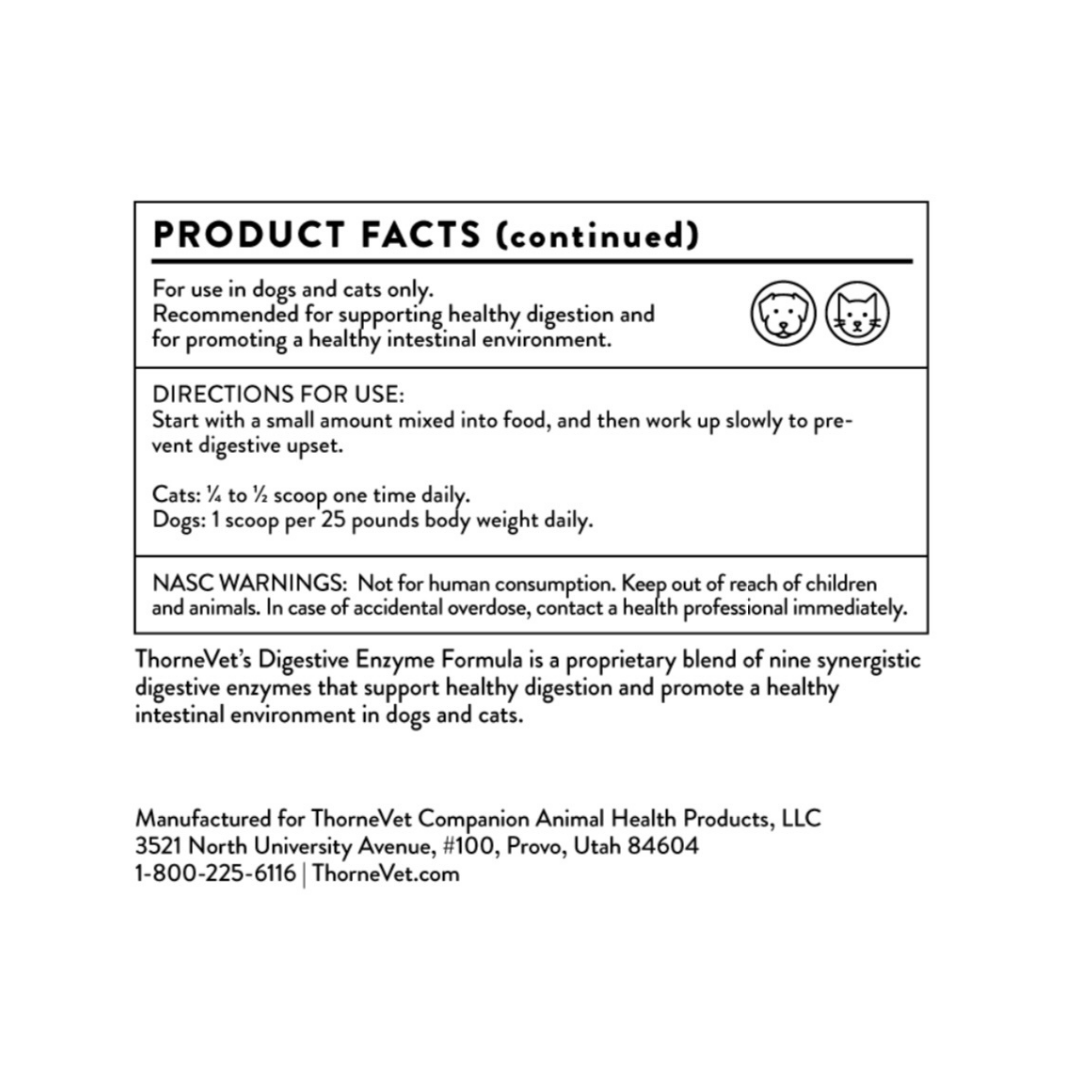
The manufacturer's official guidance is 1 scoop per 25 pounds of body weight daily for dogs and ¼ to ½ scoop once daily for cats. A 120-scoop container is roughly a 60-day supply for a 50-pound dog at 2 scoops per day, or roughly 240 days for a cat at ½ scoop per day. Start at a quarter of the target amount and work up over a week or two to give the natural digestion time to adjust.
What to expect, week by week.
For wet or canned food. Sprinkle the scoop directly over the food and stir to distribute evenly. The powder integrates naturally and most pets do not notice it.
For dry kibble. Add a small amount of warm water, bone broth, or goat's milk to the kibble first to provide moisture, then sprinkle the enzyme powder over the top and stir. Dry powder on dry kibble tends to settle at the bottom of the bowl, which means part of the dose goes uneaten.
For raw or gently cooked diets. The enzyme powder complements the natural enzymes already present in the food. Sprinkle directly over the meal and stir.
Storage. Store the container in a cool, dry place with the lid closed tightly. Enzymes are sensitive to heat and moisture, and proper storage preserves the natural enzymatic potency through the printed shelf life. Avoid storing the container near the stove, in a sunny window, or in a damp pantry.
Subscribe and save. ThorneVet offers 10% off with delivery cadences of every 1, 2, 3, or 4 months. A small-dog household at ½ scoop per day will use a container roughly every 8 months. A large-dog household at 3 scoops per day will use one roughly every 6 weeks. Synchronizing the enzyme delivery with the rest of the holistic supplement routine simplifies the monthly schedule considerably.
Works Well With
Three holistic companions that complement the daily enzyme work.
ThorneVet Probiotic Support Formula
The natural same-brand companion that broadens the holistic digestive support routine. ThorneVet's probiotic combines soil-based organisms, yeast-fighting Saccharomyces boulardii (a beneficial yeast that helps maintain natural microbial balance), and gut-repairing L-glutamine (the amino acid the intestinal lining uses as fuel). The two products work through different mechanisms without overlap, which is why ThorneVet positions them as a clean daily pair for senior pets and households building a layered holistic protocol.
ION Gut Support for Pets
A mineral-rich liquid that supports the natural integrity of the gut lining at the tight-junction level (the protein structures that seal the cells of the intestinal wall together and control what crosses the barrier). Multi-species accessible, easy to add to the same meal as the enzyme powder, and a clean holistic companion for households running multiple digestive supports in the daily routine.
Shepherd Boy Farms Freeze-Dried Raw Goat's Milk
Raw goat's milk carries naturally occurring digestive enzymes, beneficial bacteria, and bioavailable minerals that complement the broad-spectrum enzyme work. Households that add a small amount of rehydrated raw goat's milk to a meal alongside the ThorneVet enzyme powder are layering two different forms of natural digestive aid, one whole-food and one isolated enzyme. Particularly useful for raw and gently cooked feeding households where the natural enzyme story is already part of the bowl.
Frequently Asked Questions
The questions holistic households ask before buying.
Does my dog or cat need digestive enzymes if they are on a high-quality kibble or raw diet?
It depends on age, diet composition, and natural enzyme reserve. Younger pets on simple, well-tolerated diets often produce enough natural enzymes on their own. Senior pets, pets on plant-forward or legume-heavy diets, pets with reduced pancreatic reserve, and pets showing signs of incomplete digestion (visible undigested food in stool, chronic gas, greasy stools, larger-than-normal stool volume) tend to benefit most from holistic enzyme support. Raw-feeding households sometimes find that the natural enzymes already in raw food cover most of the work, but adding broad-spectrum enzymes is still useful during protein transitions or for older pets whose natural production has declined.
Can I give this to both my cat and my dog from the same container?
Yes. One container covers both species. Cats and very small dogs get ¼ to ½ scoop daily. Larger dogs are dosed at 1 scoop per 25 pounds of body weight. The same nine-enzyme proprietary blend is appropriate for both species, and the only difference is the scoop amount, which is calibrated to body weight. Multi-pet households can run one trusted formula rather than juggling species-specific bottles, and the daily routine is simpler for it.
My dog has EPI. Can I use this instead of his prescription pancreatic enzymes?
No. Exocrine pancreatic insufficiency is a serious veterinary diagnosis that requires prescription pancreatic enzyme replacement therapy, dosed and monitored under veterinary supervision. This natural broad-spectrum enzyme formula is supportive for pets with reduced pancreatic reserve, which is a different and milder situation than diagnosed EPI. Some EPI households use this formula as a complementary natural supplement alongside the prescription protocol, but that decision should be made with the veterinary team rather than as a substitution.
What does alpha-galactosidase do that the other enzymes do not?
Alpha-galactosidase is the only enzyme in the formula that breaks down alpha-galactoside sugars, the specific family of complex carbohydrates found in peas, lentils, chickpeas, soybeans, and many vegetables that show up in modern pet diets. Cats and dogs do not produce alpha-galactosidase on their own, which means without supplementation those legume sugars travel intact to the large intestine and ferment into gas. The other eight enzymes in the formula handle starches, fats, proteins, and plant cell walls, but none of them can break down the alpha-galactosides. For pets on plant-forward, grain-free, or legume-rich kibbles, this single enzyme is often the most immediately visible reason to start the daily scoop.
Why is the enzyme blend listed as a proprietary blend with one total weight rather than individual amounts?
Enzymes are typically measured by their activity units (FCC, HUT, GalU, DU, and similar designations) rather than by milligram weight, because the functional question is how much enzymatic work the dose can do, not how much physical material is present. A 50mg dose of a highly active enzyme can do more work than a 500mg dose of a less active enzyme. The 300mg total weight on this proprietary blend represents the physical material in the scoop. The functional enzyme activity is verified through third-party testing and the formulation is calibrated by ThorneVet's veterinary advisors to deliver clinically meaningful activity. Pet parents who want more granular activity-unit disclosure can request the technical specifications from the manufacturer.
Will the enzyme powder make my dog's food taste different?
The powder has a mild, neutral natural flavor that most cats and dogs do not notice when it is mixed into wet food, kibble with broth, or raw food. Pets with sensitive palates may need a slow introduction, starting at a quarter of the target amount and working up over a week or two. For pets who refuse the powder mixed into kibble alone, adding a small amount of natural goat's milk, bone broth, or a spoonful of canned food typically resolves the acceptance issue.
How long until I see results?
The alpha-galactosidase effect on gas typically shows up within the first week, since that enzyme works on the most immediately visible symptom. Improvements in stool quality, volume, and consistency typically appear over weeks two through four. Energy, coat quality, and weight maintenance benefits, which depend on improved nutrient absorption, build over one to three months of consistent daily use. As with any holistic supplement, the natural rhythm rewards consistency more than intensity.
Why this enzyme product over other natural digestive enzyme blends?
Three reasons. First, the nine-enzyme coverage is broader than most competing products, which often cover three or four enzymes and leave gaps on the legume-sugar or NSP-enzyme sides. Second, the brand reputation is veterinarian-channel rather than retail-channel, with a clinical history of use in practices across the country and the Thorne Research science platform behind it. Third, the formula has no GMOs, no fillers in the active blend, no artificial colors, and the third-party testing program verifies that enzyme potency holds through shelf life. Other enzyme products may match on one or two of these dimensions. ThorneVet matches on all three.
The Daily Natural Enzyme Scoop
Nine broad-spectrum natural enzymes for the meals the body's own production cannot quite finish anymore.
Nine natural enzymes covering carbohydrates, fats, proteins, plant fibers, and the legume sugars that cause gas. NASC Quality Seal. Third-party tested for enzyme potency through shelf life on the Thorne Research science platform. No GMOs, no artificial colors, no fillers in the active blend. The 300mg per scoop is enzyme content, calibrated by ThorneVet's veterinary advisors to deliver clinically meaningful activity at the daily dose.
If your pet is a senior dog or senior cat whose digestion has slowed down, a younger pet on a plant-forward kibble that produces post-meal gas, a pet with reduced pancreatic reserve, a cat whose biology produces less natural amylase than her kibble asks for, or simply a pet whose stool quality and post-meal comfort have shifted enough that you want to support the natural enzyme work, this is a clean place to start. One scoop in the food, once a day, dosed by body weight. Cats and dogs covered by the same trusted formula.
Nine natural enzymes. The work that finishes the meal.
Share