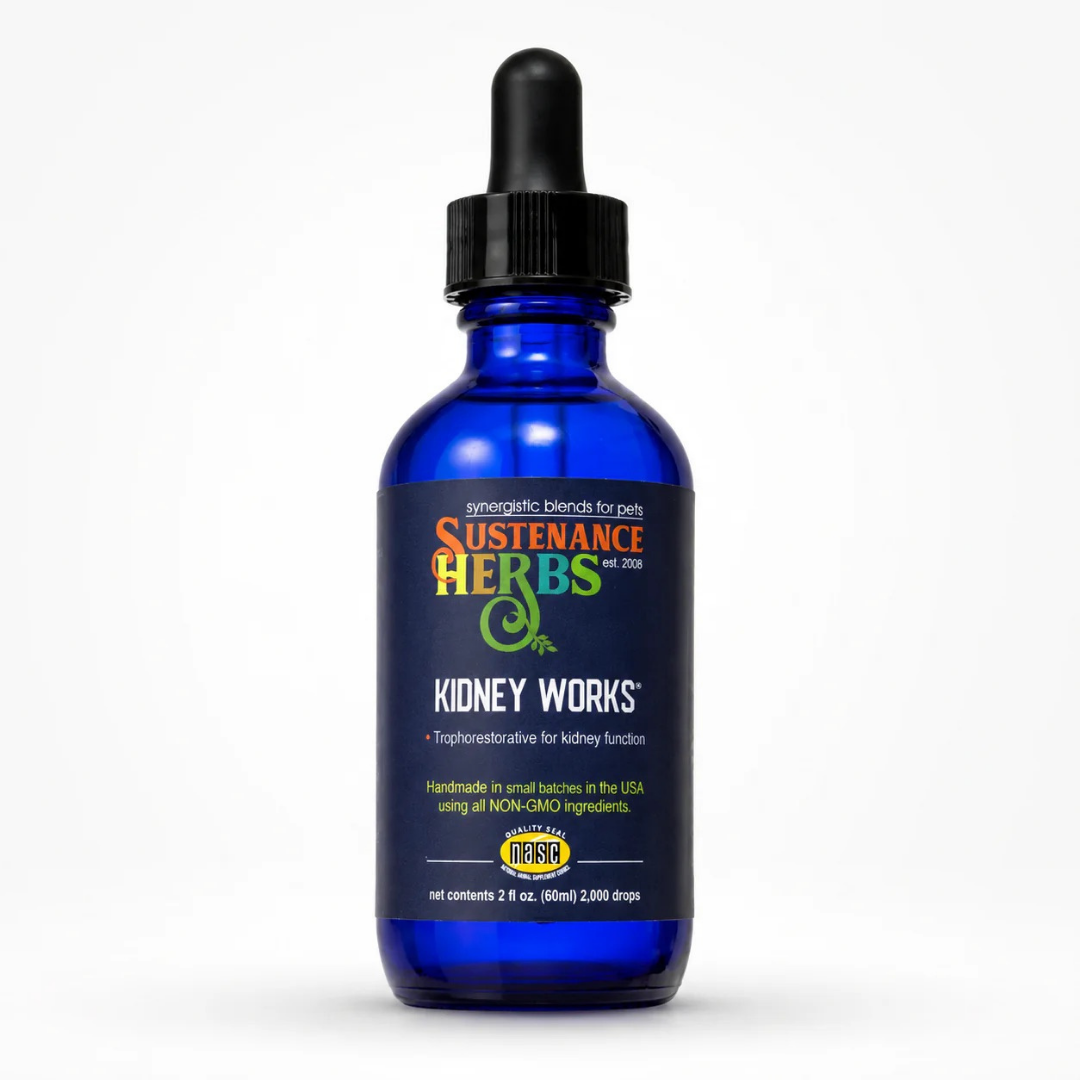


Kidney Works | Organic Herbal Kidney Support Drops for Senior + Aging Dogs
Sustenance Herbs
Kidney Works for Dogs
A seven-herb certified organic tincture to support your dog's natural kidney function, used alongside your vet's care.
Why Holistic Households Reach For This
Seven certified organic herbs that support your dog's natural kidney function, used alongside your vet's care.
You know the moment. Your senior dog's annual bloodwork came back and the vet pointed to a creatinine value that is creeping up year over year. Or the recheck panel showed a sharper bump than expected. Or your Lyme-history dog's urine test flagged some protein. Or you just had the kidney diagnosis conversation, and your vet is putting together the conventional protocol: a prescription renal diet, fluid therapy, regular bloodwork monitoring. You walk out of the appointment with a folder of information and a question that does not have an easy answer. Is there a natural herbal layer that can help support what your vet is doing?
Kidney Works is the herbal tincture that holistic vets reach for in moments like these. Seven certified organic and ethically wildcrafted herbs support your dog's natural kidney function. The product is used alongside your vet's care, not instead of it. You give the drops in your dog's food daily. Your vet helps you plan the cycle (the standard pattern is three to four weeks on, one week off). The herbs do their work while the prescription diet, fluids, and monitoring keep doing theirs.
The brand is small-batch and built by veterinarians for use in holistic veterinary practices. Five of the seven herbs come from the traditional Chinese medicine and Western herbal kidney traditions, which have used these specific plants for centuries. Two of those herbs (astragalus and nettle seed) have growing modern research bases behind them. Every herb is certified organic or ethically wildcrafted. The whole product carries the NASC Quality Seal, an independent check on the label and the manufacturing.
What this is: a natural herbal tincture to support your dog's kidney function as part of holistic care. What this is not: a treatment for chronic kidney disease, a substitute for your vet's prescription protocol, or a cure for any condition. Kidney health is a serious chronic territory and your vet is the central partner in your dog's care. This tincture is the herbal layer that joins that protocol, not the one that replaces it.
A few important safety notes before you keep reading. One of the herbs in this formula (Dan Shen) can interact with prescription blood thinners. If your dog is on aspirin, clopidogrel, warfarin, or any other anticoagulant, your vet needs to know before you start. Stop the tincture at least 10 days before any scheduled surgery. The product is not for use during active diarrhea, not for pregnant or nursing dogs, and not for indefinite daily use. The full set of cautions is spelled out in plain English further down the page.
Conventional kidney care manages the load. These herbs nourish the filter.
Why Pulse Protocols Work
Three to four weeks on, one week off. Here is why strong kidney herbs use cycles.
When you read the label on this kidney support tincture and see the words "avoid long-term continuous use," it can feel confusing. Most pet supplements are designed for daily use forever. This one is not. The reason has to do with how strong herbal blends work in the body, and why holistic herbalists have used cycles for centuries.
Each cycle gives the body time to do its thing. Three to four weeks of consistent daily drops lets the herbal effect build steadily. Your dog's kidneys get several weeks of natural backing. The bowel and liver carry the herbal load. The support compounds over time. Then the one-week rest lets the bowel reset. Chinese rhubarb has gentle laxative activity that needs breaks. The liver also gets time to clear the herbal load. And the kidneys integrate the support without becoming dependent on it.
Your vet calibrates the rhythm. The label gives you the framework. Your vet helps you plan how long each on-phase should last. Your vet also helps you set the right rest period. And as your dog's bloodwork changes, the rhythm changes with it. Acute situations may call for shorter cycles with closer monitoring. Long-term maintenance may call for longer rest periods between cycles. Holistic herbalists have used this pattern for centuries. Modern integrative vets have confirmed it works well for chronic kidney protocols.
When To Reach For This
Six situations this tincture was built for.
Senior Dogs With Kidney Trend Changes
Annual bloodwork is showing creatinine, BUN, or SDMA values your vet is watching. The numbers are not yet a diagnosis, but the trend is real. A natural herbal layer fits cleanly with the watch-and-monitor approach.
Early Or Moderate CKD Diagnosis
Your vet has diagnosed chronic kidney disease and is managing it with prescription diet, fluids, and monitoring. The integrative protocol calls for adding a holistic herbal layer to support natural kidney function alongside the conventional care.
Lyme-History Dogs
Your vet is watching for Lyme nephritis, which is a real concern in tick-exposed dogs. Kidney Works pairs naturally with the same brand's Bor-L-Immune tincture for a layered holistic protocol.
Documented Proteinuria
Your dog's urine test showed protein your vet is tracking. Nettle seed has a long traditional reputation and growing modern research interest for supporting dogs with proteinuria, used alongside your vet's protocol.
After Kidney-Stressing Medications
Your dog finished a course of medication that can be hard on the kidneys (certain antibiotics, NSAIDs, anesthetics). A holistic herbal layer supports the natural kidney recovery under your vet's guidance.
Households Already On Sustenance Herbs
You already use Bor-L-Immune, AntiBact, or Pet Calming Formula. Kidney Works is the fourth product in the brand line, and many households build out their Sustenance Herbs cabinet as different needs emerge over their dog's life.
What Is In The Bottle
Seven certified organic herbs, each with a clear role in kidney support.
Featured Herb
Nettle Seed
Nettle seed is the single most important kidney support herb in modern Western herbal medicine. Most other herbs work on the kidney indirectly, by routing fluid through it or by clearing toxins around it. Nettle seed does something different. It supports the structure of the kidney itself. The seeds are dense with carotenoids, flavonoids, trace minerals, and other natural compounds that the kidney uses every day to maintain its own function.
Think of nettle seed as kidney food. Where many kidney supplements just push more fluid through, nettle seed gives the kidney the raw materials it needs to keep doing its own work. This is the herb that earns nettle seed its place at the top of every serious holistic kidney protocol. Modern case reports and small studies have linked nettle seed support to improvements in proteinuria. The herb also helps with the natural mineral depletion that often comes with declining kidney function.
Honest cautions. Nettle seed is broadly well-tolerated. Dogs on prescription diuretics should have their vet aware of any nettle use, since the gentle natural fluid-balance support can occasionally call for medication adjustment.
Featured Herb
Astragalus
Astragalus is the traditional Chinese medicine tonic herb that integrative vets reach for most often when building a holistic kidney protocol. It is also the herb in this formula with the strongest modern research base. Studies in kidney conditions, including one form of autoimmune kidney disease, have shown promising results. The herb supports kidney function markers and reduces inflammation in the small blood vessels where filtering happens.
Think of astragalus as the herb that increases natural blood flow to the kidneys and supports the immune signaling that protects kidney tissue. The kidney is one of the most blood-flow-dependent organs in the body. Anything that supports healthy circulation through the small kidney blood vessels supports the natural filtering work the kidney is trying to do every minute of every day.
Honest cautions. Astragalus is broadly well-tolerated. But its effect on the immune system means it should be used with vet supervision in dogs with autoimmune conditions. The same goes for dogs on prescription immunosuppressant medications.
Dan Shen (Salvia miltiorrhiza)
Dan Shen is the traditional Chinese medicine red sage root that TCM has used for centuries to support healthy circulation through the small blood vessels. The kidney has thousands of microscopic blood vessels doing the filtering work, and supporting blood flow through those small vessels is one of the foundations of TCM kidney support. The active compounds (tanshinones and salvianolic acids) have been studied in modern research for their effects on circulation and antioxidant activity in kidney tissue.
Honest cautions. This is the herb in the formula with the most important safety story. Dan Shen has documented blood-thinning activity. If your dog is on aspirin, clopidogrel, warfarin, or any prescription blood thinner, your vet needs to know before you start this tincture. Stop the product at least 10 days before any scheduled surgery that requires normal blood clotting.
Rehmannia Root
Rehmannia is the traditional Chinese medicine kidney tonic that TCM reserves for nourishing kidney function at the deepest level. The TCM tradition has a concept called Kidney Yin, which maps roughly onto what Western medicine recognizes as the structural and fluid foundation of kidney function. Rehmannia is the herb the tradition uses to support that foundation. Modern research has linked the natural compounds in rehmannia to kidney-protective effects and antioxidant activity in kidney tissue.
Honest cautions. Rehmannia is broadly safe at the amounts used in formulated blends. It can occasionally cause mild loose stools in sensitive dogs, particularly when combined with Chinese rhubarb. The pulse protocol approach (three to four weeks on, one week off) addresses this.
Chinese Rhubarb and Dandelion Root: The Elimination Pair
Chinese rhubarb (Da Huang in traditional Chinese medicine) is the herb that supports the body's natural ability to route waste through the bowel instead of overworking the kidneys. When the kidneys are not filtering at full capacity, the body needs alternative exit routes for waste products, and the bowel is one of the most important. TCM kidney protocols have used Da Huang for this purpose for centuries.
Dandelion root is the gentle Western herbal staple that almost every traditional kidney formula includes. The liver and kidneys share natural detoxification work, and supporting the liver indirectly supports the kidneys by reducing the metabolic load they have to process. Where the leaf of dandelion is a stronger diuretic, the root is the gentler liver-kidney axis support herb.
Honest cautions. Chinese rhubarb has gentle laxative activity. Do not use this tincture during active diarrhea, when the body is already losing fluid through the bowel. If diarrhea develops during use, pause the protocol and talk to your vet before restarting. Dandelion root is one of the most broadly tolerated herbs in the Western tradition, with rare allergic reactions in dogs with confirmed ragweed allergies.
Nettle Leaf
Nettle leaf is the partner to nettle seed in this formula. Where the seed nourishes kidney structure, the leaf supports kidney function in real time. The leaf is what herbalists call a potassium-sparing diuretic, which means it supports natural fluid balance without depleting potassium the way many prescription diuretics do. Potassium matters for the kidney's electrolyte work, and the natural mineral richness of nettle leaf supports both the fluid and the mineral side of the kidney's daily job.
Honest cautions. Nettle leaf is broadly well-tolerated. Dogs on prescription diuretics should have their vet aware of any nettle leaf use, since the gentle natural fluid-balance support can occasionally call for medication adjustment.
What This Looks Like For Your Dog
Seven herbs working together, alongside your vet's protocol.
Picture your eleven-year-old Labrador whose annual bloodwork showed creeping creatinine at last year's senior panel and a sharper bump at this year's recheck. Your vet has staged him at early chronic kidney disease. He is on a prescription renal diet now. Your vet showed you how to give the daily subcutaneous fluids at home. You are doing everything the conventional protocol asks. The next question, the one you and your vet talked about together, is whether there is a holistic herbal layer that can support what is already happening.
You start the herbal tincture in cycles your vet helped you plan. Here is what tends to happen inside your dog's body when seven kidney herbs are working alongside the prescription protocol.
Nettle seed feeds the kidney itself
Nettle seed is dense with minerals, flavonoids, and other natural compounds. Your dog's remaining kidney tissue uses these raw materials every day to maintain its own structure and function.
Astragalus and Dan Shen support blood flow to the kidneys
Astragalus and Dan Shen are both circulation-supporting herbs. The kidney depends on healthy blood flow through thousands of tiny vessels, and these two herbs work on different parts of that vascular support story.
Rehmannia delivers the deep TCM kidney tonic support
The Chinese herbal tradition's deepest kidney-foundational herb. Modern research has tied rehmannia's natural compounds to kidney-protective and antioxidant effects in kidney tissue.
Chinese rhubarb routes waste through the bowel
When the kidneys are not filtering at full capacity, the body needs alternative exit routes for waste. Chinese rhubarb supports the natural bowel-clearing pathway that takes some of the load off the kidneys.
Nettle leaf supports fluid balance without dropping potassium
A gentle natural fluid-balance support that does not deplete the potassium your dog's kidneys depend on for their electrolyte work. Different from many prescription diuretics on this point.
Dandelion root supports the liver-kidney axis
The liver and kidneys share detox work. Supporting the liver reduces the upstream load the kidneys have to process, which is one of the oldest reasons traditional kidney formulas include this Western herbal staple.
Over weeks and months, the picture often steadies
Pet parents working with holistic vets often notice that their dog seems steadier in her energy. She seems more comfortable in her hydration patterns. And she seems more resilient through the daily rhythm of life with managed kidney disease.
The Quality Standard
Certified organic, NASC-checked, TCM and Western herbal heritage, vet-formulated.
Seven Organic or Wildcrafted Herbs
Every herb in the bottle is either certified organic or ethically wildcrafted from suppliers the brand has worked with for years.
NASC Quality Seal
An independent group, the National Animal Supplement Council, checks the label, the manufacturing, and the ingredients against industry quality standards.
TCM and Western Herbal Heritage
Five of the seven herbs come from the traditional Chinese medicine and Western herbal kidney lineages, which have used these specific plants for centuries.
Whole-Plant Tincturing
Distilled water and gluten-free organic grain alcohol pull out the full natural mix of compounds from each herb, the way traditional herbalists have always made tinctures.
Vet-Formulated
Sustenance Herbs builds its formulas with veterinarians, for veterinarians. The product is used in holistic and integrative practices across the country.
Amber Glass Bottle
Light-protective amber glass with a glass dropper. No plastic touches the tincture, which protects the herbal compounds over time.
Why Holistic Vets Trust This Formula
Traditional Chinese medicine plus Western herbal kidney heritage, with vet-channel formulation and a growing modern research base.
This formula sits at an intersection that is hard to find anywhere else. The traditional Chinese medicine kidney lineage (astragalus, Dan Shen, rehmannia, Chinese rhubarb) has used these specific herbs for centuries. The Western herbal kidney tradition (nettle seed, nettle leaf, dandelion root) has done the same. Two of the seven herbs (astragalus and nettle seed) have growing modern research bases behind them, including peer-reviewed studies on kidney function and proteinuria. And the brand itself is built by veterinarians for use in holistic and integrative veterinary practices, which means the people who recommend it are the same kind of people who built it. You are buying a product that brings together ancient herbal knowledge, modern research, and active veterinary practice in one tincture.
Honest Disclosures
What you need to know before you buy.
Dan Shen can interact with blood thinners and surgery.
This is the biggest safety item on the page. Dan Shen has documented blood-thinning activity. If your dog is on aspirin, clopidogrel, warfarin, or any other prescription anticoagulant, your vet needs to know before you start. Stop the tincture at least 10 days before any scheduled surgery that requires normal blood clotting. Your vet will help you plan the timing.
Not for use during active diarrhea.
Chinese rhubarb has gentle laxative activity. When your dog already has loose stools, the body is losing fluid and minerals through the bowel and does not need additional bowel-stimulating support. If diarrhea develops during use, pause the protocol and talk to your vet before restarting.
Use in cycles, not every single day forever.
The manufacturer's own guidance is to avoid long-term continuous use. The standard pattern is three to four weeks of daily drops, then one week off, then back on if your vet calls for it. The rest week lets the bowel reset, the liver clear the herbal load, and the kidneys integrate the support. Your vet helps you plan the rhythm that fits your dog's situation.
Not for pregnant or nursing dogs.
Several herbs in this formula, including Chinese rhubarb and Dan Shen, carry warnings against use in pregnant or nursing dogs. This product is not the right fit for breeding-stage animals.
Loop in your vet for any prescription medication.
Astragalus can interact with immunosuppressant medications. Nettle leaf's gentle natural fluid balance support can stack with prescription diuretics. Kidney health is a serious chronic territory and your vet is the central partner in your dog's care. Any dog on prescription medication or with chronic health concerns needs your vet on board before this tincture joins the routine.
Is This Right For Your Dog
Who this tincture was built for.
Strongest Match
Senior dogs whose bloodwork is showing kidney trend changes.
Your senior dog's annual panel showed creatinine, BUN, or SDMA values your vet is watching. The numbers are not yet a diagnosis, but the trend is real. Your vet is talking about closer monitoring, maybe a diet shift, maybe checking again in six months. This is the moment many holistic households add a natural herbal layer that supports kidney function while the watch-and-monitor approach continues. Your vet stays the central partner. The herbs are the supportive backdrop.
Strongest Match
Dogs with diagnosed early or moderate chronic kidney disease.
Your vet has made the CKD diagnosis. The prescription renal diet is in place. Daily subcutaneous fluids may be part of the routine. Bloodwork rechecks are on the calendar. Your vet is open to adding a holistic herbal layer to support natural kidney function alongside the conventional protocol. This is the buyer this product was built for. Used in cycles with your vet on board, the herbal layer joins the long-arc work the conventional protocol is already doing.
Lyme-history dogs being watched for kidney involvement. Lyme nephritis is a real concern in tick-exposed dogs, especially in breeds like Labradors, Golden Retrievers, and Bernese Mountain Dogs. Your vet is monitoring bloodwork and urine values. Kidney Works pairs naturally with Sustenance Herbs Bor-L-Immune for a layered protocol.
Households already on Sustenance Herbs products. You already use Bor-L-Immune, AntiBact, or Pet Calming Formula and trust the brand. Kidney Works is the fourth product in the line, and many households build out their cabinet across the four formulas as different needs emerge in their dog's life.
Recovery from kidney-stressing medications. Your dog has finished a course of medication that can be hard on the kidneys (certain antibiotics, NSAIDs, anesthetics). With your vet on board, a holistic herbal layer can support the natural kidney recovery during the weeks that follow.
Label-reading households. Certified organic sourcing, ethical wildcrafting, clear contraindication disclosure, and a brand voice that names safety items up front. The label reflects your values.
Households that can do the safety checks. Not pregnant or nursing, not in active diarrhea, willing to loop in your vet if your dog is on blood thinners, on prescription kidney medications, or has surgery on the calendar. If those checks fit your household, this is a clean place to start with your vet on board.
How To Give It
Vet-guided dosing, used in cycles.
The standard dose is one drop per 2 pounds of body weight, once or twice daily, calibrated under your vet's guidance for your dog's specific situation. Because kidney health is a serious chronic territory, your vet is the right partner for figuring out the exact daily amount, frequency, and cycle rhythm. The dosing table below is a starting framework rather than a one-size protocol.
Vet-guided daily dosing by body weight.
Start at the lower end of the range for your dog's size on the first week and work up to the target amount under your vet's guidance. This gives your dog's body time to adjust.
The standard cycle: three to four weeks on, one week off.
The manufacturer's guidance is to avoid long-term continuous use. The standard pattern is three to four weeks of daily drops, followed by one week off, then back on if your vet's protocol calls for it. The week off lets the bowel reset, the liver clear the herbal metabolites, and the kidneys integrate the support.
Your vet calibrates the exact rhythm for your dog. Acute situations may call for shorter cycles with closer monitoring. Long-term maintenance protocols may use longer rest periods. The bloodwork your vet pulls at each recheck helps you adjust the rhythm over time.
Surgery discontinuation.
If your dog has a scheduled surgery that requires normal blood clotting (most surgeries do), stop this tincture at least 10 days before the procedure. Dan Shen's natural blood-thinning activity can add to surgical bleeding risk. Resume after surgery only when your vet has cleared post-operative herbal use.
Directly in the mouth. The fastest way for the herbs to absorb. Lift your dog's lip and place the drops on her gum or inner cheek.
In food. Mix the drops into wet food, bone broth, or a moistened portion of the prescription renal diet. The herbal taste is mild and most dogs accept it without resistance.
In water with the alcohol burned off. Place the drops in a tablespoon of warm water or bone broth and let it sit uncovered for 30 to 60 seconds. The alcohol evaporates. Then mix it into the food.
Storage. Keep the bottle in a cool, dry place out of direct sunlight. Do not refrigerate. The amber glass protects the herbs from breaking down in light.
Subscribe and save. A 50-pound dog on a three-weeks-on, one-week-off cycle at the standard daily dose uses one bottle roughly every 50 to 60 days. The subscription cadence can be adjusted to match the rhythm your vet helps you set.
Works Well With
Three companions for a layered kidney support protocol.
A complete holistic kidney support protocol works on more than one front at a time. The herbal layer (this tincture) supports the kidney itself. The omega-3 layer addresses the inflammation that drives kidney decline. The gut-kidney axis layer reduces the upstream toxin load the kidneys have to process. These three pairings are the support team that integrative vets most often build alongside Kidney Works.
Sustenance Herbs Bor-L-Immune
The same-brand sibling for any household whose dog has a Lyme history. Lyme nephritis is a real veterinary concern in tick-exposed dogs. Many holistic vets pair Kidney Works with Bor-L-Immune to address both the tick-borne side and the kidney side of the long-arc support story. Both are vet-channel Sustenance Herbs tinctures and stack cleanly without mechanism overlap.
Nordic Naturals Omega-3 Pet
The EPA-leaning fish oil that integrative vets most often recommend as the foundational anti-inflammatory layer of a holistic kidney support protocol. Peer-reviewed veterinary research has linked EPA supplementation to slower progression of chronic kidney disease in dogs and cats. This is the structural anti-inflammatory layer that complements the herbal support work.
ION Gut Support for Pets
The gut-kidney axis layer. Modern research has connected the gut microbiome to kidney health through what is called the gut-kidney axis. When the gut lining is leaky, bacterial toxins enter the bloodstream and add to the load the kidneys have to filter. ION supports the natural integrity of the gut lining at the cellular junction level, which reduces the upstream toxin load that reaches the kidneys.
Frequently Asked Questions
The questions pet parents ask before buying.
Is this a treatment for chronic kidney disease?
No. This is a herbal wellness tincture to support natural kidney function alongside your vet's care, not a treatment for chronic kidney disease and not a cure for any condition. Dogs with diagnosed CKD need the conventional protocol from your vet (prescription renal diet, fluid therapy as appropriate, phosphorus binders if indicated, ongoing bloodwork monitoring). This herbal tincture joins that protocol as a supportive layer, not as a replacement for it.
My dog is on prescription kidney medication. Can I still use this?
Only with your vet's go-ahead. The biggest concern is Dan Shen, which has blood-thinning activity and can interact with prescription blood thinners and some blood-pressure medications often used in kidney protocols. Astragalus can interact with immunosuppressant medications. Nettle leaf can mildly stack with prescription diuretics. Your vet can manage all of these interactions, but cannot do it without knowing what your dog is getting.
Why does the manufacturer say to avoid long-term continuous use?
Because several herbs in this formula are traditionally used in cycles rather than every single day forever. Chinese rhubarb has gentle laxative activity that needs breaks. The other strong herbs benefit from the rest week to let the body integrate the support and clear the herbal load. The standard cycle is three to four weeks on, one week off, then back on if your vet's protocol calls for it. This pattern has been the holistic standard for centuries and is now confirmed by modern integrative veterinary practice.
What does nettle seed actually do for my dog's kidneys?
Nettle seed is the most important kidney support herb in modern Western herbal medicine. Most kidney supplements work indirectly, by pushing more fluid through the kidney or by helping clear toxins around it. Nettle seed works on the kidney itself. The seeds are dense with natural minerals, flavonoids, and other compounds the kidney uses to maintain its own structure and function. Think of it as kidney food. Modern case reports and small studies have linked nettle seed support to improvements in proteinuria and the natural mineral depletion that comes with declining kidney function.
Should I give this every day or in cycles?
In cycles, with your vet's guidance. The standard pattern is three to four weeks of daily drops followed by one week off, then back on if your dog's situation calls for ongoing support. Your vet helps you calibrate the rhythm based on your dog's bloodwork, the stage of any diagnosed kidney issue, and the other medications and supplements in play. Continuous daily use without rest weeks is not the recommended approach for this formula.
My dog has a Lyme history. Should I be using this?
If your vet is monitoring for Lyme nephritis, the herbal kidney support layer is worth a conversation. Lyme nephritis is a real concern in tick-exposed dogs, especially in breeds like Labradors, Golden Retrievers, and Bernese Mountain Dogs. Many Lyme-history households use both Bor-L-Immune (for the tick-borne immune support side) and Kidney Works (for the kidney support side) under their holistic vet's guidance. The two products were built to work together.
What about the alcohol in the tincture?
The base is gluten-free organic grain alcohol. The amount in a per-drop dose is very small. The alcohol does important work: it pulls out the herbal compounds water alone cannot reach. It also preserves the tincture without synthetic preservatives. If you want to minimize the alcohol, place the drops in a tablespoon of warm water or bone broth. Let it sit uncovered for 30 to 60 seconds before mixing into food. The alcohol evaporates and the herbs stay.
How does this compare to the other Sustenance Herbs products?
All four are vet-formulated, certified organic, and NASC-quality-checked. Bor-L-Immune is the cryptolepis tincture for tick-borne disease immune support. AntiBact is the broader antibacterial herbal tincture. Pet Calming Formula is the acute nervous system tincture in a low-alcohol raw honey base. Kidney Works is the chronic kidney support tincture. The four products cover four distinct holistic protocols, and many label-reading households build out their Sustenance Herbs cabinet across the four formulas as different needs emerge over their dog's life.
Why this kidney support product over others?
Three reasons. First, the brand is vet-formulated for use in holistic veterinary practices, not built for the retail shelf. Second, the formula combines the foundational Western herbal kidney pillar (nettle seed) with established TCM kidney tonic herbs (astragalus, Dan Shen, rehmannia, Chinese rhubarb). It rounds out with nettle leaf and dandelion root. The combined TCM-and-Western approach is the strongest modern canon for natural kidney support. Third, the certified organic and ethically wildcrafted sourcing reflects the brand's commitment to taking the herbal tradition's ethical responsibilities seriously.
The Holistic Kidney Support Layer
A seven-herb certified organic tincture for senior dogs whose kidneys could use natural support.
Nettle seed gives the kidney itself the natural raw materials it uses to maintain its own function. Astragalus and Dan Shen support healthy blood flow through the small kidney blood vessels. Rehmannia delivers the deep TCM kidney tonic foundation. Chinese rhubarb routes waste through the bowel to take some of the load off the kidneys. Nettle leaf supports fluid balance without dropping potassium. Dandelion root supports the shared liver-kidney detox work. Five of the seven herbs come from the traditional Chinese medicine and Western herbal kidney lineages, with two (astragalus and nettle seed) carrying growing modern research bases behind them.
Used in cycles, with your vet on board. Stop 10 days before any scheduled surgery. Not for use during active diarrhea, not for pregnant or nursing dogs, and not for indefinite daily use. Loop in your vet if your dog is on blood thinners, immunosuppressants, or prescription diuretics. If your senior dog's bloodwork is showing kidney trend changes, if your dog has been diagnosed with early or moderate CKD, if your Lyme-history dog is being watched for kidney involvement, or if you are building out your Sustenance Herbs cabinet, this is the holistic kidney layer that joins your vet's protocol.
Conventional kidney care manages the load. These herbs nourish the filter.